





Summary of this article
Don't pick a mutual fund just because it did well last year. Its performance may not last.
Think twice before locking your money into long-term FDs or selling equities just because the market is down.
Don't let festive offers or market trends drive your decisions. Invest with your goals, needs and ability to take risks in mind.
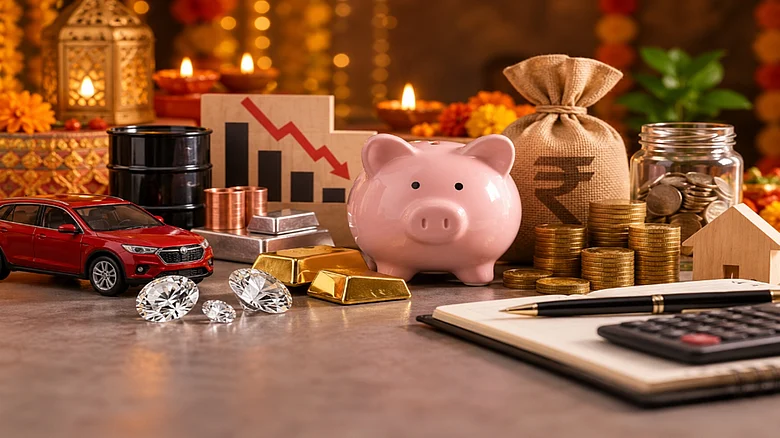
The festive season often brings a temptation to do something with money, whether it is buying gold or diamonds, investing a bonus or reshuffling an existing portfolio. But this year, a little caution may be more useful than rushing into new investments. With inflationary pressures building, interest rates moving up, job uncertainty lingering and equity markets struggling to gain ground amid crude oil prices above $100 a barrel, the case for being selective is stronger than ever.
Before putting fresh money to work, it makes sense to take stock of existing investments. What is driving their performance? Why were they bought in the first place? And have the financial goals they were meant to serve changed? A festive occasion, by itself, is no reason to disturb a portfolio that is otherwise on track.
Here are five investment decisions worth avoiding this festive season, given the current market conditions.
1. Buying Diamonds On Impulse
Festive discounts can make diamonds look like an attractive purchase, particularly when they are marketed as a store of value. But buying jewellery for personal enjoyment is very different from buying diamonds as an investment.
“Natural diamond wholesale prices have fallen about 50-60 per cent from their peaks, the lowest in two decades, while lab-grown diamonds, which are considerably cheaper, have gained ground. The growing availability of these stones has also changed the way buyers look at diamond prices. Unlike gold, diamonds do not have a widely accepted, transparent resale market, and the price offered when selling a stone can be much lower than its original purchase price,” says Mohit Bagdi, Founding Partner & Head of Investment Research at MIRA Money.
For anyone looking to invest, an attractive festive offer is not enough to make a diamond a sound financial decision. Buy one if it is meant to be worn and enjoyed, rather than with the expectation of earning a return later.

2. Betting On Silver, Copper Or Crude As The Next Gold
Gold has traditionally served as a store of value, and central banks have continued to add it to their reserves. Silver, copper and crude oil, however, have different drivers. Their prices are much more closely tied to industrial demand, economic growth and global supply conditions.
Silver can be particularly volatile, while copper prices tend to react to changes in manufacturing activity and infrastructure demand. Crude oil, meanwhile, can rise sharply when geopolitical tensions disrupt supplies but fall just as quickly if those tensions ease or demand weakens.
The risks are greater when these commodities are traded through futures and options, where leverage can magnify losses. A sharp price movement in the wrong direction can wipe out a substantial part of the capital invested.
“Investors looking for a hedge against uncertainty should be careful about treating every commodity rally as the next big investment opportunity. Gold itself can fall in value, but adding silver, copper or crude oil simply because their prices have risen is not a substitute for a well-planned portfolio,” says Bagdi.
3. Locking Into A One- To Three-Year Fixed Deposit In A Hurry
Fixed deposits offer predictable returns, but the timing of an investment matters when interest rates are moving higher. If banks raise deposit rates in response to tighter monetary policy, a fixed deposit booked today could start looking less attractive in a few months.
That does not mean deposit rates will rise immediately or that every bank will pass on a rate hike in full. But locking money away for one to three years without comparing available rates could mean missing out on better returns later. Premature withdrawal may also attract a penalty, adding to the cost of changing course.
“For money that may be needed in the near term, liquid funds or money market funds can be considered as alternatives. They offer relatively easy access to money, though their returns are not guaranteed and they do not carry the same deposit protection as bank FDs,” says Bagdi.
The sensible approach is to compare current FD rates across banks, consider the possibility of further rate changes and avoid locking away money simply because a festive deposit offer looks attractive.
4. Moving Out of Equities and Into Debt Funds In A Falling Market
When equity markets remain weak for months, shifting money into fixed deposits or debt funds can seem like a welcome escape from volatility. But selling investments purely out of fear can turn a temporary fall on paper into a realised loss.
“Consider an equity investment that falls 25 per cent. It would need to rise by about 33.3 per cent to return to its original value. A fixed-income investment earning 7 per cent annually would take roughly four years to grow by a similar proportion, before tax and assuming annual compounding,” says Bagdi.
Equities have recovered from previous market crashes, but the time taken has varied considerably. The decision to reduce equity exposure should, therefore, depend on the investor's financial goals, time horizon, risk appetite and need for liquidity, rather than the latest market fall. Someone approaching a major financial goal may need to reduce risk, but a long-term investor with a suitable asset allocation should think carefully before abandoning equities at a low point.
5. Chasing Last Year's Best-Performing Mutual Funds
A fund that gave 40 per cent returns last year may not be the best place to put fresh money today. Much depends on what drove those returns and whether the same conditions still hold. A fund that benefited from a rally in small-cap stocks or a particular sector could struggle if the market turns.


Yet investors often look at the return figures first and invest without checking what the fund holds or how much risk it has taken. Before putting money into last year's winners, it is worth looking beyond the returns and checking whether the fund still makes sense for the portfolio. A good year is no guarantee of another.
The Bottom Line
The festive season can be a good time to review finances, put surplus money to work and make planned purchases. But it need not become a reason to chase the latest market trend or make hurried changes to existing investments.
According to financial experts, with markets and interest rates facing uncertainty, the better approach is to look for value, keep enough money accessible for emergencies and invest in line with clearly defined financial goals.
Spending on things that are genuinely needed and investing only after weighing the risks can be more rewarding than making a move simply because it is the festive season.





