Summary of this article
US inflation data could decide gold’s next move ahead of the Fed meeting
Higher bond yields and a stronger dollar could pressure gold prices
A weaker rupee may limit the fall in gold prices in India
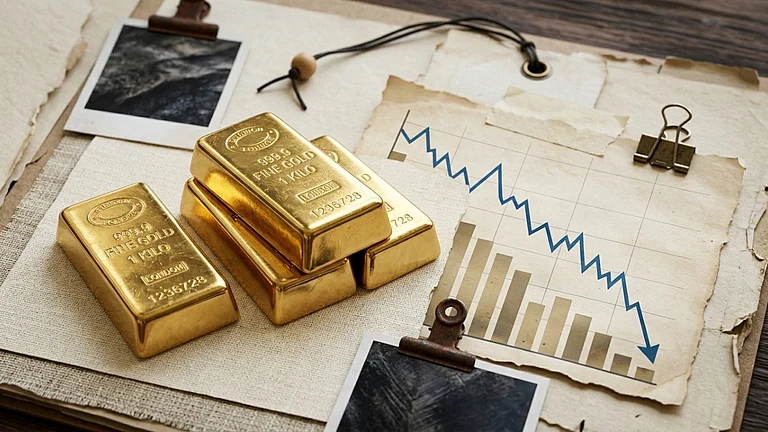
Gold has had a rough fortnight. Prices have fallen more than 6.50 per cent in two weeks as bets of a US Federal Reserve rate hike have grown, crude oil prices have surged, and US bond yields have moved higher. On the Multi Commodity Exchange (MCX), gold futures were trading at Rs 1,53,944 per 10 grams as at 12 pm on September 10, up 0.12 per cent from the previous close. On COMEX, the international benchmark, gold futures were almost flat at $4,424.5 an ounce.
The next two days could set the tone for gold through the rest of September. The US producer price index (PPI), which tracks wholesale-level price pressures, is due later today, followed by the consumer price index (CPI) on September 11. Both data points come just days before the Federal Reserve’s policy meeting next week.
Crude oil is adding to the inflation risk. Brent crude, the global benchmark, has stayed above $100 a barrel, while US West Texas Intermediate (WTI) has remained above $95. Elevated oil prices could keep inflation pressures alive as the Federal Reserve weighs its next policy move.
Why Inflation Matters So Much To The Fed
The Federal Reserve has a dual mandate of price stability and maximum employment. Its preferred inflation gauge is the personal consumption expenditures (PCE) index, which is scheduled for release by the US Bureau of Economic Analysis on September 30, 2026.
But CPI and PPI are closely watched by markets, too, as they are released earlier and can influence expectations around the Fed’s September 15-16 policy decision.
Hotter inflation, particularly if price pressures remain broad-based and extend into services, can strengthen the case for keeping interest rates higher for longer. A softer inflation reading, on the other hand, could give the Fed more room to cut rates.
How The Data Could Move Gold
Ross Maxwell, chief strategy officer at VT Markets, said the timing makes the inflation data particularly important, adding that it could be “a key factor ahead of the Fed meeting next week”. A stronger-than-expected CPI reading, particularly if core inflation remains sticky, would reinforce the view that “price pressures are not yet under control”, Maxwell said.
Markets will also look for signs that “inflation is spreading beyond energy into services and other underlying components”, he said. A broadening of price pressures could strengthen the case for higher rates.
For gold, the immediate impact would come through the dollar and US Treasury yields. Hotter inflation could push both higher, as investors price in tighter monetary policy. Higher yields would raise the opportunity cost of holding gold, which does not generate interest income.
Maxwell described this as a “short-term headwind” for gold. A softer inflation print could have the opposite effect by pulling yields and the dollar lower, giving the metal some support, he said.
For Indian investors, however, the impact will depend on what happens to the rupee against the dollar.
Satish Dondapati, fund manager - ETF at Kotak Mutual Fund, said that hotter-than-expected inflation could push US yields and the dollar higher, “putting pressure on gold prices in dollar terms”. However, a stronger dollar could also weaken the rupee. He said that could “provide some support to gold prices in India and limit the downside”.
Softer inflation would be more supportive for gold, as lower rate hike expectations could pull down the dollar and US yields while supporting gold prices in dollar terms, he added.
For Indian investors, Dondapati said, the eventual impact will depend on both international gold prices and the USD/INR movement.

The Risk Of Yields Staying High For Longer
A bigger risk could arise if US bond yields remain elevated even after this week’s inflation data. The benchmark 10-year US Treasury yield crossed 4.85 per cent, a level last seen in October 2023.
Dondapati said gold prices “could soften further” if yields remain high, because higher-yielding bonds become more attractive compared to an asset that does not pay interest.
Strong demand for US government bonds can also support the dollar. A stronger US currency can add another layer of pressure on gold, Dondapati said, as “a stronger dollar can put further downward pressure on gold prices”.
The rupee has weakened past the 95 per dollar mark amid elevated crude oil prices, with USD/INR trading around 95.37 as on September 10, up about 0.23 per cent.
What Should Investors Do Now
Both analysts advised investors against trying to call the exact bottom in gold. Maxwell said he would “favour gradual accumulation rather than attempt to identify the perfect entry point”. Geopolitical uncertainty, central bank buying, and long-term diversification demand continue to provide support to gold despite the recent correction, he said.
Elsewhere, a stronger-than-expected inflation print could trigger another leg lower, potentially creating a better entry point. He said his preference is to “scale into gold gradually” instead of trying to pick a single buying level.
Dondapati also favoured staggered buying. He said retail investors could consider keeping “around 10-15 per cent of their portfolio in gold”, and use corrections to add rather than invest the entire amount at once.
Even at current levels, investors can “continue with staggered buying and keep a long-term view”, he said. He cited central bank purchases, rising global debt, and increasing allocation to gold as factors supporting the longer-term case for the precious metal.