Summary of this article
Asset allocation should guide investing decisions, not recent market performance
Global investing can diversify portfolios beyond Indian equities
Small-cap valuations and AI themes require careful risk assessment
Mutual funds may suit investors better than complex AIFs or PMS
The temptation to chase whichever market or theme has performed well lately is familiar to investors. At a panel discussion during Outlook Money’s The Money Questions: Where Should You Invest Now, moderated by Editor Nidhi Sinha, three investment leaders urged investors to decide how much risk they can take, understand what they are buying, and give their investment plans time to work.
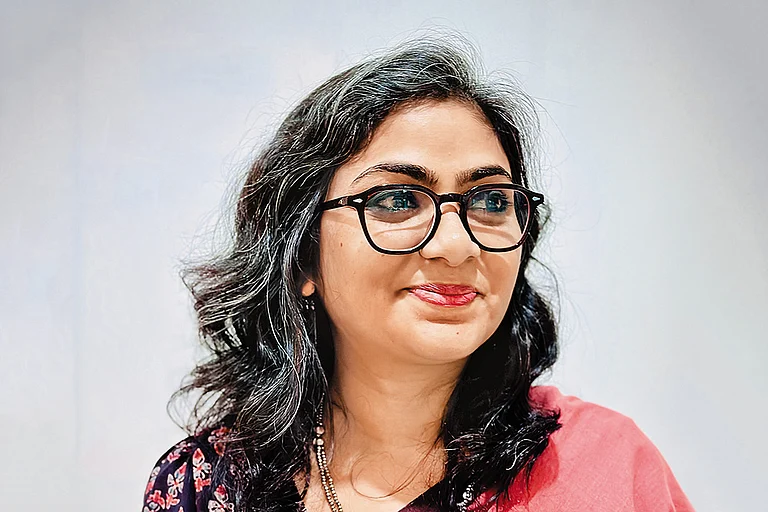
The panel featured Devina Mehra, chairperson, Managing Director and founder of First Global; Kailash Kulkarni, CEO of HSBC Mutual Fund; and Vetri Subramaniam, Managing Director and CEO of UTI Mutual Fund.
Here are edited excerpts from the discussion.
Nidhi Sinha: For someone who has invested in equities for 10–15 years, what has changed in the equity playbook?
Devina Mehra: Markets change, but the broad investing principles do not. Global investing is receiving more attention now, partly because Indian equities have disappointed some investors over the past two years. That is not, by itself, a sound reason to move money overseas. The reason to invest globally is diversification.
Get your asset allocation right first. Have an appropriate mix of equities, debt, gold and global investments. Then avoid knee-jerk decisions when one part of the portfolio goes through a weak period. Investors often put more money into equities after markets have risen and pull back after they have fallen.
Nidhi Sinha: With so much information available to everyone, is it harder for an investor to find an edge?
Devina Mehra: The information advantage that existed in the 1990s has largely disappeared. Even company presentations and analyst meeting transcripts are readily available. The challenge now is analysing that information consistently and avoiding mistakes that cause serious damage to your capital.
At First Global, we use a system that assesses companies on a common set of factors. The aim is to bring discipline to decisions that might otherwise be influenced by bias or a fund manager’s mood on a particular day.
Nidhi Sinha: Many younger investors are dissatisfied with the prospect of earning around 12 per cent a year from equities. What would you tell them?
Kailash Kulkarni: Twelve per cent is a reasonable expectation to discuss. Investors should compare it with what they might earn from alternatives, while remembering that equity returns will not arrive evenly each year. A portfolio can have a poor year and then a much stronger one.
Expectations matter. If you come in assuming very high returns every year, you are more likely to give up on equities when performance falls short. A 12 per cent return should not be treated as disappointing, though it is an expectation, not a promise.
Nidhi Sinha: Investors seeking higher returns often turn to small and mid-cap stocks. How should they think about that part of their portfolio?
Vetri Subramaniam: For a young investor, the first thing to remember is that your career may be your biggest source of compounding. Early in your working life, you may have very little money to invest. You should still start early, because it builds the habit, but growing your earning capacity matters enormously.
On small caps, I would be cautious at current valuations. There are two risks to consider: the risk in the businesses you own and the price the market is asking you to pay for them. An individual company can sometimes justify a higher valuation than its peers. It is more concerning when an entire group of companies is priced as though exceptional growth is assured.
Nidhi Sinha: What should a first-time global investor watch out for?
Devina Mehra: Do not assume that investing globally means buying only a US index. The US is one market, and even within it, different segments can perform very differently. A global allocation should be considered across geographies and, where appropriate, asset classes.
Investors also need to understand the route they use to invest overseas, including its costs and how closely a fund’s market price tracks the value of its holdings. Do not buy a product simply because it offers exposure to a fashionable market.
Nidhi Sinha: Artificial intelligence (AI) is attracting considerable investor interest. Where might the opportunities be?
Vetri Subramaniam: It is difficult to know today which companies will ultimately benefit most. Investors are focused heavily on businesses building AI models, but some of the larger benefits may eventually go to companies that use the technology well.
The theme has also reached businesses further along the supply chain, including some in India. Investors should ask whether the profits expected from AI can support the valuations being paid for those companies.
Kailash Kulkarni: Even companies supplying equipment to a fast-growing industry can be cyclical. Strong demand and high margins today do not necessarily continue indefinitely. Investors need to consider what happens when the current wave of spending slows.
Nidhi Sinha: Portfolio management services (PMS) and alternative investment funds (AIFs) are attracting attention. Do they fill a gap for investors?
Vetri Subramaniam: They can be appropriate for some investors, but simple products will meet the needs of many people. An AIF should offer something meaningfully different from a mutual fund. That could involve less liquid investments, the use of leverage, or a more concentrated portfolio. Each comes with risks that the investor must be willing and able to bear.
Kailash Kulkarni: Liquidity deserves more attention. Investors often realise its value only when they need access to their money. Someone new to investing should think carefully before choosing a product that restricts withdrawals.
Devina Mehra: First, decide what assets you want to own. Then decide whether a mutual fund, PMS, or AIF is the right way to hold them. AIF is a product structure, not an asset class. More complex products do not automatically make for a better portfolio.
FAQs
1. Should I move money overseas because Indian equities have been underperforming?
The panellists said global investing should serve a diversification goal, rather than be a reaction to recent returns. Decide how much overseas exposure fits your overall asset allocation.
2. Is 12 per cent an unrealistic expectation from equities?
Kulkarni described it as a reasonable expectation to discuss, but stressed that returns will vary from year to year. It is not a guaranteed annual return.
3. Do I need an AIF or PMS to build a strong portfolio?
No. The panellists said simpler products may meet many investors’ needs. Before choosing an AIF or PMS, understand its costs, risks, and limits on withdrawals.