



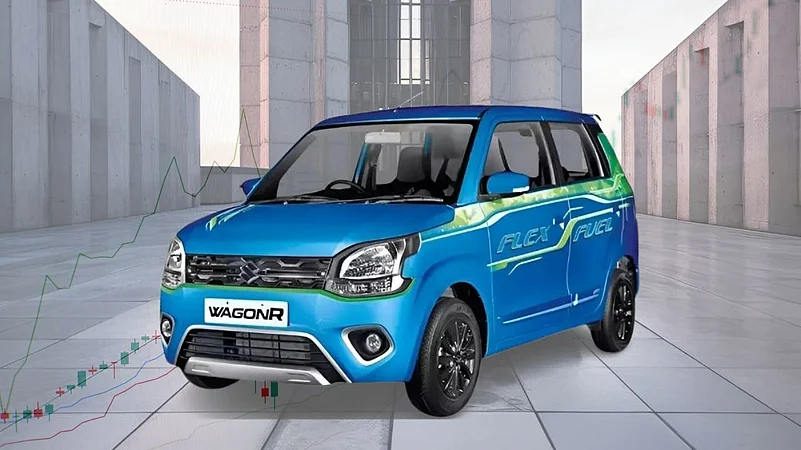

Maruti Suzuki India shares traded higher on June 4 after the country's largest carmaker launched a flex-fuel version of the Wagon R, becoming the first passenger vehicle in India to be commercially introduced with the ability to run on high-ethanol fuel blends.
The stock gained as much as 1.68 per cent during the session and was trading around Rs 13,105.00 apiece at 2:30 PM on the NSE.
Maruti Suzuki shares have fallen more than 21 per cent so far in 2026, weighed down by concerns over a decline in market share, rising competition in the SUV segment, and pressure on margins due to higher input costs.
Wagon R Gets Ethanol-Compatible Powertrain
The automaker showcased the Wagon R Flex Fuel at an event in New Delhi ahead of World Environment Day. The new vehicle can run on both petrol and ethanol-based fuels, including up to 100 per cent ethanol (E100), allowing it to use different fuel blends.
With this launch, Maruti Suzuki has taken a step towards supporting the government's efforts to increase the use of cleaner biofuels and reduce India's dependence on imported crude oil. Union Road Transport and Highways Minister Nitin Gadkari and Petroleum and Natural Gas Minister Hardeep Singh Puri were present at the event.
What's Driving The Shift Towards Ethanol Fuel
The launch comes at a time when global crude oil prices are under pressure from geopolitical tensions. International benchmark Brent crude has surged more than 32.00 per cent since the US-Iran conflict began in late February, amid concerns that disruptions in the Strait of Hormuz could affect global oil supplies. Brent is currently trading around $96.00 per barrel.
As oil prices remain elevated, the government has been pushing for greater use of ethanol-blended fuels to reduce import dependence and improve energy security.
In May, the Bureau of Indian Standards (BIS) introduced IS 19850:2026, a new set of quality standards for petrol blended with 22.00 per cent to 30.00 per cent ethanol. The standards cover fuel variants such as E22, E25, E27 and E30, laying the groundwork for the next phase of India's ethanol blending programme.
The push is expected to continue. Petroleum and Natural Gas Minister Hardeep Singh Puri recently said that E85 fuel, which contains 85.00 per cent ethanol, could be introduced in the market soon. He also said the fuel, which contains 85.00 per cent ethanol, is expected to be priced lower than the E20 petrol currently available.
Maruti Suzuki Sees Biofuels As Key To Reduce Crude Oil Dependence
Maruti Suzuki Managing Director and CEO Hisashi Takeuchi said the company is pursuing multiple technology pathways to reduce vehicle emissions, including electric vehicles, strong hybrids, compressed natural gas (CNG), flex-fuel technology and compressed biogas (CBG).
"To meet the different needs of different customers in India and to use all possible technologies to reduce carbon, Maruti Suzuki is committed to a multi-pathway strategy including EVs, strong hybrids, and compressed natural gas," he said.
Speaking about the role of biofuels in reducing India's dependence on imported oil, Takeuchi said, "Long-term dependence on imported crude oil cannot be an option. We need solutions that are cleaner, affordable, scalable, and based on India's own strengths."
Takeuchi said Maruti Suzuki sees CBG as another important pillar in its clean mobility plans.


"And if that Natural Gas is produced from biomass, it becomes carbon negative. So, we have identified CBG as a very powerful method for Carbon Net Zero," he said.
The executive said Maruti Suzuki has announced plans for nine compressed biogas (CBG) plants, with two of them already operational. The company is also carrying out research on hydrogen-based technologies as part of its broader efforts to reduce carbon emissions.





