





Summary of this article
NSE shares dropped below their initial public offering price.
Institutional profit booking and strict regulatory headwinds caused selloffs.
Unlisted market investors face steep mandatory lock in losses.
Shares of the National Stock Exchange (NSE) fell 1.76 per cent to trade at an early low of Rs 1761 per share on the BSE. With the decline seen in early trade today, the stock has slipped below the issue price set for its initial public offering (IPO).
Notably, the price band for the public issue was fixed at Rs 1,700 to Rs 1,785 per share. Compared to the upper end of the price band the stock is trading 1.34 per cent below it. On the other hand, the stock has also slipped 2.1 per cent from its listing price of Rs 1800 per share.
Why Are NSE Shares Falling
The decline in NSE shares is likely to have come due to selloffs post the listing of the stock earlier last week on September 24 along with regulatory impact of stricter F&O norms.

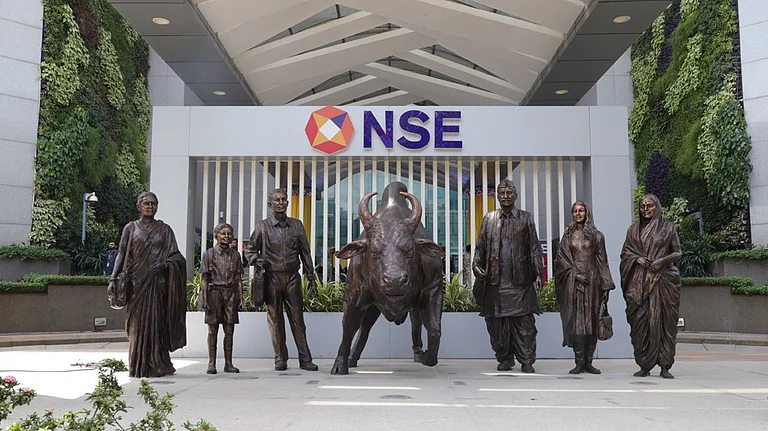



It is likely that the excitement around the public issue has faded, following a modest debut compared to the issue price. The subdued debut has given way to profit booking from institutional buyers capitalising on the premium available immediately post listing, driving the stock below both its listing and issue prices.
Another reason is a shift in sentiment around the overall Futures & Options space, according to the Securities Exchange Board of India (Sebi) Bulletin released in September, the average daily notional turnover (ADNT) dropped to a 14-month low of Rs 346.9 trillion in August 2026, representing a 22.3 per cent month-on-month (m-o-m) decline compared to July 2026. The Average daily turnover (ADT) fell 9.9 per cent m-o-m to Rs 1.22 lakh crore.
Notably, Sebi attributed this moderation to ongoing market adaptations following the enhanced Securities Transaction Tax (STT) structure implemented on April 1, 2026.
Stricter regulations for the F&O segment directly impact NSE’s business as equity options contribute heavily to the total transaction charge revenue earned by the exchange. Thus any move to curb retail participation in derivatives threatens NSE’s core business model. The NSE relies heavily on the F&O segment as it accounted for over 69 per cent of its total operating revenue in FY26. Additionally, the total revenue from operations earned by NSE stood at Rs 16,601.31 crore out of which total transaction charges made up Rs 13,057.01 crore or 78.65 per cent of operating revenue in FY26.
Unlisted Share Investors Face 15% Paper Losses
The downward trajectory is also expected to have led to anxiety for investors who have accumulated NSE shares in the private or unlisted market.

In the first few months of 2026, as the NSE IPO received Sebi’s green light, NSE emerged as one of the most sought after scrips in the unlisted space. Several retail and high net worth individuals bought into the exchange, hoping for listing gains.
However, a direct comparison between today's low and unlisted stock market prices prior to the IPO reveals portfolio losses for such investors. Data aggregated from multiple unlisted market platforms, including prominent unlisted brokers like Precize and Safal Capital, shows that weeks prior to the IPO, NSE shares had actively changed hands in the range of Rs 1950 to Rs 2050 per share.
At the current early low of Rs 1761, those investors are staring at a steep paper loss ranging between 9.69 per cent to 14.09 per cent on their unlisted investment. However, these are paper losses as individuals and funds who acquire shares prior to an IPO are subject to a strict six month lock in from the actual date of listing.
This means that despite shares trading below their original acquisition cost, these unlisted market participants simply cannot exit their positions to cut their losses. They have to mandatorily hold onto the stock and wait out the ongoing volatility.
At the time of writing shares of NSE traded at Rs 1765 apiece, down by 1.54 per cent on the BSE.





