






Summary of this article
Extending your investment horizon reduces market volatility risks significantly.
Holding equities for seven years historically prevents market losses.
Missing the best trading days severely destroys your wealth.
The domestic stock market has delivered a harsh reality check for investors in 2026. On January 1, 2026, the benchmark Nifty 50 traded around 26,146.55 levels. As of October 12, it tumbled to 22,363.35, indicating a year-to-date (YTD) decline of 14.46 per cent.
The near 15 per cent tumble has led to heightened anxiety among retail investors. Several investors are left second-guessing their investment decisions, or pausing their Systematic Investment Plans (SIPs), redeeming mutual fund units to seek safer returns from other investments.
However, a report by wealth management and investment platform FundInIndia shows that the decision to take an exit as the market witnesses a fall might not be the best one for your portfolio. The report shows that if an investor extends their investment horizon to a minimum of seven years, they can reduce the threat of market volatility and eliminate the probability of losing money in the market.
Rationale Behind The ‘7 Year’ Rule
There is no definite "safe" holding period for equities. The report indicates that the longer an investor stays invested, the lower their odds of experiencing negative returns become.

Analysing the historical performance of the Nifty 50 TRI, data shows that in the past decade, there has been no instance of negative returns over any rolling seven-year period. The lowest return ever recorded over a 7-year investment horizon is 5 per cent. Additionally, the analysis showed that the holding period has consistently led to a highly positive investment experience, as in 85 per cent of the historical instances, domestic equities have delivered annualised returns exceeding 10 per cent over a 7-year timeframe.
Table 1: Nifty 50 TRI Rolling Returns Probability (Since Inception in June 1999)
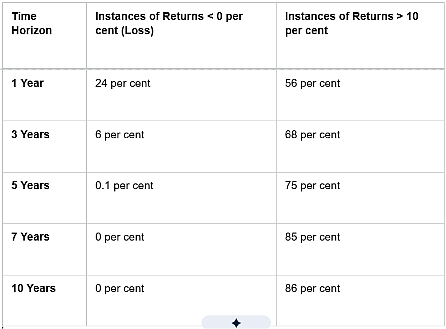

The report also showed that those investors who stretched their investment horizon from seven years to a decade saw the probability of making double-digit returns rise to 86 per cent.
How Investors Should View Dips In A Downturn
For an investor to hold on to their investments even as the stock market witnesses a double-digit fall, they must change how they see market corrections. It becomes important to understand that market declines are a part of wealth creation.
According to the report, equity markets tend to witness declines of 10 to 20 per cent almost every single year. Yet, despite these routine drops, three out of every four years have historically ended with positive returns.
While severe market crashes may look terrifying, looking at the historical performance of the indices shows that they are a frequent occurrence. Additionally, temporary market declines of 30 to 60 per cent have historically occurred once every 7 to 10 years. However, historical data indicate that every single crisis in the past has eventually been followed by a market recovery and further upside.
Even though historical data shows market volatility is commonplace in the stock market, investors often end up attempting to time the market by moving investments to cash. According to the report, missing out on just a few of the market's best trading days can significantly reduce an investor's long-term returns.
The report also shows that, contrary to popular belief, most of these "best days" in the market tend to occur in the middle of a market crash and withdrawing on such days ends up punishing investors who panic sell during a drawdown.
According to the report during the 2020 COVID-19 pandemic, the market fell by 40 per cent, but four of the top 30 best trading days occurred during the fallout. The following data table illustrates how attempting to time the market can lead to missing out on the best trading days, which in turn destroy long-term compounding:
Table 2: The Impact of Missing the Best Days (Rs. 10 Lakh Invested in Nifty 50 TRI, 1999 to 2026 YTD)
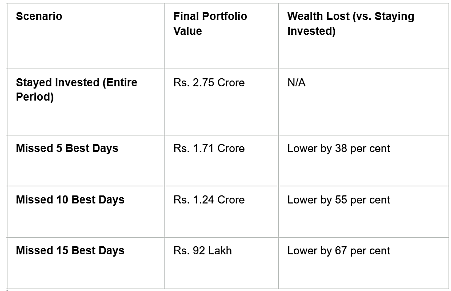
As the data shows, if an investor missed just the 15 best days over a 25-year period, their portfolio lost two-thirds of its potential value. On the flip side, investors also frequently make the mistake of stopping investments when the market hits record peaks, fearing that a drop is about to come.
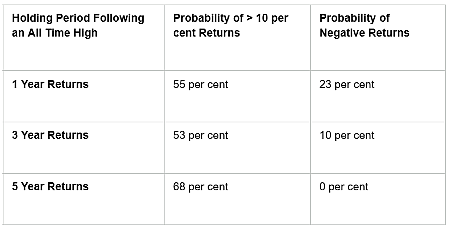
According to the report, all-time highs are also a part of any growing asset class and not something to be feared. Achieving an all-time high automatically does not imply that a market fall is imminent. In fact, the probability of incurring negative returns following an all-time high also decreases when an investor stays invested. The analysis shows that if an investor stays invested for five years after the market touches an all-time high, they can drastically reduce the odds of incurring negative returns and increase the probability of making double-digit returns.
Table 3: Performance Post All Time Highs (Nifty 50 TRI, 2000 to 2026 YTD)
Ultimately, for retail investors navigating the current market drawdown, the strategy remains to invest based on their goals and not make decisions based on either hype or panic.





