






Summary of this article
Sebi alleges two entities manipulated Sensex’s CAS using large buy and sell orders
Copthall and Mansi allegedly benefited from options positions linked to the Sensex’s expiry-day closing price
Sebi has barred both entities and impounded Rs 3.67 crore pending further investigation
The Securities and Exchange Board of India (Sebi) has barred Copthall Mauritius Investment, a unit of JPMorgan Chase & Co, and Mansi Share and Stock Broking from the securities market and impounded Rs 3.67 crore after finding that the two entities had prima facie manipulated the Sensex closing price during the exchange’s new Closing Auction Session (CAS) on August 13, 2026, a Sensex weekly expiry day.
In an ex-parte interim order dated August 19, whole-time member Kamlesh Chandra Varshney said the two entities had prima facie violated Sebi’s fraud and manipulation rules under Regulations 3 and 4 of the PFUTP Regulations and Section 12A of the Sebi Act, 1992. According to the regulator, the two entities placed large and aggressive orders that moved the Sensex’s Indicative Equilibrium Price sharply within seconds while holding options positions that were due to expire on the same day. Sebi said it acted without first hearing the entities because of the risk that similar activity could be repeated during the following week’s expiry.
The CAS itself was barely two weeks old when the trades took place. Sebi had introduced the new system from August 3 through a circular issued on January 16, 2026. Under CAS, regular cash market trading ends at 15:15, after which a five-minute window is used to set the reference price. The auction starts at 15:20 and closes randomly between 15:28 and 15:30. During this period, the Sensex can move up or down by up to 3 per cent from the reference price. The price at which the auction ends becomes the official closing price for the day and is used to settle Sensex options.
What Sebi’s Surveillance Caught
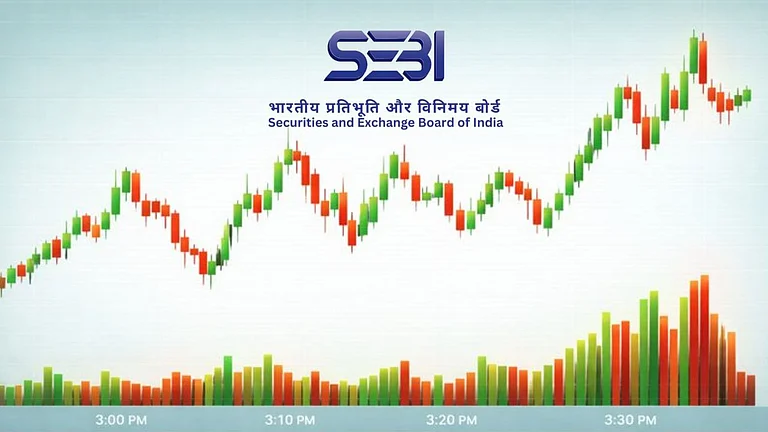
On August 13, the Sensex closing price showed unusual movements during the auction. The CAS began at 15:20 and the Sensex closing price was eventually determined at 78,079.96, rounded off to 78,080 for calculations. Sebi’s surveillance team, however, noticed abrupt changes in the index’s Indicative Equilibrium Price (IEP) during the session.
After examining the order book on a tick-by-tick basis, Sebi identified three substantial price spikes and one gradual drawdown during the CAS.
The first major spike took place between 15:20:41 and 15:20:43, when the Sensex IEP jumped 362.02 points from 77,661.40 to 78,023.42 in just two seconds. A second spike occurred between 15:24:08 and 15:24:20, when the index rose 132.67 points from 77,707.84 to 77,840.51. The third and biggest spike came between 15:25:49 and 15:26:17, when the IEP surged 405.08 points from 77,787.94 to 78,193.02 in 28 seconds.
These sharp spikes came even as the Sensex was otherwise moving lower. Between 15:21:03 and 15:26:00, the index’s IEP fell from 77,991.05 to 77,893.61. Sebi said the decline was briefly interrupted by one of the spikes, which pushed the Sensex higher before it resumed its broader downward trend.
How The Two Entities Allegedly Rigged The Auction
Once Sebi examined the order logs using the Permanent Account Number (PAN) details, it found that the two entities appeared to be pushing the index in opposite directions, based on their respective positions.
Copthall had pushed the index higher. During the entire CAS session, Copthall accounted for 86.6 per cent of the total gross buy value in Sensex constituents. It placed buy orders worth Rs 191.29 crore out of the total Rs 220.8 crore. Its share was even higher during the three price spikes, accounting for 99.91 per cent of the buy order value during Spike 1, 96.09 per cent during Spike 2, and 85.21 per cent during Spike 3.
Sebi also found that every Copthall buy order was placed 3 per cent above the reference price, which was the maximum allowed under CAS rules. Other market participants were placing buy orders at less than 2 per cent above the reference price. Sebi said, “As a buyer, there does not appear to be any economic rationale for Copthall to place large buy orders across the Sensex constituents at prices 3 per cent above the reference price, particularly when the prevailing IEP was much lower.”
The buying was also done in similar bursts across Sensex constituents and at almost the same time. This happened three times during the CAS. After the Sensex had moved higher, Copthall cancelled a large part of its buy orders. One such order worth Rs 98.11 crore was placed at 15:26:14 and cancelled just seven seconds later at 15:26:21.
The regulator said, “The pattern also indicated that Copthall did not intend to acquire the securities under its last buy order because it cancelled that buy order aggregating to approximately Rs 98.12 crore across 30 Sensex constituents which was 32.79 per cent of its outstanding buy orders.”
Mansi took the opposite approach. Between 15:21:03 and 15:26:00, Mansi placed sell orders worth Rs 145.65 crore across eight Sensex stocks, including Reliance, State Bank of India (SBI), Eternal (formerly Zomato), ICICI Bank, Larsen & Toubro (L&T) and Infosys. These orders were placed at prices between 1.5 per cent and 3 per cent below the reference price.
Sebi said, “There does not appear to be any economic rationale for Mansi placing sell orders aggregating 12.65 lakh shares across eight Sensex constituents at prices substantially below the reference price.”
The sell orders were not executed. Instead, Mansi cancelled 99.06 per cent of the 12.65 lakh shares covered by these orders within a 4-5 second window between 15:26:02 and 15:26:05. The cancellation was followed by a sharp rise in seven of the stocks. Their prices increased between 0.27 per cent and 2.89 per cent after the sell orders were removed, pushing the Sensex higher as well.
Sebi said, “These sell orders that were cancelled during 15:26:02 to 15:26:05 prima facie reveal the intention of Mansi to never legitimately sell these shares but to knowingly suppress the IEP.”

Why They Did It - The Options Angle
Both entities had Sensex options positions that were set to expire on August 13, meaning the final Sensex closing price determined during the CAS would affect their positions. Copthall had net long call and net short put positions at the 77,500, 78,000 and 78,500 strikes. These positions would benefit from a higher closing level for the Sensex.
Mansi, on the other hand, had net long put positions at the 77,800, 77,900 and 78,000 points. However, instead of holding these positions until expiry, it sold the puts for cash during the session while its sell orders were keeping the Sensex lower. It then cancelled those sell orders, after which the index moved higher.
Sebi estimated what the Sensex’s “fair” closing price could have been arrived at by using the Nifty’s actual movement as a benchmark. It arrived at 77,840, compared with the CAS closing price of 78,080.
Based on this difference, the regulator estimated that Copthall made a wrongful gain of Rs 2.96 crore from its options positions. Mansi’s wrongful gain was estimated at Rs 71.64 lakh. The regulator said this gain came from selling its puts at higher prices before they would have expired worthless. Together, the estimated wrongful gain stood at Rs 3.67 crore.
Sebi, however, has not alleged that the two entities acted together. The order states, “It is not prima facie being alleged that Noticees acted in concert,” while noting that both entities independently “tried to create a favourable move for themselves in the Sensex constituents to enrich themselves with wrongful gains.”
What Sebi Has Ordered Against The Two Entities
Sebi also noted that both entities had already built positions in the Sensex options expiring on August 20. This was one of the reasons cited by the regulator for taking interim action without first hearing the entities, given the possibility of similar activity during the following week’s expiry.
Under the interim order, Sebi has impounded Rs 2.96 crore from Copthall and Rs 71.64 lakh from Mansi. The funds will be kept in fixed deposits with a lien marked in favour of the regulator.
Both entities have also been barred from participating in the securities market and specifically prohibited from placing, modifying or cancelling orders in the CAS until further orders. Mansi, which is also a Sebi-registered stock broker, can continue operating its client-facing bank accounts, while restrictions have been placed on its proprietary trading activity.
Banks and depositories have been directed not to permit debits from the entities’ accounts without Sebi’s approval. Registrars have also been asked to prevent transfers or redemptions of securities and mutual fund units held by the two entities.


The entities can close their existing derivative positions within three months of the order or at expiry, whichever comes earlier. They have 21 days to file their objections and can also seek a personal hearing before Sebi.





