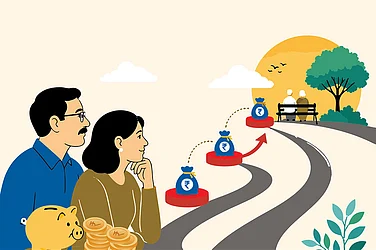

By 2036, just a decade away, nearly 15 per cent of Indians will be over the age of 60, up sharply from 10.50 per cent in 2011. This should make us pause, because it means nearly 240 million Indians will soon face a retirement challenge.
Retirement is not easy because senior citizens go through a phase of physical and social adjustment. But when financial insecurity gets added to this, it becomes a double burden.
At its core, the problem is simple: awareness, affordability, and discipline. To understand the scale of this challenge, we need to look at India’s workforce and the vastly different realities they face.
1 July 2026
Get the latest issue of Outlook Money

The Reality We Don’t See
India has roughly 560 million working people. Of these, about 450 million are in the informal sector, while the rest 110 million work in the formal sector. This distinction is critical because each segment faces different retirement planning challenges.
Affordability is a significant constraint, particularly for the informal segment. Auto drivers, vegetable vendors, and daily wage workers typically earn between Rs 15,000 and Rs 25,000 per month, which is just about enough to pull through the month, leaving virtually no surplus for retirement planning.
Solutions Exist, But Awareness Does Not
Awareness is an even bigger barrier. The government matches every rupee contributed by citizens in schemes, such as Pradhan Mantri Shram Yogi Maandhan (PM-SYM), and the Atal Pension Yojana (APY), essentially offering free money for retirement. Yet, millions of Indians remain unaware that these schemes even exist.
The government has created three primary pension schemes designed for different income segments of the informal workforce.
The PM-SYM targets unorganised workers earning up to Rs 15,000 per month. An 18-year-old can contribute just Rs 55 per month, while a 25-year-old Rs 80, and both will receive a guaranteed pension of Rs 3,000 per month for life after the age of 60. The government matches every rupee contributed. Even someone starting at age 40, the maximum entry age, needs to contribute only Rs 200 per month until age 60 to receive the same lifelong pension.
Retirement is not merely about money; it is about respect and security. A steady flow of income after retirement provides both independence and dignity
The APY casts a wider net, covering all citizens in the unorganised sector, including those earning above Rs 15,000 per month. A 25-year-old contributing Rs 376 per month receives Rs 5,000 per month for life after age 60. The pension continues to the spouse after the subscriber’s death, and the accumulated corpus eventually goes to the nominee. While Rs 5,000 is a relatively small sum, it provides crucial financial dignity during retirement.
The National Pension System (NPS) targets all citizens, particularly those in the organised sector without employer pensions and the higher-earning unorganised segment. For mid-income earners making Rs 30,000-40,000 per month, such as chemists or small distributors, investing Rs 10,000 per month from age 30-60 can potentially build a corpus of around Rs 2.26 crore, assuming a conservative 10 per cent annual return. The scheme offers flexibility in asset allocation and tax benefits under Section 80C.
The Real Gap: Awareness and Discipline
I met a 65-year-old sports coach recently who had fallen into hard times and sought financial help. Coincidentally, this request came when I was preparing to speak on this subject. While helping, I asked him a simple question: during your working years, did you have the means to invest Rs 10,000 per month? He said, “Yes of course, that much I could certainly afford.”
We calculated that even at a 12 per cent annual return over 30 years, he could have built a corpus of about Rs 3.50 crore. Small amounts, invested with discipline over long periods, can create meaningful wealth. He said, “I wish I knew.”
That is the real problem: it is not always affordability; it is awareness.
Making It Simple
Digital tools have made retirement planning more accessible.
At IDFC FIRST Bank, for instance, our mobile app allows customers to input goals like “I want Rs 5 crore in 20 years”, and the system calculates the required monthly investment, factoring in risk appetite and fund performance. With this, we are democratising financial planning that was once accessible only through expensive advisors.
Behind this simplicity lies detailed analysis. The platform evaluates the performance of mutual funds the track records of fund managers, along with the underlying quality of the mutual fund—research that individual investors may find difficult or time-consuming to undertake on their own.
After choosing investment schemes through the platform, customers can set up automatic monthly transfers. The discipline is built in: money moves from their account to their retirement corpus every month without requiring any further action.
Meeting Seniors Where They Are
Even the best retirement tools fail if seniors cannot use them. Senior citizens may prefer simpler interfaces, clearer communication, and more conservative investments. Features like larger fonts, streamlined journeys, and life-stage-appropriate mutual fund suggestions bridge the awareness gap for a generation that may be less digitally native. We must design platforms that serve all age groups, not just the tech-savvy young.
The Way Forward
People need awareness and accessible digital tools to plan effectively. Most critically, retirement solutions must reach the middle- and lower-income segments for whom this crisis is most acute.
This is where the “Power of Three”, Awareness, Affordability, and Discipline, become relevant. When these three come together, compounding does the rest.
The infrastructure exists—government schemes offer guaranteed pensions for minimal contributions while digital platforms demystify investment planning. What remains is a concerted effort to spread financial literacy and make millions of Indians aware of the pathways available to them.
In the end, the issue is not merely about money; it is about respect and security. A steady flow of income after retirement provides independence and dignity, more valuable than anything else.