
When I listen to parents and older adults talk, I notice that they often comment about young people lacking in respect for authority, and bemoaning the case of them having no desire to read.
In the world of doom scrolling, Instagram reels and podcasts, picking up a book is not as commonplace as it used to be. Complaining about the young is a longstanding tradition. Remember, Aristotle too commented on Greece’s young people: “They think they know everything, and are always quite sure about it.”
However, the reverse holds, too. I have seen posts on social media of people comparing themselves with their grandparents or parents in context of money not going very far.

3 September 2026
Get the latest issue of Outlook Money

They will be along these lines: “Just one lifetime ago, our grandparents were able to buy a home, have three to four children, live on one salary, get their children married, and live comfortably. What happened?”
The responses to “What happened?” are varied—women joining the workforce, feminism, inflation, capitalism, greedy politicians, hedonism, hyper consumption, and so on. Honestly, I don’t have any answer to this. And going by the responses, there is no consensus either.
So I am going to tackle this from a different angle.
Using The Older Generation As A Benchmark Is Futile
When comparing, you can’t cherry-pick one or two aspects and ignore the rest. If you insist on drawing parallels, let’s go the whole hog.
Did they have OTT platforms streaming movies, music, and podcasts all through the day? Did they go to coffee shops to work? Oh wait, they would need a computer, laptop, smart TV or mobile phone for that. But they probably did not even have a B&W television or a landline phone. And certainly no coffee shops to work in.
Did they have air conditioning, a vacuum cleaner, dishwasher, washing machine and a car? Could they afford to have a maid, nanny, cook or a driver?
The immediate fallout of basing our identity on material possessions and lifestyle is that we judge our worth relative to society
Could they afford global holidays? How often did they fly when they travelled to other states? Did they eat out regularly or call in for takeout? How often did they visit the salon for facials, manicures and pedicures? Did they have gym memberships? Did they have access to what is happening around the world at their fingertips as we do now? Were there as varied options available to younger people in pursuit of a career as there are today?
I can go on and on, but I am sure you get the point. It is a futile comparison. Maybe our grandparents lived with more austerity because there was no choice. The world was a different place back then. The way society functions has evolved.
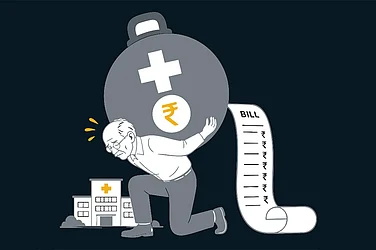
Salaries of the working class have risen. Two working parents are a norm now. Household income has increased, as well. But the cost of owning a home has shot up faster than our earnings have. Healthcare has become frightfully expensive. According to various estimates, healthcare inflation rate in India now stands at 12-14 per cent per year, significantly higher than the general inflation. Our salaries do not increase by that percentage annually.
Awareness about education has spread and more girls are getting educated. Education is no longer just an expense, but an investment. But since education is now a business, the commodification of education means that it will follow the laws of demand, supply, and profit. A report by IndiaMacroIndicators, citing Ministry of Statistics and Programme Implementation (MoSPI) data, states that households spent Rs 1.80 lakh crore on education in FY2012, and it went up to Rs 8.43 lakh crore by FY2024. In FY2012, education made up 3.10 per cent of total private consumption, which went up to 4.10 per cent by FY2024.
The evolution of societal patterns will impact all of us in every aspect of our lives. And a matter of fact is that life has become more expensive.
Look Within To See What Is Driving Your Consumption
A stark difference between the older generations and today’s world is that per capita consumption has risen significantly. Consumption has become an obsession. A tool to define our identity. A means to establish our individuality. It cements our standing in society. It has become an expression of how we want to be perceived.
So, we must check out the fine dining restaurants in our city, travel to certain countries, dress with particular brands, have a destination wedding with pre-wedding shoots, and a themed birthday party for our children. Most importantly, flaunt it all on social media, because that is what defines our image.
Your financial situation could be the result of aping others and NOT living your life on your terms and within your affordability
The immediate fallout of basing our identity on material possessions and lifestyle is that we judge our worth relative to society. If we want to be perceived as rich, we must earn and live better than our friends, family, neighbours and colleagues. If that is not possible, then we must consume at a level that makes us equal. Otherwise, we are poorer (God forbid!!).
To live a particular lifestyle, we have to earn much more. If we cannot, then we can get someone to pay for it. This is how we flirt with debt, because it is so unbelievably convenient and accessible. So even if consumption is rising faster than income, we can indulge in a lifestyle we really cannot afford. Personal loans and credit cards fuel our consumption, which is essential to maintain our social status.
A WhatsApp forward was recently doing the rounds, and it is worth reproducing here: Comparison bred competition. Competition fuelled aspiration. Aspiration drove consumption. Consumption trapped us in debt. Inflation didn’t kill us. Aspiration did. Advertising engineered it. Finance sold it. And we bought it—proudly, competitively, and endlessly.
Remember This
The issue is NOT that we are consumers, the issue is NOT that we consume more than our grandparents, both of which are perfectly natural. The issue is when we link our identity and self-worth to our lifestyle, because then our consumption takes us down the rabbit hole.
Have you ever considered that you are getting played by Instagram reels? You subconsciously begin to ape the lifestyle of others just to fit in. If that is the case, your financial situation could be the result of NOT living your life on your terms and within your affordability. And comparisons with grandparents are not going to absolve you of responsibility.
By Larissa Fernand, Behavioural Finance Expert