
What a volatile year it has been, and we aren’t even halfway through. The tariff war between India and the US, intensified selling by foreign institutional investors (FIIs), the joint US-Israel attack on Iran, a depreciating rupee, rising price of crude oil, lay-offs in big companies, such as Oracle, Amazon, UPS, and Volkswagen, the AI supercycle driving a new era of earnings growth, assembly elections in India, and a fragmented global policy landscape, with each central bank reacting based on its own constraints, the news cycle seems endless.
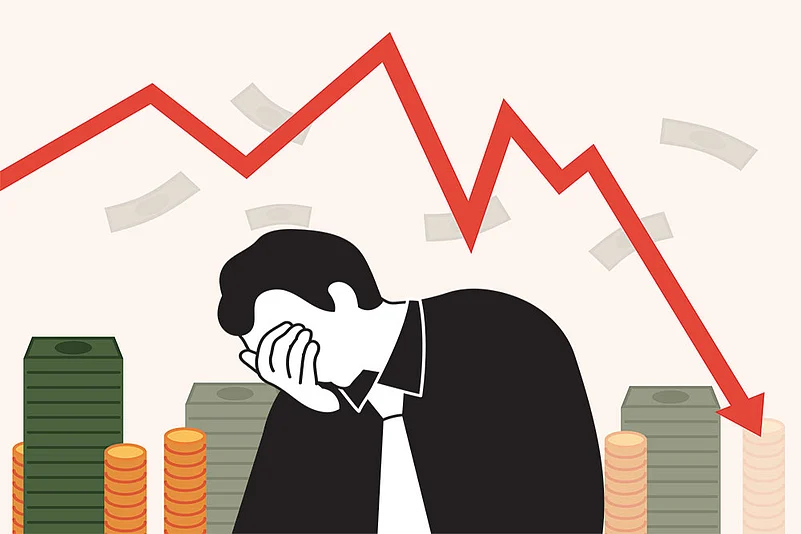
Every time the market hits a low, two things happen: recency bias kicks in and catastrophising comes to the forefront.
Catastrophising is a mindset where people make a catastrophe out of a current situation and predict the worst possible outcome. When you magnify a situation in your mind, you believe that nothing is going to be “normal” again.
1 October 2026
Get the latest issue of Outlook Money

Recency bias is the tendency to form an opinion about the future based on the most recently presented information. Simply put, we give more weight to recent events. Consequently, we estimate what is going to happen, not on the basis of long-term experience, but rather on what is happening right now.
Together, they have a powerful impact on our psyche, and test our investing convictions. The only way you can play the game is by reframing the narrative in your mind. To do that, there are four factual issues you need to understand.
Markets Have Seen It All
The Sensex was launched on January 2, 1986, and for the first time closed at 1,001 points on July 25, 1990. Look at where we are today!
Over these decades, we have seen border skirmishes, military operations, and terrorist attacks; Iraq-Kuwait war in 1990; Kargil in 1999; India-Pakistan stand-off in 2001; 9/11 attacks in 2001; US-Iraq war in 2003; the Mumbai attacks in 2008; Russia-Crimea in 2014; Balakot attacks in 2019; Russia-Ukraine war in 2022; Israel-Gaza in 2023; Pahalgam in 2025; and US/Israel- Iran in 2026.
Catastrophising is a mindset. When you magnify a situation in your mind, you believe that nothing is going to be “normal” again
Prior to that, global stock markets witnessed the China-Taiwan conflict, two world wars, the Cuban missile crisis, the Korean war, Vietnam, and Afghanistan. While neither list is exhaustive, other catastrophes too occurred, such as the Asian financial crisis, global financial crisis, the dot com bust, the European debt crisis, the influenza pandemic of 1918 and the Covid pandemic of 2020, the lost decade of the US market, Black Monday, Watergate, tariff wars, and taper tantrum.
Make peace with the fact that we live in a world where we cannot escape the inevitability and consequences of wars, terrorist attacks, or financial turmoil. It has happened many times before, and it will happen again. Events create market chaos, and sentiment fuels it. But that does not justify an exit from the market. A column in the New Zealand press earlier this year captured my attention with the provocative headline: "The dogs of war are loose, but investors don’t need to run scared." The takeaway was that selling during a “mess of madness” often results in locking-in losses before a market stabilises—wars end, ceasefires take place, and markets continue their upward trajectory over time.
A Downturn Is Not An Anomaly
On the contrary, it is a normal, expected part of a long-term investment cycle. While market downturns can be frightening, they are inherent to investing, and history shows that markets have rewarded investors who can withstand them.
Over time, the Sensex has seen precipitous drops; May 2004 (-22 per cent in two days), May 2006 (-19 per cent in three days), January 2008 (-14 per cent in two days) and October 2008 (-21 per cent in two days). However, the natural trajectory of the stock market is to ascend. No matter how brutal the bear market is, the comeback ensures that the course stays upward, and never in a linear fashion. If you don’t lose sight of the long term, the bumps along the way won’t be uncomfortable.
I starkly remember a study done by Fidelity Mutual Fund when they were a mutual fund in India. They looked at the Sensex data over a decade and cited May 17, 2004, when the Sensex dropped 11.14 per cent. They noted that those who exited in panic on that day would have missed out on a gain of around 8.25 per cent the very next day, which brings me to my next point.
The Risk Lies In Your Behaviour
We have no control over wars, epidemics, or central banks, but we can control our emotional response. The worst time to make investment decisions is when fear is at its highest and there is no clear path as to the road ahead. Uncertainty is uncomfortable, and the market’s initial reaction will be one of chaos and volatility. But the market inevitably rebounds and rises. And those who refuse to succumb to knee-jerk reactions preserve the long-term value of their portfolio.
The biggest mistake new investors make is to conflate volatility with risk. The two are not the same. Volatility is nothing, but extreme fluctuations in the market that are caused by multiple factors.
There is no risk in volatility or uncertainty. The risk lies in your behaviour. The risk lies in buying poor quality stocks without doing the research required and without a margin of safety.
The wealth creation opportunity is immense if you continue to invest during bear runs. If you don’t have the money or courage to invest in such a market, at least don’t pull out what has been previously invested. As renowned investor Shelby Davis once remarked, “You make most of your money in a bear market, you just don’t realise it at the time."
Never Force Your Hand
The stock market always pushes you to act irrationally. That is because human emotions are powerful and get triggered by market movements. Any news affects sentiment—optimism, pessimism, fear or greed. If not disciplined, then one’s impulsive behaviour takes precedence.
There are two things a stock market investor should never do. Never buy because of fear of missing out (FOMO). During bull markets, investors pay no heed to the margin of safety and buy stocks at extremely rich valuations, or pile into equity funds. During bear markets, instead of waiting it out, they sell in panic and want to flee the market completely. In both cases, they ignore their asset allocation and act on emotions.
Equally detrimental is boredom during a sideways market which makes investors believe that they must “do something”. Doing something about the situation makes us believe that we are in control, when in reality, we are causing more damage to our portfolio. As the famous quote from the 1983 movie, War Games, reminds us: “But sometimes the only winning move is not to play.” Volatility is part and parcel of equity investing. It should not affect you, unless you convert the paper losses into actual losses by selling. When fear turns volatility into a bad decision, you lose. So don’t give in to fear.
By Larissa Fernand, Behavioural Finance Expert