The Indian household fiscal math is under pressure. The ongoing conflict in West Asia is slowly pushing us to accept a new normal, marked by uncertainty. The stock market is already on a roller coaster and affecting investment plans.
Many households are redrawing budgets as disrupted global supply chains pinch their pockets. India’s annual wholesale price index (WPI) inflation grew to a three-and-a half-year high of 8.30 per cent in April 2026, a staggering jump from 3.88 per cent in February 2022. The jump was led by the “Fuel and Power” category, which recorded an annual inflation rate of 24.71 per cent. On the other hand, mobility itself is set to get costlier. On May 15, oil marketing companies implemented a sharp hike of Rs 3 per litre for both petrol and diesel, marking the first significant revision in fuel prices in over four years. Following the initial price hike, three more hikes were introduced. As on May 25, petrol prices have breached the Rs 100 mark in most major cities. In New Delhi, the cost of petrol is Rs 102.12 per litre, while in Mumbai and Hyderabad, it is Rs 111.21 and Rs 115.73 per litre, respectively. Fuel hike is a bummer, as it leads to price hikes even for essential commodities.
In view of the rising prices, even Prime Minister Narendra Modi has stepped in and appealed to people to cut costs and practise frugality. He has advocated choosing old jewellery instead of new, domestic holidays instead of international, and adoption of energy conservation practices by carpooling or working from home or using public transport, in addition to reducing spends on international goods like oil, among others.
1 August 2026
Get the latest issue of Outlook Money

Even in the middle of a war, life needs to go on, but it may need to change and adjust to new realities. The biggest casualty of this change are presumably leisure activities, such as travel and eating out.
But is that happening? Not quite. The younger generation doesn’t seem to be ready to give up on having fun, and is pushing what planners may call discretionary expenses into the non-discretionary basket.
The Need For Leisure…
India is not giving up on leisure activities despite rising prices. But how does one understand that? Experts say people tend to look for mental relief in uncertain times, and at least some leisure activities can provide the much-needed respite from the daily grind.
Says V.P. Singh, Director of Economics, Post Graduate Program in Management at Great Lakes Institute of Management, Gurugram: “While costs have certainly risen, the demand remains high, suggesting that the desire for social connection and escape is currently stronger than the fear of price hikes. The current adversity has led people to seek smaller pleasures for the time being.”
Young Indians are not giving up on leisure activities despite rising prices. Food and weekend travel continues to be on the rise
Nidhi Somaiya, 23, a Mumbai-based marketing professional, feels the pinch, but says it is necessary to unwind. For her, the rising cost of mobility is a challenge, as cab fares in Mumbai tend to spike during busy hours, and with the recent fuel price hike, the costs are expected to escalate. “After a long day, opening a cab app and seeing Rs 700-900 for a single ride feels unreasonable, even though in that moment, that comfort is exactly what you need,” says Nidhi.
Spending money on fun activities is a small reminder for her to not let life revolve only around work. “In cities like Mumbai, people are just trying to find moments that make life feel less repetitive and more lived,” she adds.
…Is Keeping Demand Strong
The demand for travel and eating out remains strong as of now. Singh says international travel has shrunk on safety fears and the PM’s austerity appeal, but domestic travel has actually boomed.
Says Aviral Gupta, CEO of Zostel and Zo World, a chain of backpacker hostels: “Luxury domestic vacations and hyper-local weekend getaways are seeing a massive spike. Before the geopolitical disruptions and the start of the conflict in early 2026, the pre-war baseline average room rate for premium hotels pan-India was between Rs 7,800 and Rs 8,200 per night. It has now risen to Rs 8,200-8,500.”
Gupta says that while weekday travel remains a strong baseline, weekend travel is seeing sustained growth. “Weekend check-ins grew from 31.60 per cent in FY25 to 36.90 per cent in FY26. These stays now contribute nearly 57 per cent of our total net revenue. Travellers aren’t just checking in for a Saturday night anymore. They are arriving on Fridays or leaving on Mondays, turning weekends into short breaks.”
The demand is consistent in the food and beverage industry, too. Stakeholders say maintaining quality works for them.
Sidhant Kalra, director of Khan Chacha, an iconic quick-service restaurant (QSR) chain in Delhi National Capital Region (Delhi-NCR), says that meat, oil, packaging, and logistics have all seen noticeable price increases. “For a QSR brand operating at scale, these fluctuations impact operating margins as consistency in quality cannot be compromised.”
He adds that despite the cost increase and the jump in commercial LPG prices, the crowd at eateries has not thinned out. “Weekday and weekend demand continues to hold steady, and the after-work segment remains consistent,” Kalra says. If disruptions continue, they might have to shorten the menu to focus on high-demand items to reduce complexity.
Vidhatha Annamaneni, co-founder of Ironhill India, a Hyderabad-based craft brewery and brewpub chain, says that instead of a decline, they have seen an uptick in footfall recently. “We believe this is a testament to the flight to quality. When consumers become more conscious of their spending, they gravitate toward brands they trust to deliver a consistent and premium experience,” says Annamaneni. He also remains optimistic regarding the social ritual of gathering.
Talking about providing quality and experiences, he says the brewery performs annual menu refreshes that introduces higher-efficiency dishes and new trending items to reflect evolving consumer palates and prices.

The Key Drivers
So what’s helping them fund their wants-turned-needs? A sense of balance and mindful spending.
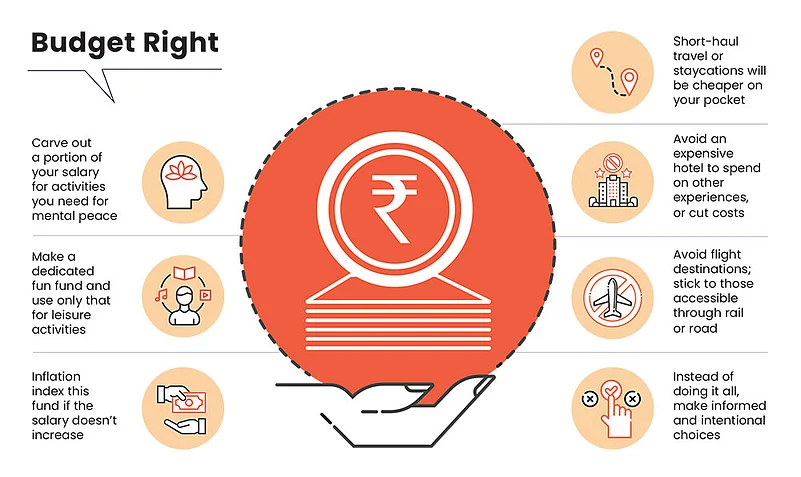
Sense of Balance: For Nidhi, rising prices are a challenge, but she is managing it by becoming more “intentional” about spending. For instance, she won’t compromise with certain aspects like doing 23 new things before she turns 23.
Piyali Chatterjee Konar, executive vice president and head of customer experience at the Mumbai-based Hansa Research Group, a global market research agency, says that consumers are not necessarily trading down their joy, but trading smart.
She says: “Consumers are not abandoning leisure or experiences. They are becoming more selective about where they spend and where they save. People are willing to skip a five-star room if it allows them to lengthen the duration of the trip, add a unique dining experience, or spend more on activities that create memories.”
India is a price sensitive market even when the going is good. Says Konar: “What creates friction is not price alone, but the feeling that the value equation has changed. People don’t mind spending more when they understand why. They react when inflation arrives in disguise.”
For the upcoming holiday season, Konar projects that travellers will redesign their journeys rather than cancel them. She expects a surge in hyper-local travel, staycations, and short-haul getaways which remove the pain points of high airfare and fatigue.
Experts say setting aside a budget for fun and leisure activities is the right approach, so that other goals are not hampered
The travel industry is already seeing these shifts in real time. Gupta says despite the rising cost of living in tourist hubs, the digital nomad segment led by employees making the most of work-from-home remains strong. Some are actively avoiding the war tax of high airfare. He says: “Rail- and road-accessible destinations accounted for 82 per cent of our FY26 year-to-date (YTD) bookings, up from 80.10 per cent in FY25. The preference is real and measurable. Corridors like Goa, Rishikesh, Mussoorie, Manali, Kasol, Hampi, Gokarna, Pondicherry and Bir are performing strongly.”
In flight-reliant destinations, such as Spiti or the Andamans, demand growth is still healthy, but average booking values have corrected by about 10 per cent, he adds.
Smart Budgeting: To make such choices, investors need to go back to the good old budgeting drawing board. Manasvi Garg, CFA and founder of Moneyvesta, an investment advisory and wealth management firm, emphasises the importance of value-based budgeting and creating a specific morale fund amid rising costs. He highlighted that behavioural finance shows that people feel less guilty when spending from a pre-set category, so fun should be treated as a planned expense rather than something taken from leftover money.
He suggests that the best approach is to recognise the price rise early and plan accordingly. “Plan for rising leisure prices by indexing your fun fund with approximately 8 per cent inflation,” Garg says.
Once you have made an allocation, you can spend guilt-free. “This sinking fund approach ensures that long-term goals, such as retirement or debt paydown, aren’t undercut by impulse splurges on high-cost weekends,” says Garg. He provides a framework for stress-testing these budgets. If a person with a Rs 1 lakh net salary and a Rs 20,000 leisure plan faces a 20 per cent inflation spike in costs like airfare, they would need an extra Rs 4,000 to maintain the same standard. He suggests that in tight months, one should trim the frequency of leisure activities or other wants to keep the 50:30:20 ratio intact (50 per cent for expenses, 30 per cent for investment and 20 per cent for spending).
A cautious planner could set aside this buffer in advance to avoid financial shock. You can do this by automating transfers to a dedicated “fun fund” and using only that account for discretionary spending as the first step, says Garg. He adds that monitoring consumer price inflation (CPI) data for food and travel helps.
But he cautions against turning fun into high-interest debt. “Avoid credit traps. Treat buy now pay later (BNPL) or other forms of credit as short-term liquidity. If you use a credit card, ensure full repayment. Prioritise saving for planned treats rather than borrowing,” he adds.
Leisure is no longer the first thing to be lopped off from a tight budget; it needs to be protected as a vital resource for mental health. By moving from impulsive spending to indexed budgeting, India can find a way to keep the spirit of life going until better times roll around.