



When Sunita Singla, a 69-year-old resident from Hyderabad, called the customer care number of an e-commerce app to complain about a rotten watermelon delivered to her, little did she know that it would cost her Rs 63,650. She had placed the order while visiting her cousin in Mumbai in April 2025, and had Googled the customer care number instead of raising a complaint through the app.
That number led her to a scamster who posed as a professional support agent. During the call, which lasted around 50 minutes, the scamster tricked Sunita into sharing her screen to get sensitive bank details. Trusting his step-by-step guidance, she involuntarily shared her banking details and entered the numbers “23000” and “40650”, believing them to be codes. They were, in fact, the amounts that were siphoned off her bank account, totalling to Rs 63,650.
By the time she realised it was a scam, it was too late: the amounts were already debited from her account. She immediately ended the call and dialled the cybercrime helpline number, but could not furnish the full bank number as it was not readily available with her. Later, she reported the matter to the police, providing them with the WhatsApp call details and the fraudster’s WhatsApp photo. Even after a year, there has been no recovery or arrest, she says.

1 October 2026
Get the latest issue of Outlook Money

Digital frauds are not uncommon these days, and senior citizens are often on target. According to data shared by Union Minister of State for Home Bandi Sanjay Kumar in a written reply to Rajya Sabha on August 5, 2026, a total of 103,488 senior citizens lodged financial cyber fraud complaints in 2025, involving Rs 4,005.12 crore. Earlier on February 11, 2026, Kumar had raised the issue of rising cyber fraud complaints, from more than 260,000 cases in 2021 to over 2.40 million cases in 2025 (see Rising Risks).


Data shows that senior citizens’ complaints account for 4.30 per cent of the total financial cybercrime complaints in 2025, but make up 18 per cent of the total amount lost.
Why Are Seniors On Target
Fraudsters play on the weakness of seniors, whether it’s lack of digital awareness, fear, greed, or blind trust.
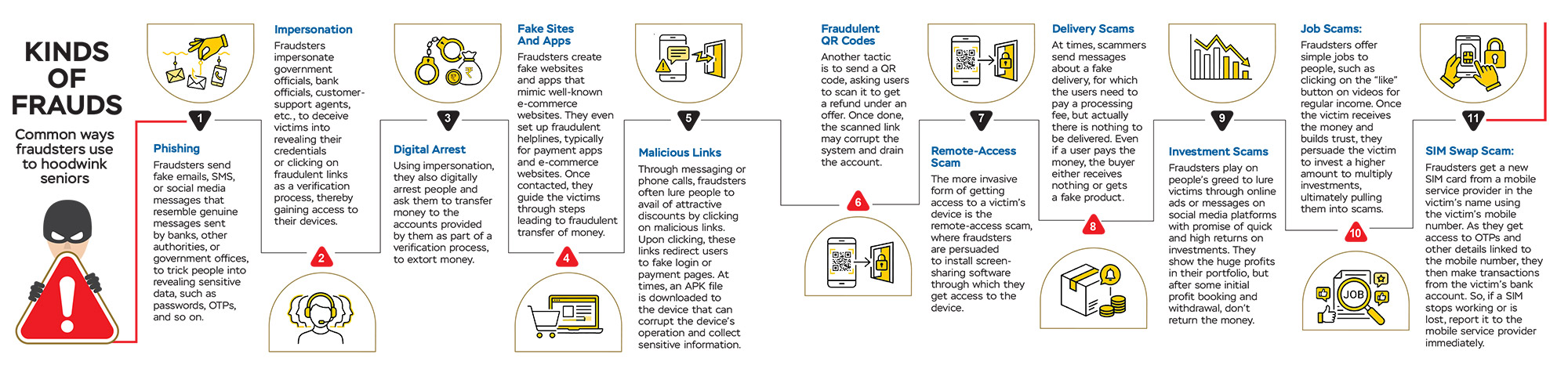
Though awareness among senior citizens is improving, they are sometimes unable to detect new kinds of frauds (see Kinds of Frauds, page 74). Says Harish Kumar, CEO, Quick Heal Technologies, a cybersecurity and software development company: “Awareness is improving, but it remains uneven. Many seniors know that OTPs should not be shared, but fraudsters increasingly use fear, authority, and urgency through digital arrest, investment fraud, fake customer care, and impersonation.”
Technical unfamiliarity compounds the risk because many seniors didn’t grow up navigating OTPs, phishing links, or app permissions. So, recognising a fraudulent interface for them can be difficult, says Hemanshu Jain, founder and CEO, Khyaal, an app-based community platform to engage and educate senior citizens.
Says Shreya Suri, partner, CMS Induslaw, a law firm: “Senior citizens, not having grown up with technology, find it difficult to adapt than the younger generations. Add to that, fraudsters use deceptive tools, which make it tough to distinguish genuine messages and calls from phishing scams. Often, many seniors will not even realise if they are talking to AI bots or real people.”
Loneliness also plays a big role. Says Jain, “Loneliness and isolation can also make people more inclined to trust an unexpected caller who offers conversation or help, particularly for seniors with smaller immediate support networks.”
How To Empower Seniors
Don’t Become Their Crutch: Many seniors stop using digital tools when they hear about digital financial fraud. This reaction is typical when a near and dear one goes through a similar experience. “Avoiding digital tools altogether is not the right answer for senior citizens,” says Kumar.
Many others tend to depend on younger family members for digital transactions to stay protected. However, that can lead to other complications. Says Jain: “Although leaning on family for support is not inherently wrong, outsourcing digital participation entirely is not the right long-term answer. When seniors withdraw from digital tools out of fear and hand over transactions completely to someone else, they do not just lose exposure to scams, they lose autonomy over their own finances and daily life, which creates a different kind of vulnerability.”
To safeguard senior citizens from digital fraud, empower them to identify red flags and also set up effective mechanisms for quick recovery of lost funds
Kumar says family members can help set up devices and discuss suspicious messages, but seniors should not be made completely dependent on others for routine transactions. “That can create different risks, including loss of privacy and reduced confidence.”
Sensitise Them Instead: To safeguard retirees from digital fraud, it is crucial to empower them to identify red flags and safeguard themselves, besides establishing effective safety rules and mechanisms for quick recovery of lost funds.
The most important red flag is urgency. Says Kumar: “A caller claiming to be a police officer, bank executive, CEO, delivery agent, or government official who demands immediate action is trying to prevent independent verification. Seniors should ignore requests for OTPs, Unified Payments Interface (UPI) PINs, screen sharing, remote-access app installation, or payments to ‘secure’ an account. A bank, police officer, or government department will not demand secrecy or insist on payment through an unverified link.”

While families can play a role in educating them, community workshops are often more effective, thanks to similar concerns and shared experiences, says Jain, who conducts digital fraud awareness workshops for the elderly in community settings. He says: “Our community functions as an early-warning network. When one user flags a scam pattern, that knowledge travels quickly through the platform, effectively crowdsourcing vigilance across thousands of seniors.”
Be Supportive: Sometimes, the savviest and most aware people can also become victims, thanks to fraudsters coming up with novel ways of scamming people. Blaming seniors can be bad for their confidence.
Sunita says she had come across such fraudulent phone calls previously and has avoided entertaining them. She feels guilty she fell into the trap. She cautions people not to blindly trust all information available on Google, as there could be fake websites and fake customer care numbers.
Protecting your retirement kitty from fraudsters is as important as building one. Says Jain: “Digital alertness has become an important pillar of retirement readiness, alongside saving, budgeting, and investing. Traditional financial planning has always focused on accumulation and allocation, but in a digital-first economy, protecting that corpus requires an equally deliberate skill of recognising a possible fraud. A well-planned retirement portfolio offers no protection if a single unverified phone call can drain it.”
This Diwali, stay vigilant and protect yourself from cybercriminals lurking behind festive deals and tempting advertisements.
versha@outlookindia.com