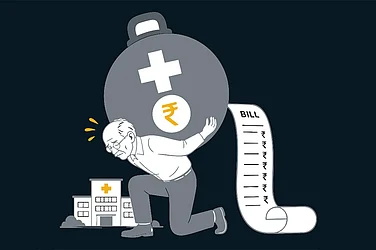
There is a large segment of seniors in India, who cannot afford health insurance, irrespective of the strategies they adopt to lower the cost and increase the coverage. That’s because either they do not get enough pension, or, they rely on their families for their senior years.
According to NITI Aayog’s position paper, Senior Care Reforms in India (2024), nearly 78 per cent of India’s senior citizens do not have pension and 70 per cent rely on others for daily maintenance, suggesting a high dependency ratio, which makes it critical for the elderly to take a basic health cover.
The Centre’s Ayushman Bharat Pradhan Mantri Jan Arogya Yojana (AB PM-JAY) solves this issue, but only partially.

3 September 2026
Get the latest issue of Outlook Money

The PM-JAY Solution
As on July 1, 2026, a total of 37,452 hospitals in India, including 20,176 public, and 17,276 private, are empanelled under the scheme.
What 70+ Get: In October 2024, PM-JAY extended a health cover of Rs 5 lakh to all senior citizens aged 70 years and above, irrespective of their health condition or socio-economic background (see How To Use PM-JAY). But that leaves those between ages 60 and 70 vulnerable.


Silver Lining For 60+: In India, 60 is the typical retirement age. However, a large number of people retire without pension security, leaving them without any cover.
Says Himanshu Rath, founder chairman, Agewell Foundation: “Geriatric care in India remains a challenge due to rising costs of chronic disease management, hospitalisations, surgeries, and long-term care. Out-of-pocket expenses are significant for many families.”
But there’s hope. The Parliamentary Standing Committee on Health and Family Welfare (2025), in its 163rd report, recommended rationalisation of age criteria and extending the PM-JAY scheme to all seniors aged 60 years and above, irrespective of their socio-economic status. The committee also recommended increasing the coverage amount from Rs 5 lakh to Rs 10 lakh per family per year and suggested a periodic review of the treatment packages to include high-cost diagnostics, such as CT and MRI scans, among others.
Gaps Remain
Though the scheme can come to the aid of many senior citizens aged 70 and above, the utilisation is low.
The committee observed a consistent lower utilisation compared to the budget estimate. In financial year (FY), 2023-24, the actual expenditure was Rs 6,800 crore against the Budget allocation of Rs 7,200 crore. In FY 2024-25, the allocation was Rs 7,300 crore, which was revised to Rs 7,605.54 crore, but the actual expenditure was Rs 7,136 crore (see PM-JAY: Allocation vs Utilisation).
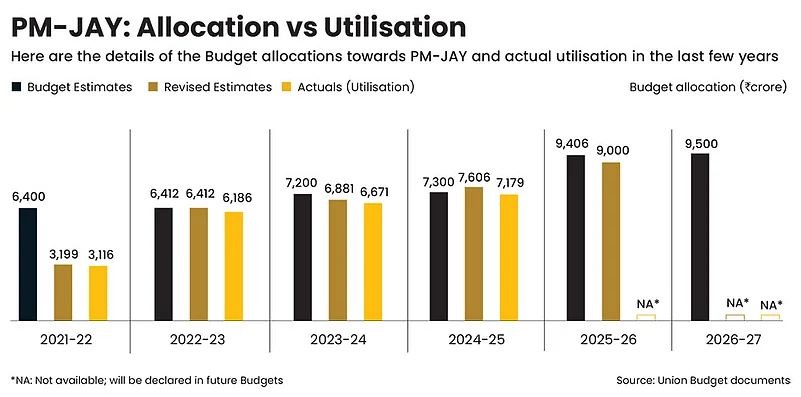
The committee recommended identifying operational and other bottlenecks and removing them to utilise the total allocated funds.
In 2023, too, the Standing Committee, in its 151st report, had made similar observations. It had recommended the use of technology for monitoring fund utilisation, ensuring timely disbursement, detecting overbilling, and unnecessary medical procedures, and strengthening oversight mechanisms. The committee had also stressed timely reimbursement to empanelled private hospitals to prevent de-empanelment, free supply of medicines, and creation of dedicated funds to support high-cost surgeries.
Says Rath, “While schemes like Ayushman Bharat represent a commendable effort to support elderly healthcare, a large section of India’s older population—particularly the poor, destitute, and those with low digital literacy or no digital access still remains largely untouched by these benefits. Many vulnerable seniors face barriers in enrolment, Aadhaar linkage, awareness, and navigating hospital processes.”
He emphasises the need for simplified, community-based outreach, assisted registration drives, and stronger last-mile coordination with non-governmental organisations (NGOs) and self-help groups (SHGs) so that the most marginalised elderly can truly benefit from the scheme.
Is Rs 5 Lakh Cover Enough?
Given the pace of medical inflation, a health cover of Rs 5 lakh may not always be sufficient.
Says Siddharth Singhal, head of health insurance, Policybazaar: “While this coverage will help manage most medical expenses, age-related illnesses can sometimes lead to costly treatments, placing significant financial burden on seniors, especially as they often lack a regular income stream. Treatments involving critical illnesses, prolonged ICU stays, cancer care, or major cardiac procedures can result in expenses that exceed this limit, making an additional individual cover with a higher sum insured advisable for those with chronic health issues.”
Harsh Roongta, a Securities and Exchange Board of India-registered investment advisor (Sebi RIA), pegs the amount at a minimum of Rs 10 lakh. He says: “One should have a minimum health cover of Rs 10 lakh, and beyond that, as much as one can afford.”
Even if a Rs 5 lakh health cover is not enough, having some insurance is better than having none at all, as individual health insurance policies become significantly more expensive after the age of 60 or 65.
Purchasing a personal policy with a similar sum insured could cost several thousands annually (see The Best Health Insurance Strategy For Seniors, Pg 10). The premiums may vary depending on several factors. Says Dr. S. Prakash, CEO, health insurance ecosystem and strategic partnerships, General Insurance Council: “The premium depends on several factors, including the product design, inclusions and exclusions, waiting period, city of residence, policy features, risk profile of the proposer, and the underwriting policy of the insurance company. The difference in premium between a medically fit individual and someone with a pre-existing disease depends largely on the type of health insurance product chosen.”
For now, those who can’t afford to buy their own health insurance can just hope that the government heeds the Parliamentary committee’s proposal to increase the cover from Rs 5 lakh to Rs 10 lakh.
versha@outlookindia.com