Vadodara-based Naveen Patel, a 42-year-old engineering professional, knows that he needs to invest more for retirement and review his insurance policy. At the start of the year, he had calculated his existing retirement savings and had figured it won’t be enough; he also found his health insurance cover short of what’s required for adequate protection given the rising medical costs. He has been planning to fix it all but has done nothing about it yet.
Certainly, he has the right intent and is aware of his financial reality, but has been putting away the decision of increasing his mutual fund systematic investment plan (SIP) amount. Every month he is unable to act due to a large sudden expense or other reasons, he thinks he will do it when the next salary is credited, but the decision keeps getting postponed month-on-month.
The Psychology Behind Procrastination

1 October 2026
Get the latest issue of Outlook Money

Naveen seems to be a typical case of a procrastinator, one who habitually delays taking action or doing tasks.
Says Madhupam Krishna, a Securities and Exchange Board of India-registered investment advisor (Sebi RIA) and chief planner, WealthWisher Financial Planner and Advisors: “Procrastination is essentially the gap between intention and action. You may know what needs to be done, but as there is no immediate consequence for delaying it, the brain keeps pushing the task into the future.”
The minute a future date comes into the equation, there’s usually no sense of urgency. Says Kiran Telang, Sebi RIA and director and principal officer, Dhanayush Capital Services: “People often delay financial decisions because the consequences are not immediate. Spending today gives instant gratification, while saving or investing benefits a future version of yourself. This makes it psychologically easier to postpone a decision even when you understand its importance.”
The other reasons that may cause financial procrastination are uncertainty, fear of making the wrong decision, or simply feeling overwhelmed by choices. The more complicated a task appears, the easier it is to postpone it. You may keep telling yourself that you would make a decision only after researching it right, but delays can rob you of the opportunity.
The Financial Cost
The financial cost of delaying investment decisions can be steep. Telang gives an example: when the markets are going through a downturn, delay in decision-making on, say, the choice of funds, stocks, or themes, may make you miss the opportunity to invest at low levels.
Adds Krishna: “With financial decisions, the cost of waiting can accumulate silently.”
A person who pauses before acting may avoid impulsive investments and unnecessary purchases. The problem arises when hesitation turns into indefinite avoidance.
Says Telang: “Procrastination can sometimes work in your favour when it creates a pause between an impulse and an action. The problem starts when the pause becomes permanent. In investing, you need enough time to think, but not so much that an important decision is continually pushed into tomorrow.”
In the case of insurance or creating an emergency fund, you and your family may remain unprotected during crucial times because an emergency doesn’t knock before coming in. Financial emergencies, such as hospitalisation or the passing of a breadwinner can wipe away substantial savings in a matter of weeks or just days, as medical costs are high.
What Should You Do?
To start with, automate your SIPs, set reminders for insurance reviews, and use standing instructions wherever possible. This will remove the need to make the same decision repeatedly, which you may not be good at.
Krishna says to take it one step at a time so that it feels manageable. “Instead of trying to solve your entire financial life at once, identify one decision that has been pending and act on it. Once action becomes a habit, the psychological resistance to taking the next step tends to become smaller,” he says.
Financial procrastination rarely arrives as one dramatic mistake. It appears as a series of small postponements: the SIP that starts next month, the policy review that can wait, the retirement calculation that will be done after the next salary increase and so on. Individually, these choices seem harmless; together, they can shape the outcome of a financial plan.
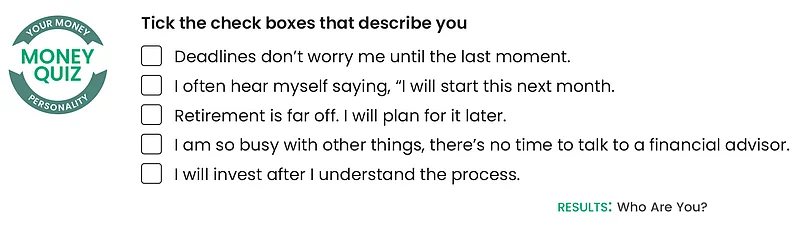

Your Superpower
You act only when you have done your homework and stay away from impulsive decision that could harm your finances
Your Blind Spots
Your long-term investment outcomes may suffer
You may miss investing opportunities because of delays
Decisions taken under pressure or at the last minute may not be the best