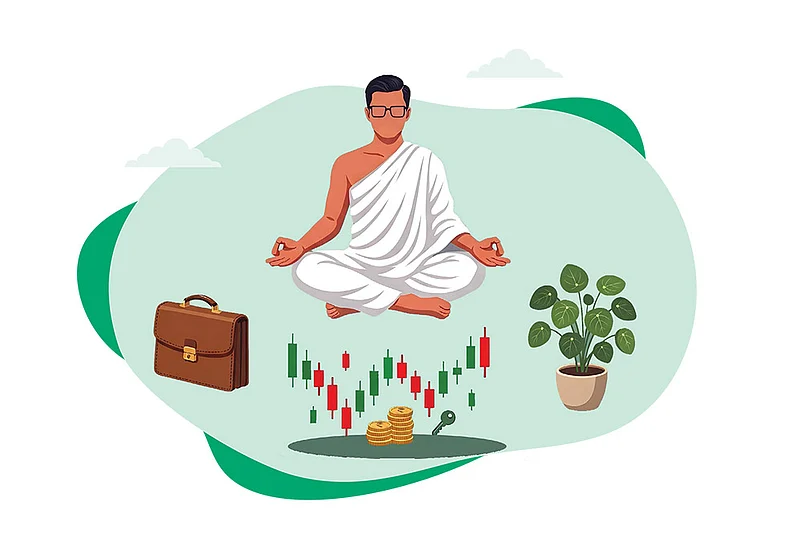

Finding a money monk may be rare in current times, but every now and then you spot a trending couple or individual, who chooses minimalism over excesses. You may identify yourself as a money monk if you view money simply as a tool to fulfil your needs comfortably, and not as a scorecard of success.
If you are a money monk, you are unlikely to lose sleep over having a bigger house, a newer car, or the latest gadget simply because others have them. You would rather have the freedom to spend time with family, pursue an interest, travel, help someone or simply enjoy a less stressful life.
That doesn’t mean you are anti-money or anti-ambition; you may simply not want your life to revolve around money and treat it as a measure of success.

1 October 2026
Get the latest issue of Outlook Money

What Works
Your biggest strength is knowing the difference between what you need and what you want. Focusing on needs can inculcate financial discipline, the bedrock of creating wealth, which ironically may not appeal to you. Since you are unlikely to indulge in excesses and avoid wasteful expenditure, you are also likely to fulfil all your goals. Your ability to resist lifestyle inflation can help you avoid unnecessary debt.
Once your needs are taken care of, you are likely to ask yourself: “What can this money do that is more meaningful?” That could mean supporting your family, travelling, pursuing a passion, helping someone in need, or backing a cause you believe in.
The world needs people like you as you are likely to apportion a part of your income towards helping others.
What Doesn’t
Your love to lead a simple life can sometimes make you overlook the need to plan for the not-so-simple moments. You may feel that you don’t need to build a large corpus, only to realise later that greater financial independence could give you more freedom and peace of mind.
There could also be a gap between what you consider “enough” and what your family wants. Your spouse or children may have bigger dreams and constantly asking them to live by your minimalist philosophy could lead to friction.
Also, while following a minimalist style may feel perfectly fine today, you may wonder later whether you gave up too much—be it travel, comforts, experiences or simply the freedom to spend. Strong conviction will matter, especially if you choose a lower-paying job or profession to follow your ideals.
What Should You Do?
You can be successful if you get one thing right: the “enough” number.
Says Sougata Basu, founder and chief executive officer, CashRich, a wealth management platform: “But enough today is not enough for 30 years of retirement. Medical inflation runs well ahead of general inflation. And here is the part most people miss: a retirement corpus must hold equity to beat inflation, yet you are withdrawing from it every month. A major market crash early in retirement can permanently damage a corpus you cannot rebuild.”
Minimalism is a personal choice, not a family policy. Says Basu: “Three goals stay non-negotiable regardless of philosophy: children’s education, the spouse’s financial security and health insurance for everyone. Fund the family’s shared goals first, fully and visibly. Then live as simply as you wish within your own share. A monk who leaves the family underprepared has only postponed a harder conversation.”
Among the thousands of families, this tension shows up often. One earning member embraces minimalism, while the spouse quietly worries about the children's education fund and other expenses.
Sequence matters more than allocation. First, go for a cushion of 12 months of expenses. Second, long-term savings for retirement because no one else will fund your old age. Only then should the surplus flow to causes and experiences.
Suggests Basu: “Once the cushion and retirement investments are on track, split the surplus in a fixed ratio, say 70 per cent to long-term investing and 30 per cent to giving and experiences.”
In short, ensure you know what’s “enough” for your and your family's goals. You can easily do that while practising minimalism, but don’t give up on a job and profession too early until the number is enough.
sanjeev.sinha@outlookindia.com