Bull markets make most mutual fund returns look good, but it is during volatile and uncertain times that the strength of a fund, the ability of a fund manager, and the resilience of the investment process is truly tested. The current challenging market environment, therefore, is the right time to assess if your funds are on course.
However, a top-performing fund can become a laggard for several reasons, and not just the markets. The OLM 50 list of funds is a curated basket, which includes only those schemes that prove themselves not just on performance metrics, but others, such as the fund manager’s track record and the quality of securities. We launched the list in 2022 and have been doing an annual review ever since to make sure the list has funds that can stand the test of time and different market conditions.
How OLM 50 Performed

1 July 2026
Get the latest issue of Outlook Money

With heightened market volatility, fund managers are finding it difficult to contain the damage in their portfolios but the schemes in the OLM 50 list have largely proved their mettle. The blips you find could be because fund managers cannot beat the benchmark and peers in every market cycle.
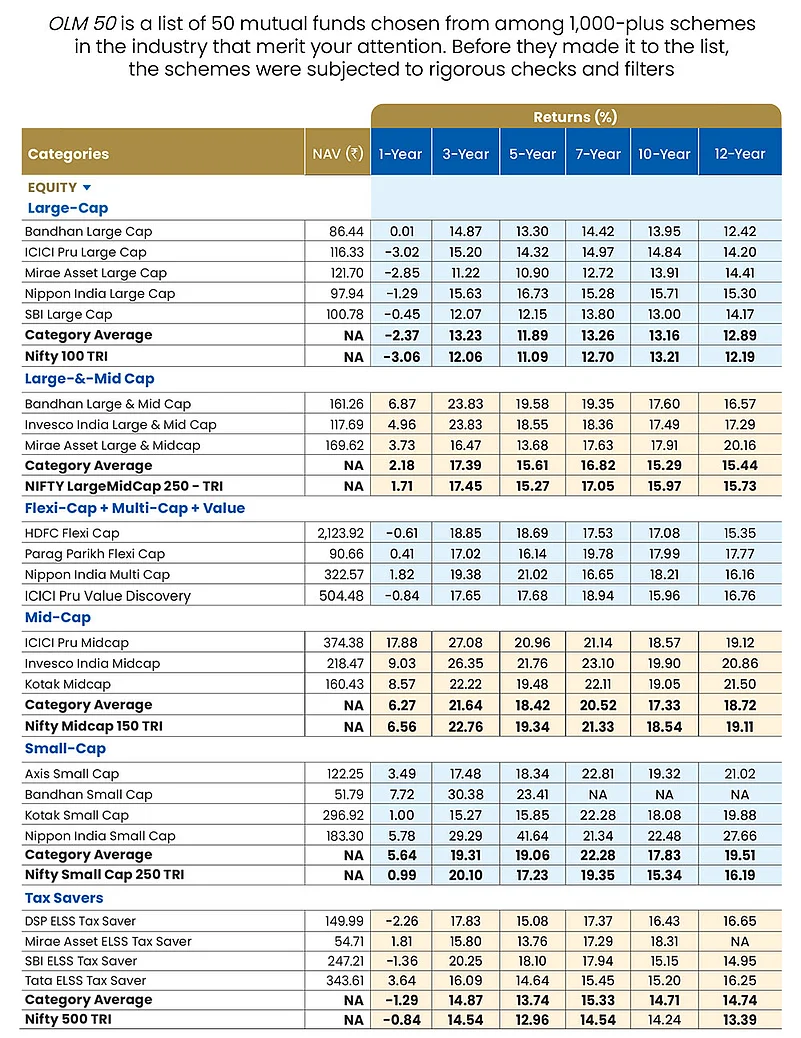
Large-cap funds, which typically invest in the top 50-100 stocks by market capitalisation, are facing the maximum heat, on the back of selling by foreign institutional investors (FIIs) in the last one-and-a-half years. While the Nifty 50 Index-TRI fell 6 per cent, the average returns from large-cap funds of OLM 50 was -1.59 per cent, better than the category average fall of -2.37 per cent.
Domestic inflows have provided a cushion to mid- and small-cap segments. Almost all the funds in these categories managed to beat the category average returns and their respective benchmarks.
The Nifty Mid Cap TRI index gave 6.51 per cent over the last one year, but the average returns from OLM 50 mid-cap funds was 3.12 per cent during the same period. Out of the four schemes in OLM 50’s small-cap category, Axis Small Cap and Kotak Small Cap underperformed the benchmark and category returns in the last one year. However, they stay in OLM 50 as the list is not just about performance. There are no issues with the schemes in terms of fundamentals or other parameters.
In the flexi-cap category, both the schemes do not just cross our parameters again but have also retained their five-star Morningstar ratings.
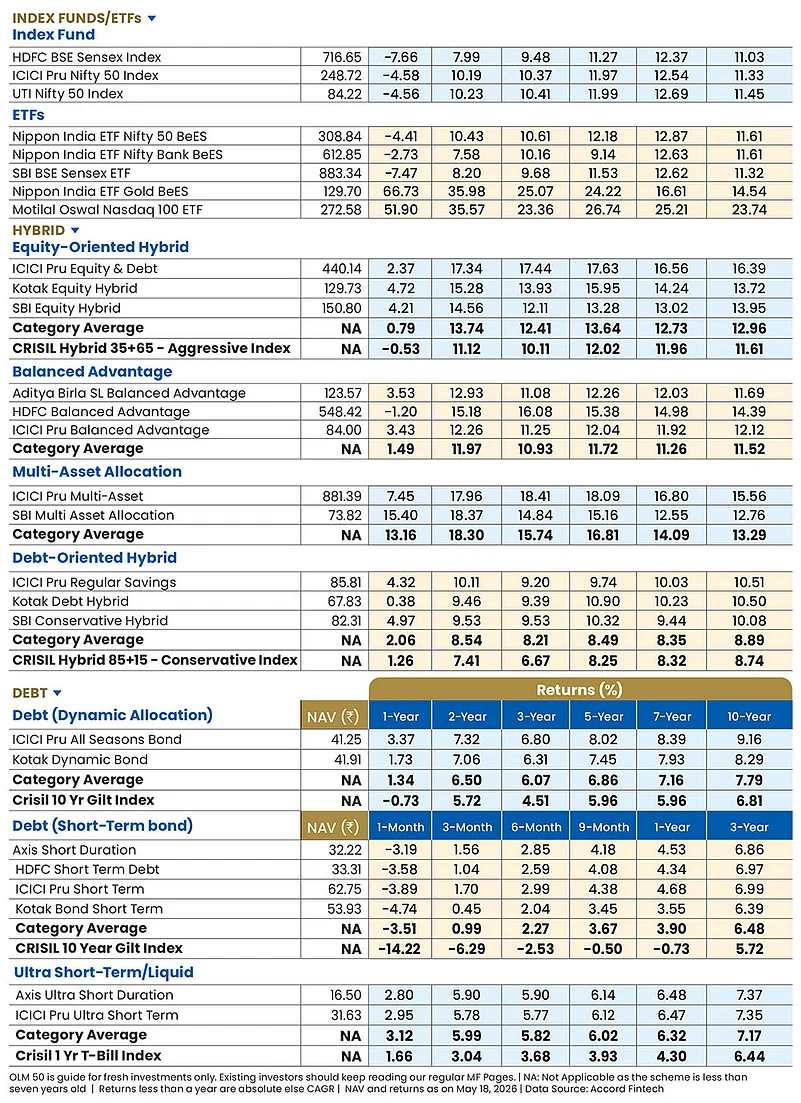
In the hybrid category, most of our schemes outperformed their peers. One scheme which unperformed the category was HDFC Balanced Advantage Fund but that’s because it has aggressive equity exposure. Historically, this fund remains high on equity as compared to its peers. This makes it susceptible to falls during volatile periods, but it’s also positioned to recover faster than its peers when the markets move up.
In the debt space, most of the funds fared in line with their peers. Investors, however, need to be very careful about selecting a debt fund. The current geopolitical situation has created volatility not only in equity, but in fixed income, too. Bond yields have witnessed some pressure, with the 10-year government bond yield moving higher due to rising crude prices and inflation concerns. Also, concerns around below-average rainfall due to El Niño conditions may keep food inflation elevated in the coming months. Against this backdrop, experts believe that there will be considerable volatility in interest rates going forward.
Also, not all debt funds are safe. Investors must choose schemes from debt fund categories that are in line with their investment horizons and risk appetite. For instance, for parking emergency funds and money needed in the near future, we recommend liquid and ultra short term funds as they are less risky.
What Has Changed?
We have made slight changes in the list. Six schemes have been replaced in the list (see Arrivals And Departures).


Just because a scheme is leaving the OLM 50 list doesn’t mean it is bad or that you should exit it immediately. Some have been replaced just because a better scheme was available in the category. One of them, Kotak ELSS Tax Saver, has exited because we were creating space for the multi-cap category. With the new tax regime becoming more popular, equity-linked savings schemes (ELSS) have lost their tax deduction edge.
You can continue investing in the exiting schemes if they fit into your overall asset allocation. Or you could pause them and start new investments in a better scheme. If you withdraw, you will lose some money in taxes.
However, keep reviewing the scheme. Exit if you spot major problems in the fund management style and predict instability in the future. According to our research, most of the schemes have been replaced only because we found better options.
Methodology
The OLM 50 basket of 50 funds has been chosen after much care and deliberation. The cut-off date for our analysis was March 31, 2026, and we have considered categories defined by the capital markets regulator, the Securities and Exchange Board of India (Sebi). We have only considered direct growth plans. Accord MF database was used for all the data and analysis.
Filters
We used two filters to reduce the number of funds. We have only taken schemes with assets under management (AUM) of at least 10 per cent of the respective category’s average corpus. If the category average AUM was Rs 1,000 crore, we did not consider schemes with an AUM size of less than Rs 100 crore in that category.
The other filter that we used is the number of years considered for the performance track record. We have only taken funds that have at least three years of track record.
Parameters
Equity and Equity-Oriented Funds: Equity funds were evaluated on three key parameters: risk-adjusted returns, downside risk and the fund manager’s stock-picking acumen. We considered these keeping in mind the retail investors’ risk-averseness and the fund manager’s ability to deliver returns.
We also considered the fund managers’ track record. For this, we evaluated other schemes under the fund manager to ensure consistency of performance and strategy. For those who started managing funds only in the last one year, we evaluated the past track record using funds they managed in previous stints.
Debt and Debt-Oriented Funds: For these categories of mutual funds, we evaluated schemes on the basis of risk-adjusted returns and credit quality (the score of investments in sovereign plus AAA/P1+ rating was evaluated and given due weightage) for three years. These ratings stand for high safety and less risk.