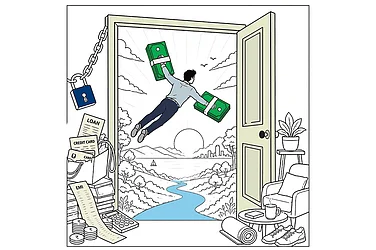

When British circumnavigator Captain James Cook travelled on long voyages, scurvy was the scourge of the sailors. According to historian Stephen Bown, scurvy was responsible for more deaths at sea than storms, shipwrecks, combat, and all other diseases combined. Cook observed that scurvy disappeared on (probably Dutch) ships that served sauerkraut daily. So he decided to load that on his ship. Unfortunately, his sailors refused to eat it.
Here’s what he documented in his journal: The men would not eat it. So I ordered it daily for the officers’ dining table and encouraged them to eat it. The moment the seamen saw their superiors set a value upon it, it became the finest stuff in the world.
Human behaviour does not change. Centuries later, even in different circumstances and scenarios, we still conduct ourselves in a similar fashion.
3 September 2026
Get the latest issue of Outlook Money

We Want, Because They Have
We tend to ape those we aspire to be. Whether it is the cheese we buy, the alcohol we drink, the clothes we wear, and the restaurants we frequent. I don’t think I can say it better than Benjamin Franklin: “It is the eyes of others and not our own eyes that ruin us. If all the world were blind, except myself, I should not care for fine clothes or furniture.”
Our desire is rarely independent, or purely authentic. Very few people question why they want the things they want at all.
The issue is NOT that we have possessions or have more than our parents; the issue is we link our self-worth to them
Economist and author Tim Harford tells of an experiment done in the US and Hong Kong of ordering speciality beers. It probably carries over to all kinds of food, fashion, and who knows what else.
The people who ordered first affected the decisions of the people who ordered later. In America, the people who ordered later would try and avoid duplicating what had already been ordered. They felt that they shouldn’t copy what had gone before. In Hong Kong, you got the reverse. People tried to copy what the first person ordered.
Both are socially conditioned. In both cases, they ended up not liking their choice as much.
Why Are We So Insecure About What We Want?
American Canadian venture capitalist Chamath Palihapitiya’s statement about accumulating possessions because we are insecure got everyone in a tizzy. He said in a podcast: “Possessions are bull****. They are worthless. They are a sign of insecurity, a rampant ego and an unsettled mind.”
When Palihapitiya was referring to possessions, he was operating in a completely different league— his indulgences were designer watches, luxury cars, a private jet and becoming an NBA owner. His possessions were wildly vivid status symbols. But all humans like to possess stuff. At one time, I was into pots and jars. Then I was fascinated with collecting teapots. The phase lasted for two years, and then faded away. Now I am into minimalism and barely own anything.
We wax and we wane in our attitude towards possessions as we go through life. Clearly Palihapitiya has evolved and now views possessions as a distraction from what he truly cares about: building and creating things. But while his statements had some truth to it, I found them harsh.
When you lack conviction about what you want from life, you will always default to the lowest common denominator
Possessions are what we appreciate. They bring beauty to our lives, and maybe even convenience. They reflect our personality, interests, beliefs, aspirations, and communicate that to the world. They could also hold tremendous sentimental value and form a part of our legacy.
The issue is NOT that we have possessions; the issue is NOT that we may have more possessions than our parents; the issue is when we link our identity and self-worth to them, when they begin to define who we are.
Wrong Q: Are Possessions Bad?
Right Q: What Is Your Relationship with Possessions?
The immediate fallout of basing our identity on possessions is that we judge our worth relative to society. It means that the world will decide what the trappings of success are and our definition of success is shaped accordingly. It becomes a means to cement our standing in society. It is a status symbol that screams “accept me” or “I am better than you”. It becomes an expression of how we are perceived. This is where we cross the line to our possessions owning us.
Human identity is complex and shaped by values, beliefs, experiences, relationships, passions, and personal histories. One’s character, morals, actions, and the way they treat others are what has a more profound impact on society. Possessions come and go. They may break or get stolen. They may no longer have the allure they once had. They are replaceable.
When possessions are what we are impressed with, we subconsciously gravitate towards certain people we want to fit in with, and avoid others. In the bargain, we miss out on engaging with many interesting, beings who have unique life stories. The lesson we should all always bear in mind is: People are not reducible to the things they own.
What Do We Do About It
Harford has a suggestion. Of course, it is in response to the beer experiment, but the lesson is priceless.
He does not want to be affected by the decisions other people make. Neither does he want to spoil their meal by ordering first and then having them avoid what he has chosen. So he decides what to order from the menu by relying on what he desires to consume at that point in time. He makes up his mind only taking his preference into account, but orders last, so as not to influence anyone. And once he decides, he does not change his stance based on what others have ordered.
Even if you hate beer, there’s something to learn from Harford. Question why you want the things you want. Let your desires truly stem from within.
When you lack a strong conviction about what you want from life, you will always default to the lowest common denominator, which is comparison with others and what society deems fit. Are the rich folk in your neighbourhood, family, or professional and social circle, your frame of reference? Your reference point should never be the earnings or lifestyle of another. What they do, what they own, and how they live is no concern of yours. What makes them happy may be burdensome to you.
You must figure out what will make your life meaningful. What your dreams are for yourself and your family. Your money must buy you your unique and personalised standard of living. Decide what you want from life—be it experiences or possessions, and then aim to get there financially.
By Larissa Fernand, Behavioural Finance Expert