
When you are out buying a house you want to make your home, what primarily matters is the location and infrastructure around it, the suitability of its size according to your family needs, the construction quality and the price appreciation potential. The parameters, however, change slightly when you buy a house for investment purposes; the price appreciation and income generation potential take centrestage.
For a while, the studio apartment was the shiny new idea. A smaller ticket size, easy maintenance, and the promise of attractive rental income made these compact units perfect investment opportunities.
Over a period of time, they took the shape of serviced apartments catering to single employees coming to work in cities away from their hometowns, with their lives packed in a suitcase. Simply put, a serviced apartment is one where you buy a property and pay for a service provider who takes care of furnishing it, renting it out, and maintaining it, and shares the profit with you.

1 October 2026
Get the latest issue of Outlook Money

It is this idea of serviced apartments that appears to be gaining ground now, not just for the studio apartment format, but also for larger flats.
The underlying demand for serviced apartments is strong, as corporate travel, medical tourism, relocations, and extended stays provide a genuine market for managed accommodation, as how people use accommodations is changing.
The concerns are different though. One, the sales pitch often puts the return first and the risks much later. Two, the buyer often doesn’t know what he or she is buying into, as usually they are commercial or hospitality-linked assets.
The Irresistible Pitch
The proposition sounds good. Buy a unit, let a professional operator manage it, and earn regular income without worrying about finding tenants, collecting rent, or maintaining the property. When developers add a recognised hospitality brand, high occupancy estimates, assured returns, and the promise of capital appreciation, the investment can begin to look almost irresistible.
Saurabh Garg, co-founder and chief business officer of NoBroker, a real estate tech platform, says the most common offer is an assured annual return of around 10-12 per cent, particularly in Noida and Greater Noida, although some projects advertise returns as high as 18 per cent. The guaranteed rental payment is generally made on a monthly basis, often until possession and sometimes for another 2-3 years after possession. After that, the return depends on what the operator generates as revenue or profit share.
The investor is promised two sources of wealth creation: income during the holding period, and appreciation when the property is eventually sold. Some projects may also come with a bank guarantee or a buyback assurance
Buyers may also be told that a reputed hospitality operator will manage the property and occupancy will remain high, which will ensure the owner receives regular rental income after possession. Then comes the bigger kicker: capital appreciation.
In short, the investor is promised two sources of wealth creation: income during the holding period, and appreciation when the property is eventually sold. Some projects may go a step further with a bank guarantee or buyback assurance.

Evaluate The Pitch
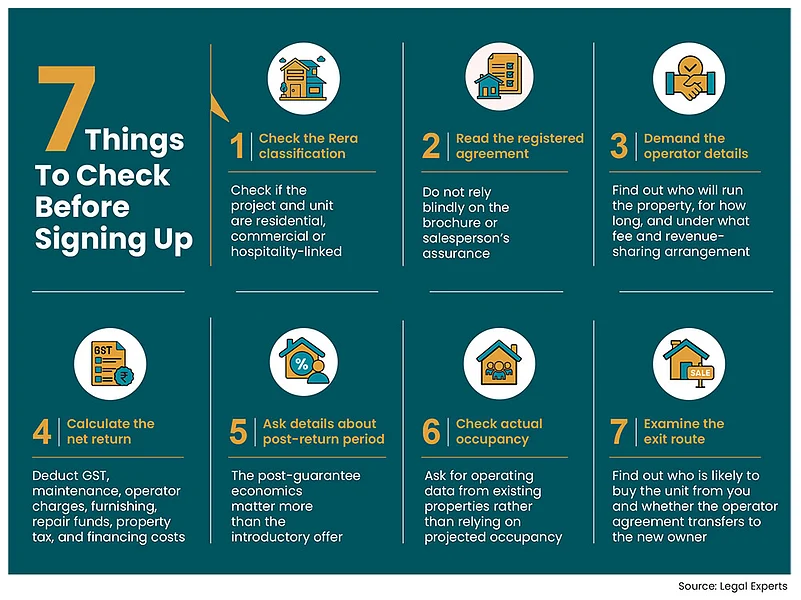
All that sounds good, but not everyone talks about the risks upfront. As a buyer, you must seek answers to some critical questions.
What Is the Property Classification? The first question a prospective buyer should ask is not “What is the return?” but “What exactly am I buying?”
The property may not be the house you think it is, which is one of the biggest potential traps. A unit described in a sales presentation as an “apartment” may actually be a part of a commercial project.
Garg points to instances in Greater Noida where projects selling “studio” units were registered as commercial and offered shops alongside. In some cases, the assured-return promise appeared in a second letter rather than the Real Estate Regulatory Authority (Rera) agreement.
That difference matters because a commercial property is not financially equivalent to a residential apartment. The goods and services tax (GST) treatment, financing terms, taxation, and ongoing costs can differ. Garg says that under-construction commercial units can attract 12 per cent GST, while the financing structure for commercial property is also generally less favourable than it is for a residential one. Home loan benefits available for residential property may not apply in the same way to commercial purchases. Banks may finance a lower proportion of the value (50-80 per cent) and for shorter tenures (10-15 years).
There is another practical difference: an investor cannot treat the unit like an ordinary flat.
Buyers should check whether the project is registered as residential, commercial or another category, and whether the specific unit being sold is clearly identifiable. The state Rera website should be the starting point.
Are You Buying Into A Business? Few owners realise they are entering a business deal. Says Shankey Agrawal, partner at BMR Legal, a boutique law firm: “Serviced apartments add another layer, as the buyer is also sold a service model (along with the property).” That model can involve a hotel operator, rental pooling, housekeeping, concierge and revenue sharing. “The mis-selling allegation in serviced apartments is not only about the nature of the unit, it is also about the business model sold to the buyer,” he adds.
That distinction is crucial. In a serviced apartment, the buyer is effectively taking exposure to an operating business, which has its own risks.
Will You Be Stuck With the Operator? There may be a binding agreement with the operator. They may control pricing, leasing, housekeeping, as well as use of the property. The buyer may not be free to move into the unit, find an independent tenant, or change the operator at will.
A serviced apartment is only as good as the business operating it. Yet the operator is sometimes the least examined part of the sales pitch.
There are some important things to keep in mind here: Who is the operator? Has the agreement actually been signed? How long does it run? What management fee does it charge? How is the revenue shared? Who pays for furniture replacement and major repairs? What happens if the operator leaves?
Says Asha Kiran Sharma, partner at King Stubb & Kasiva, a corporate law firm: “Rera requires extensive disclosures about the project, including title, encumbrances, sanctioned plans, layouts, timelines and unit details. But the operator agreement—the private commercial contract that may determine how the property is managed, what fees are deducted, and how owner income is calculated—is not a document that buyers routinely see.”
Will Income Generation Work In Tandem? The promises of assured returns, high rental yield, high occupancy, and capital appreciation may not all work at the same time. For instance, a property may appreciate without producing a high rental yield; a hotel operator may generate revenue without guaranteeing what the individual unit owner will earn, or occupancy can be strong for a project without ensuring that every rupee of revenue reaches the owner.
A buyer should obtain a complete cost sheet, including GST, stamp duty, furnishing, maintenance, repair funds, as well as the operator’s share; then calculate the return taking these costs into consideration before investing
What Happens After The Guaranteed Period Ends? An assured payment until possession can make the investment appear to be generating income even though the property has not yet begun operating. Once possession is given and the guarantee expires, the buyer is exposed to the real market—actual occupancy, room rates, operator performance, and local demand.
A project can, therefore, look attractive before completion and considerably less attractive once it has to generate operating income.
Question The Returns
There is much more to question on the returns front.
Is It Legally Assured? A fixed payment can only be as reliable as the legal and financial mechanism behind it.
Garg says buyers should check whether the promised return appears in the registered sale agreement or merely in a separate document. “Enforcement becomes significantly more difficult if commitments are not incorporated into the registered agreement,” he says.
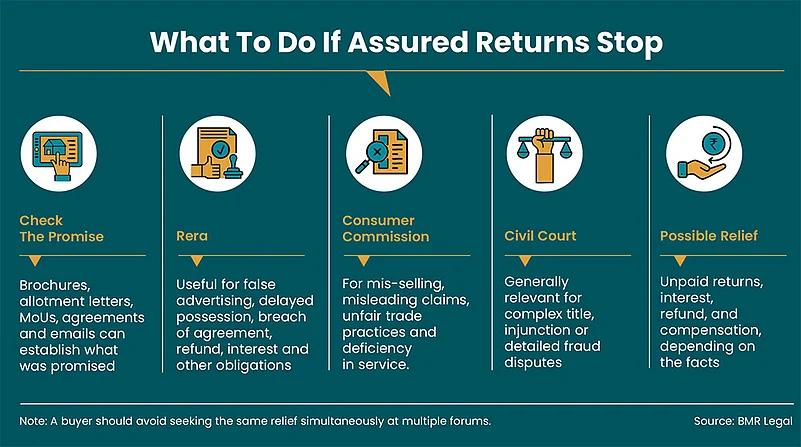
A brochure, email, WhatsApp message or allotment letter can be valuable evidence of what was represented to the buyer. But if the headline promise of a 10-12 per cent return disappears from the principal agreement, the buyer may face a more complicated legal battle when the payment stops.
However, anything outside the final agreement is not automatically worthless. Says Sharma: “Indian law may address such conduct through several routes, including misrepresentation under contract law, unfair trade practice, or misleading advertising under consumer law, and provisions under Rera relating to false statements in advertisements or prospectuses.”
The key issue is what was represented, what induced the buyer to invest, and whether the promised benefit was actually supported by the project documents and underlying arrangements. The courts and consumer forums have repeatedly shown that marketing material cannot be simply dismissed as meaningless sales talk.
In Pioneer Urban Land & Infrastructure Ltd. v. Govindan Raghavan (2019), the Supreme Court held that one-sided clauses in apartment buyer agreements can amount to an unfair trade practice. “The judgment is important because a developer cannot necessarily rely on the fact that a buyer signed a contract when the terms were heavily one-sided,” says Sharma.
Another example is Prem Lata Garg v. Shreeniwas Cotton Mills, where the National Consumer Disputes Redressal Commission (NCDRC) dealt with representations made in marketing material for the World One project in Mumbai. The Commission found misrepresentation and unfair trade practice, and ordered a substantial refund with interest.
More directly relevant is a January 2026 NCDRC ruling in Chandra Prabha Sharma & Anr. v. Imperia Structures Ltd. The case involved buyers who had booked a studio apartment in Greater Noida after being promised assured rental income. The developer argued that the buyers were investors, and therefore, had no consumer remedy. The NCDRC rejected that reasoning, holding that merely earning rental income from a single apartment did not automatically make the transaction a commercial activity.
Says Agrawal: “The message for buyers is clear: preserve the pitch. Keep the brochure. Save the WhatsApp messages. Keep emails, booking forms, allotment letters, memorandum of understanding (MoU), payment receipts, possession papers, and every document relating to the operator and rental arrangement.”
Do Returns Include Cost?
The quoted return may be calculated before GST, maintenance, furnishing, operator charges, revenue sharing, repair funds, property tax, and other expenses.
Garg says a buyer should obtain a complete cost sheet before investing. That should include GST, stamp duty, furnishing, maintenance, repair funds, and the operator’s share. The investor should calculate the return after taking all these costs into account rather than relying on the number quoted by the salesperson.
One of the mistakes that an investor can make is to compare the headline assured return with the rental yield of a conventional residential property
Maintenance can be particularly significant for small units. A 300 sq.ft studio may require much of the same building infrastructure—security, lifts, common areas, and staff—as a larger apartment. There may also be compulsory furnishing packages and periodic refurbishment, or repair costs. Maintenance is distributed over a larger number of apartments, while refurbishing is usually done by the operator.
Is Return Equal To Yield? One of the biggest mistake that an investor can make is to compare the headline assured return with the rental yield of a conventional residential property.
Garg says a Rs 50 lakh studio flat earning Rs 20,000 a month generates roughly 4.80 per cent annually before costs. Yet investors may be presented with assured returns of 10-12 per cent. The gap, he says, may effectively be built into the purchase price rather than being generated by the property’s actual rental economics.
That is why the question should not be “Is 12 per cent guaranteed?” It should be: “12 per cent of what, for how long, and after which costs?”
Buyers usually sign up based on a headline return without seeing the agreement that may limit it. “In the absence of a specific Rera disclosure requirement, buyers largely have to rely on broader contract and consumer-protection laws if a material fact was withheld or misrepresented,” says Sharma.
The Exit Risk
The exit risk often gets buried beneath the promise of entry-level returns. However, the problem can surface at the time of resale.
Says Garg: “A normal residential apartment has two broad pools of potential buyers: people looking for a home and investors looking for rental income or appreciation. A commercial serviced apartment is largely dependent on the investors. The next buyer may also face tighter financing conditions and higher borrowing costs.”
Also, the value of the unit may be closely linked to the operator contract. If the operator walks away, or the project performs poorly, the resale value may suffer.
Garg also cautions that “virtual” units—where the buyer is effectively acquiring a share of a floor rather than a clearly demarcated apartment—can be particularly difficult to sell independently.
A serviced apartment may look like a property purchase. But if the reason you are buying it is a promised monthly return, you are also taking a bet on an operating business. So look beyond the marble lobby, the hospitality brand, and the attractive yield printed in the brochure before investing.
sanjeev.sinha@outlookindia.com