Some people say they have money, so they will spend. Some others take it further: they say they don’t have money, but will spend by taking loans. Their philosophy is, there is only one life and it has to be enjoyed, either with own money or borrowed money. However, debt multiplies and gets you into a trap, which means you earn to pay your equated monthly instalments (EMIs).
Though loan-providing institutions may have a guideline on the loan limit, such as 40 per cent of net-of-tax earnings as the EMI; consumers have other ways of piling up debt, such as using credit cards or taking loans from less-stringent non-banking financial companies (NBFCs).
Changing Philosophies
1 October 2026
Get the latest issue of Outlook Money

It is a matter of philosophy or approach to life. The ancient Indian word rin, which means debt, has a negative connotation. Any rin on you has to be repaid within your lifetime; otherwise, there will be consequences when you go to heaven. On the other hand, if your ancestor has left any rin for you, it is a burden on you and you have to repay it. The underlying philosophy is: enjoy life within your means.
The counter to this is modern Western philosophy. During the US subprime mortgage crisis of 2008, financial institutions in the US were bundling loans and selling off to people who had little or no ability to repay. The people availing of the loans were of the view that if they lose their job and cannot repay and their bank takes possession of the property, they will shift to a rented accommodation. The EMIs till the point they could pay, would be seen as rent in a sense. Here, the approach is less about emotional attachment to the house, which is different from the Indian emotions towards apna ghar (own home).
Arguments On Both Sides
The argument in favour of spending is that enjoyment is not just a matter of having money, but also a matter of age.
Suppose you were 20 years old in 2004 and your father had given you money to buy a motorbike, but instead of buying a bike you had purchased shares of Eicher Motors. In that case, the value of your money would have grown by thousands of times today. The counter argument is that riding a motorbike would not be as enjoyable, say at age 60—when you have enough money to easily buy a bike—as at age 20. The underlying philosophy is that money is not the only yardstick.
Having said that, people in their 20s and 30s falling into self-made debt traps is a reality today. The term ‘lifestyle’, which the dictionary defines as the way you lead your day-to-day life, has acquired a different meaning today. It includes the brand of mobile phone you use, the car you travel in, the club membership you have, the accessories, the work, and so on. There are apps designed to trigger dopamine release and make people feel happy about spending money. For example, approximately 70–80 per cent of high-end iPhones are purchased on EMIs or flexible financing, and only about 20–30 per cent of units are sold on upfront payment. Even 10 per cent of gym protein supplements are sold on EMI.
On the other hand, there is another relatively smaller segment of people who are postponing their purchases.
FIRE—Financial Independence, Retire Early—is a movement centered around aggressive saving and investing. The goal is to accumulate a corpus large enough that passive income from investing this corpus can cover your living expenses, allowing work to become a choice rather than a necessity. Or, there are some people who are unduly worried about their retirement. Delayed gratification is good as you are not driven by impulse. However, if you are sacrificing rather than postponing, then we have to come back to the motorbike example.
As an example, there is a 40-year-old person earning reasonably well who wants FIRE at age 45. S/he is saving and investing vigorously, and not falling for the lifestyle trap mentioned earlier. S/he wants to buy a car, can afford it, but is not doing so as the FIRE goal after five years is sacrosanct. Being a spendthrift is bad, but being frugal to the extent that it becomes an unnecessary sacrifice is not desirable either.

The Balance
You have to take a deep breath, argue with yourself, and prioritise. Is instant gratification important? Is having a financial balance in life important? Or is FIRE the ultimate goal? When you upgrade your lifestyle by buying a luxury car instead of a regular one, the associated costs, such as fuel and maintenance, increase as well. One expense leads to another, and the credit card keeps getting swiped.
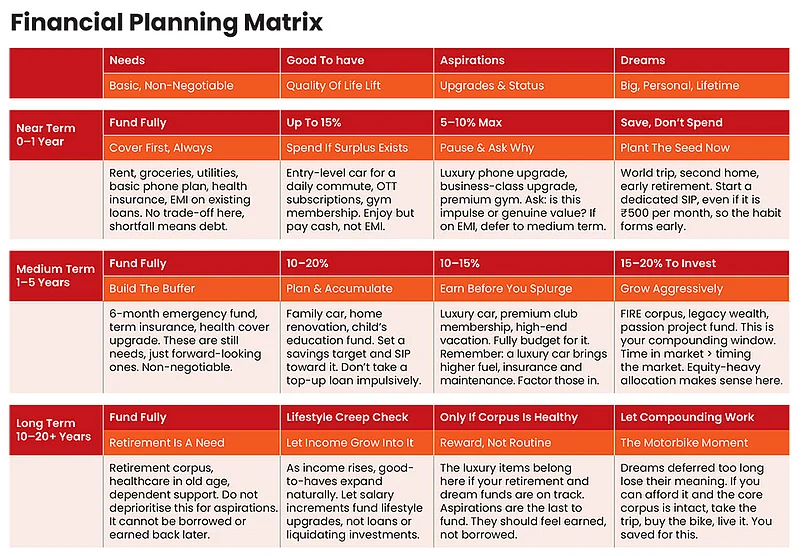
Put your priorities in a matrix. Put your expenses, current and future, in the respective brackets. FIRE may be an aspiration, but retirement planning is a need. Ask yourself, what is affordable at your current income level? Achieving your dream is a matter of time, so you need to pace yourself accordingly.
Once you have clarity on your priorities, you can place yourself better. So if you are in a debt trap, you not only need to pay the EMIs but also work towards prepayment by cutting back on aspirational spending. If you are at the margin, you can plan for your aspirations and dreams.
Conclusion
Gratification motivates us, and instant gratification feels better than delayed gratification. However, balance in life is as important. There is a saying: we spend money we don’t have, to buy things we don’t need, to impress people we don’t like or don’t know.
By Joydeep Sen Corporate Trainer and Author