The word spendthrift usually carries a negative connotation. Literally, it means someone who is careless about money and even wastes it. In a country where financial disparity is a reality, being a spendthrift could raise eyebrows even for people who can afford to be so without affecting their financial future. But for those who cannot afford to be spendthrift, being one or spending before thinking about the future can spell disaster and wreak havoc on their finances.
When It Doesn’t Matter
If you are a high spender and your income supports that lifestyle without eating into your savings, investments, or essential commitments, there’s not much of an issue unless there’s a moral dilemma involved. The Ambanis and Reddys of the world have been seen spending loads of money on weddings and lifestyle.
1 October 2026
Get the latest issue of Outlook Money

But not all of us can afford to do that. What matters, therefore, is not to view spending in isolation, but in the context of individual spending capacity.
Nilesh Gupta, professor of behavioural finance at the Indian Institute of Management, Nagpur, says, “The key thing is (to maintain) the spending-to-income ratio. If I spend a lot, but my spending is proportional to my income, I’ll survive.” As income rises, the proportion available for discretionary spending can rise too, he adds.
Travel, eating out, hobbies, shopping, and entertainment can all be part of a healthy financial life if they do not come at the expense of financial goals. “Spending money on things we want is not always bad,” says Ramesh Vishwanathan, CEO, Financial Planning Standards Board (FPSB) India. “The main thing is to spend money on these things after we have taken care of our needs and put some money away for later,” he says.
When It’s A Problem
The problem arises when you spend without realising that your earning today is also meant for your future.
There is a behavioural reason why the future can repeatedly lose the battle against the immediate pleasure that spending brings. Gupta says it is hyperbolic discounting, a tendency to heavily discount outcomes that are far away. “Outcomes that occur too far into the future tend to be heavily discounted, so we barely give them much thought today,” he says. Retirement is a classic example. For someone in their 20s, the benefit of saving for their 60s can feel distant and unimportant in the present.
The other problem arises when your spending is tied with identity and status. “If I take the absolute stereotypical person who is choosing everything because it may enhance their standing, their consumption is status seeking,” says Gupta.
Arijit Sen, a Kolkata-based Securities and Exchange Board of India-registered investment advisor (Sebi-RIA), says a common mistake is “treating income as the spending limit rather than the starting point”.
The Pitfalls
The problem can become a crisis when you resort to indiscriminate borrowing to maintain a lifestyle.
“Borrowing is actually consuming tomorrow’s income today,” says Gupta. If tomorrow’s income is expected to be higher and more stable, you may live with it, but a job loss, illness or another financial shock can remove the income against which today’s spending was planned. Says Gupta: “Imagine you have borrowed from the future to pay for your consumption in the present. But suddenly, there is no future income.”
Sen also points at the opportunity cost. Small, recurring expenses can be quietly damaging. Sen gives an example: an extra Rs 500 a day on eating out and small purchases can add up to nearly Rs 1.80 lakh a year. That money loses the opportunity to compound over the years.
What Should You Do?
If it’s an impulse you find difficult to get rid of, start with building a system that protects future goals before discretionary spending starts. Sen recommends automating savings. “’Pay yourself first’ works far better than trying to save whatever is left over, because for a spendthrift there is rarely anything left over.”
Vishwanathan cautions against relying entirely on willpower and advises setting limits, reviewing expenses, and creating a cooling-off period before an unplanned purchase can make discipline more sustainable. “A budget can tell you where to spend your money, but it cannot always stop you from making an impulsive purchase,” he adds.
Gupta believes recognising the problem is the first step. “Recognition of the problem is step one... but there has to be willingness to act upon it.” That willingness also requires being open to different opinions, and surrounding yourself with people who can challenge your behaviour.
You may need to try different approaches, seek help from financial planners or advisors and accept “trial and error”.
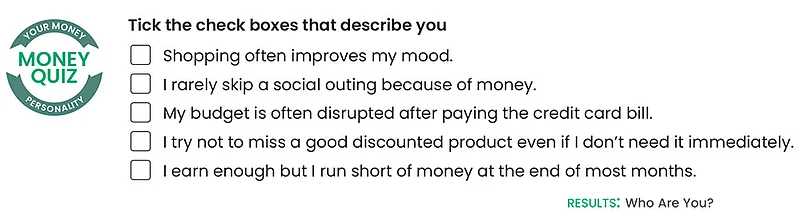

Your Superpower
You are carefree, easy-going and like to build on experiences and make memories
Your Blind Spots
You depend too much on regular income
Your ability to reach financial goals may be hampered by your spending pattern
You face the danger of falling into a debt trap