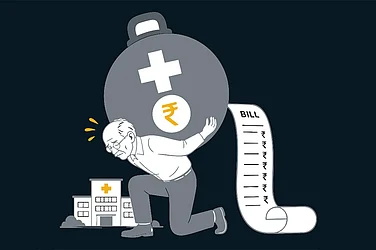
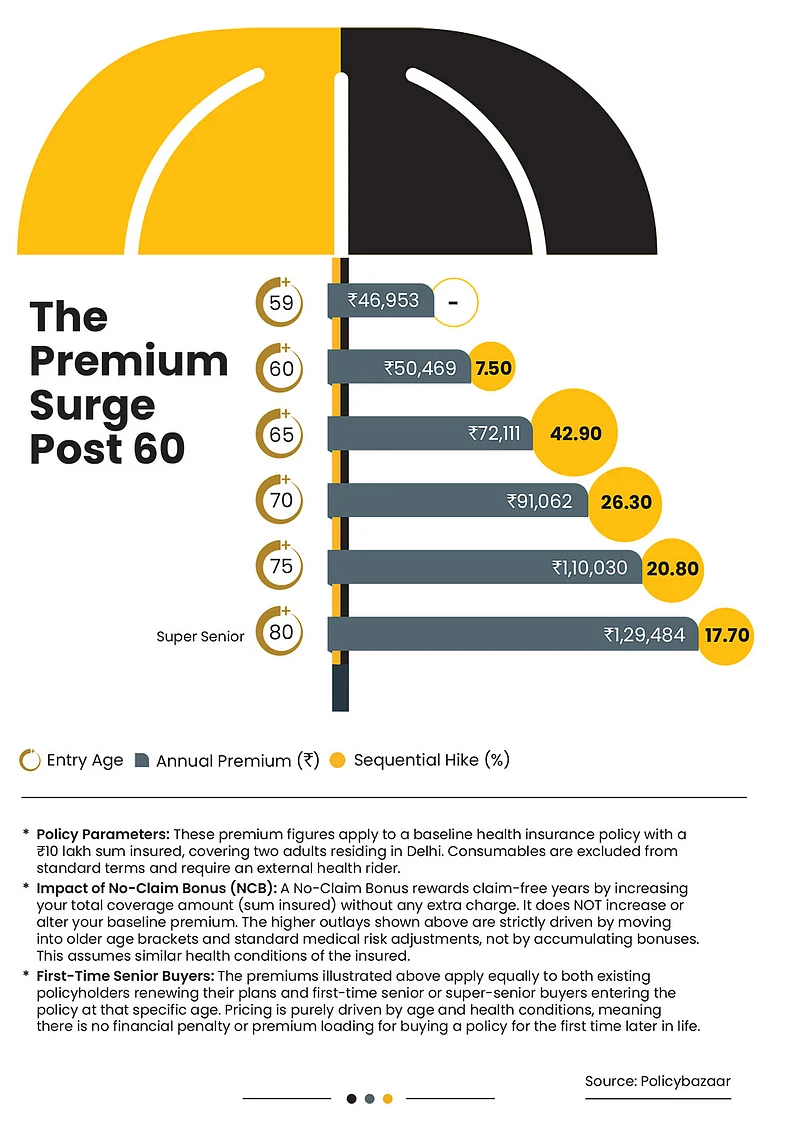
The high cost of health insurance for seniors is often the top reason why its uptake is low. The moment you cross 60 and go out to buy health insurance, you will find the premiums inhibiting and several restrictions coming into play on account of medical complications that typically arise in old age. Even if you have been renewing a regular health insurance policy since you were in your 20s, the premiums will still go up once you cross 60.
However, high costs or increased restrictions should not deter you from buying health insurance, as staying without it can prove to be costlier, given that chronic diseases are more common among seniors. According to the India Ageing Report 2023, published by the United Nations Population Fund (UNFPA) India in collaboration with the International Institute for Population Sciences (IIPS), over 30 per cent of elderly women and 28 per cent of men had one chronic morbid condition, and nearly one-fourth (across both sexes) had more than two morbid conditions.
According to The Longitudinal Ageing Study of India (LASI) 2021, around 75 per cent of elderly Indians suffer from one or more chronic diseases that do not have a permanent cure and require continuous care. These include diabetes, hypertension, hypotension, asthma, arthritis, as well as mental health conditions, such as depression, loneliness, and other age-related psychiatric disorders.

3 September 2026
Get the latest issue of Outlook Money

Unplanned medical expenses can severely dent your retirement corpus, affect your regular cash flow, and also force you to compromise on your lifestyle. According to a position paper published by Niti Aayog in 2024, titled Senior Care Reforms In India: Reimagining the Senior Care Paradigm, only 18 per cent of seniors are covered by health insurance and the mean out-of-pocket expenditure in private health facilities is Rs 31,933. It adds that health-related expenses are the most common cause of indebtedness (26 per cent) in urban India. According to the National Sample Survey (NSS) 2017-18, medicines alone account for nearly 70 per cent of out-of-pocket expenditure in non-hospitalisation cases.
What you need to do is play it right so that your health insurance policy remains affordable, ensures maximum coverage, and the sum insured you opt for stays abreast with the 14 per cent annual medical inflation rate.
Let’s look at the challenges you may identify with as well as the strategies that can help you overcome them. Some of these strategies will help you lower the cost of health insurance, while others will help you navigate the complex universe of exclusions to get maximum coverage.
If you still think regular health insurance is unaffordable, at least get registered for Ayushman Bharat coverage of Rs 5 lakh (see Is Ayushman Bharat Yojana A Complete Solution In Itself?, Pg 30).

The Ground Reality
Premiums Go Up With Age: Premiums go up with age for primarily two reasons. Says Siddharth Singhal, head of health insurance, Policybazaar, an insurance aggregator platform: “When individuals grow older, their health risk increases, which automatically makes them a high-risk profile. Second, premiums grow sharply once an individual crosses certain age bands (45-50, 50-55, 55-60, 60-65, 65+).”
For first-time buyers, the medical condition of the individual at the time of buying a policy can make a big difference to the premiums. Let’s take an example of two 62-year-old buyers seeking a Rs 10 lakh health insurance policy. One has no major medical condition, maintains a healthy body mass index (BMI), and has no history of hospitalisation. The other has diabetes and hypertension, is overweight, and underwent cardiac treatment a few years ago. Although both are of the same age and seek the same cover, the second buyer may need to undergo additional medical tests, may have a co-payment requirement and disease-specific waiting periods in the policy, as well as pay a higher premium due to underwriting loading.
Premiums may also vary depending on whether the buyer smokes, lives in a city where hospital costs are relatively high, or chooses features, such as no room-rent cap, restoration benefits, and a shorter waiting period for pre-existing diseases.
Singhal says the annual premium for a relatively healthy senior citizen below 70 years of age may start at Rs 21,000 for a Rs 5 lakh health insurance cover. “For a Rs 25 lakh coverage, the premium for a 60-year-old and a 70-year-old would be around Rs 35,000 and Rs 63,000, respectively,” he says.
Says Hari Radhakrishnan, spokesperson, Insurance Brokers Association of India (IBAI): “Senior citizens entering the health insurance market late suffer from two handicaps. First, they will have a higher base premium due to their age demographic. Second, senior citizens are likely to have some pre-existing health conditions. Hence, their premiums are subject to additional loading over and above the age demographic loading.”
Limited Coverage Or Exclusions: High premiums lead to another problem—lower cover. The premiums you may be able to afford will only get you a sum insured that may fall short in the face of a serious ailment.
But given the rising costs of surgeries and medical procedures, it is important to have adequate cover. In the example above, we have taken a sum insured of Rs 10 lakh, which may not be enough. For instance, a knee replacement may cost around Rs 2.50-3 lakh per knee in a private hospital, while a bypass surgery may cost about Rs 5 lakh. If a person needs to get both knees replaced and subsequently undergoes bypass surgery in the same policy year, the combined bill could reach Rs 10-11 lakh (actual costs will vary depending on the city, hospital, implant, room category and medical complications). Any amount beyond the available sum insured would have to be paid for by the patient.
If you are buying health insurance before 60, factor in the future cost of treatment—after 10 years if you are buying at 50, after 20 years if you are buying at 40, and so on. For instance, a surgery that costs Rs 6 lakh today could cost around Rs 22.20 lakh after 10 years, assuming an annual medical inflation of 14 per cent.
If you are buying health insurance before 60, factor in the future cost of treatment. A surgery costing Rs 6 lakh now may cost Rs 22.20 lakh in 10 years
Even if the sum insured is enough, there are restrictions related to insurance sub-limits and pre-existing diseases that lead to restricted coverage and out-of-pocket expenses. Insurance sub-limits restrict coverage of certain items to a certain amount. For instance, a sub-limit on room rent will cover that only till a certain amount, say Rs 2,000; if the room you choose or the only one available costs, say Rs 3,000, you will have to pay the difference. The problem with this kind of sub-limit is that hospitals peg other costs, such as that of surgery and tests to the room rent. So, in the example above, the difference will be much higher than the apparent Rs 1,000, depending on the procedures and treatments.
A pre-existing disease (PED) detected at the time of buying a policy will have a waiting period of 2-3 years, during which you cannot make a claim related to the disease. At an advanced age, insurers can even refuse to cover it or may choose to give a cover at a high cost.
Other exclusions could include daily medical and consultation cost for conditions, such as dementia or mental health issues that do not require hospitalisation.
Says Amarnath Saxena, chief technical officer - commercial, Bajaj General Insurance: “The waiting period, typically, ranges up to three years under current regulations, though some insurers offer add‑ons that may reduce it further, subject to underwriting, which shortens the waiting period by 30 days or even eliminates it in some cases.”
But some innovations have eased up the landscape. “Insurers today offer features such as Day 1 coverage for select illnesses and PED reduction riders that can reduce PED waiting periods, thus helping customers access coverage sooner,” says Singhal. But they come at an extra cost.
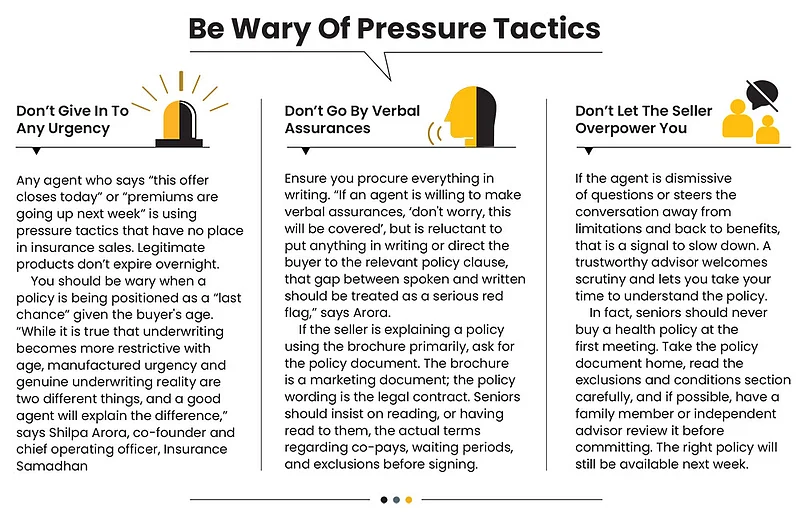
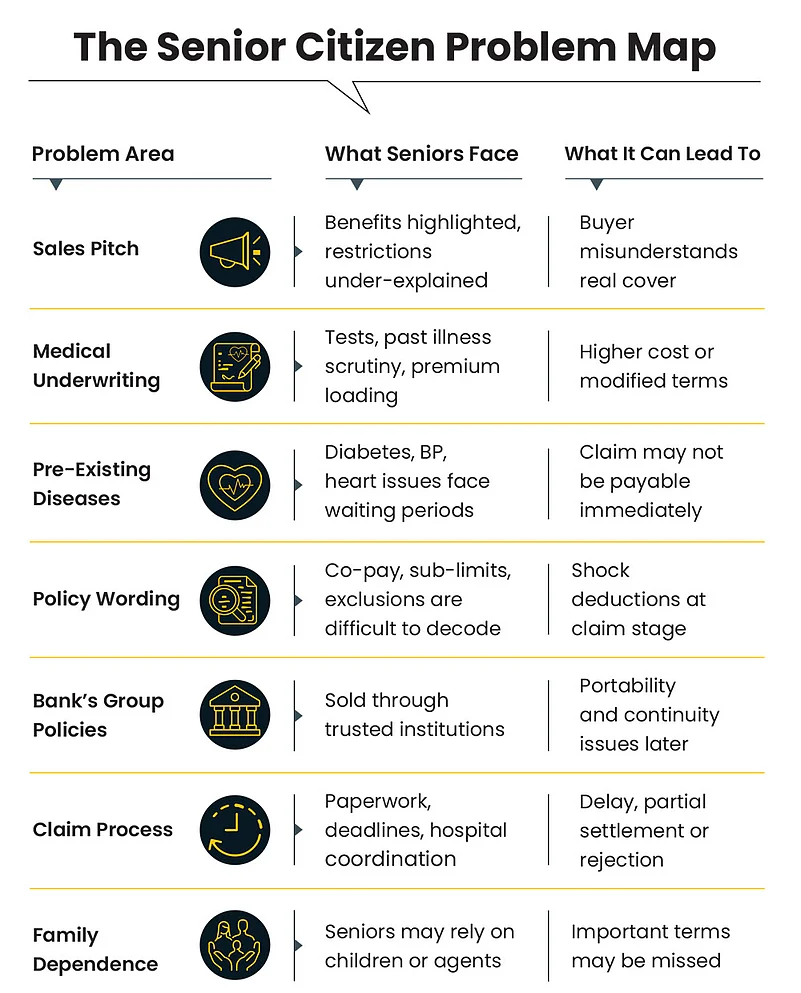
The Fine Print Gets Lost In The Sales Pitch: At the point of sale, agents or intermediaries often highlight the sum insured and premium, but do not always adequately explain co-payments, room-rent caps, disease-wise sub-limits, waiting periods, exclusions, permanent exclusions, and claim conditions. In some cases, policies may be sold as a broad or comprehensive cover even though important restrictions apply.
When Ankur Anand, a 32-year-old resident of Ranchi, Jharkhand, began looking for health insurance for his parents, Birendra Kumar Sinha, 61, and Poonam Sinha, 60, he bought a policy from a bank with which they had a 15-20 years relationship. He later realised that the health insurance policy didn’t have several important features.
Says Ankur: “It did not cover robotic surgery, which is important because many procedures in large hospitals today, such as knee replacement, may involve robotic surgery. Restoration benefit was also not there, even though my parents are diabetic and may need repeated hospitalisation.”
Both life and health insurance products can be complex, particularly for senior citizens who may be purchasing coverage at a stage when medical conditions and policy restrictions become more relevant. But regrettably, the most common cases of mis-selling are where the agents highlight selective features and leave out the complicated ones. “Agents tend to highlight what sells: cashless hospitalisation, the brand name of the insurer, and the breadth of the sum insured. What often goes unexplained or is glossed over are the conditions attached to these benefits,” says Narendra Bharindwal, president, IBAI.
Even exclusions and restrictions are often left out of the discussion.
Says Shilpa Arora, co-founder and chief operating officer, Insurance Samadhan, an insurance grievance redressal platform: “During the sales process, discussions often focus on parameters, such as the sum insured, premium, eligibility, and waiting periods. However, certain policy provisions, such as co-payments, room rent limits, disease-specific sub-limits, exclusions, claim procedures, and the impact of PEDs may not always receive the same level of attention or understanding.”
Anand adds that restoration benefit, room-rent limits, exclusions, sub-limits, pre- and post-hospitalisation cover, or how deductions are crucial details that need to be explained as they may matter at the time of claim.
At the claims stage, when families are already dealing with hospitalisation, paperwork, and tight timelines, discovering what’s not fully or partially covered can be an unpleasant, and sometimes an unmanageable, surprise.
Errors in proposal forms, incomplete medical disclosure, missing documents, or misunderstanding of policy terms can lead to delays, partial settlements, or outright rejection of claims.
Apart from incomplete information, be wary of other tactics some agents may use to seal the deal as quickly as possible (see Be Wary of Pressure Tactics).
Strategies To Buy Right
Balance Coverage And Costs: The first order of priority should be having enough sum insured to ensure your coverage is comprehensive. This may mean higher premiums, as mentioned earlier, but that can be balanced.
Though the Insurance Regulatory and Development Authority of India (Irdai) has capped annual premium renewal hikes at 10 per cent for senior citizen health insurance policies, you need to have the right strategy to ensure premiums are affordable for you.
First, you can get PEDs covered, but the trade-off may be higher premiums or conditions, such as co-payment, a deductible, or a disease-specific sub-limit. Under Irdai rules, a PED is one that has been diagnosed, or for which medical advice or treatment was received, during the 36 months before the policy began. If the insurer agrees to cover it, the waiting period cannot exceed 36 months of continuous coverage.
However, this does not mean every PED will be accepted under every policy. Insurers assess proposals according to their underwriting rules. Depending on the severity of the condition, they may offer cover on modified terms, suggest another product, postpone the decision, or decline the proposal.
A condition may remain permanently outside the cover when it is specifically listed as an exclusion in the policy or when the claim falls under a general exclusion. Buyers should distinguish between a waiting period, after which coverage begins, and an exclusion, under which the treatment or expense remains uncovered.
Says Dr Santosh Puri, head - retail underwriting, TATA AIG General Insurance: “While these features potentially increase out-of-pocket costs, they may also improve access to all health plans and lower premium costs over time. Be sure to take all of these factors into consideration with your unique health care needs.”
Second, adding a co-payment clause will reduce your premium as the risk to the insurer reduces, enabling you to opt for a larger sum insured. Co-payment is a clause where you agree to bear a part of the cost. “It’s all about balance. As we have seen, to keep premiums manageable, senior buyers often face ‘co-payment’ clauses, which means the insurer pays most of the bill, but you cover a small slice (10-30 per cent),” says Sarita Joshi, head of life and health insurance, Probus, an insurtech platform. Let’s understand through an example. If the total bill is Rs 5 lakh, and there is a 30 per cent co-payment clause, then the patient or the family needs to pay Rs 1.50 lakh from their own pocket.
Similarly, be smart about how you use deductibles. This is a fixed amount till which the insurance policy doesn’t come into play. So if your deductible is Rs 5 lakh, the insurer will not cover any hospitalisation or other cost up to that amount. The policy will trigger for the claim amount above Rs 5 lakh. So, for a Rs 8 lakh claim, the insurer will pay Rs 3 lakh.
Higher deductibles mean the health insurance will not be used for routine hospitalisation, and hence, insurers may offer economical premiums. Says S. Prakash, CEO, health insurance ecosystem and strategic partnerships, General Insurance Council: “Deductibles should be reviewed carefully as the policyholder must bear the deductible amount before insurance coverage becomes applicable.”
Even choosing a deductible of Rs 25,000-50,000 in a regular policy can make your premiums a lot lower, says Singhal.
You could use top-up or super top-up policies to cover the deductible amount that will enable you to get a large cover while keeping the cost under control. These plans trigger after a deductible.
You should choose a deductible equal to your base policy to avoid out-of-pocket expenses altogether. So, if your base policy gives a cover of Rs 10 lakh, you should opt for a deductible of that amount. This is especially useful for large claims involving procedures such, as liver transplants and bone marrow transplants, which can cost more than Rs 10 lakh.
Says Saxena: “These options are a cost‑effective way to enhance overall coverage, especially when paired with a base policy. In addition, many insurers provide customisable products and add‑on benefits, allowing customers to tailor coverage according to their comfort and requirements.”
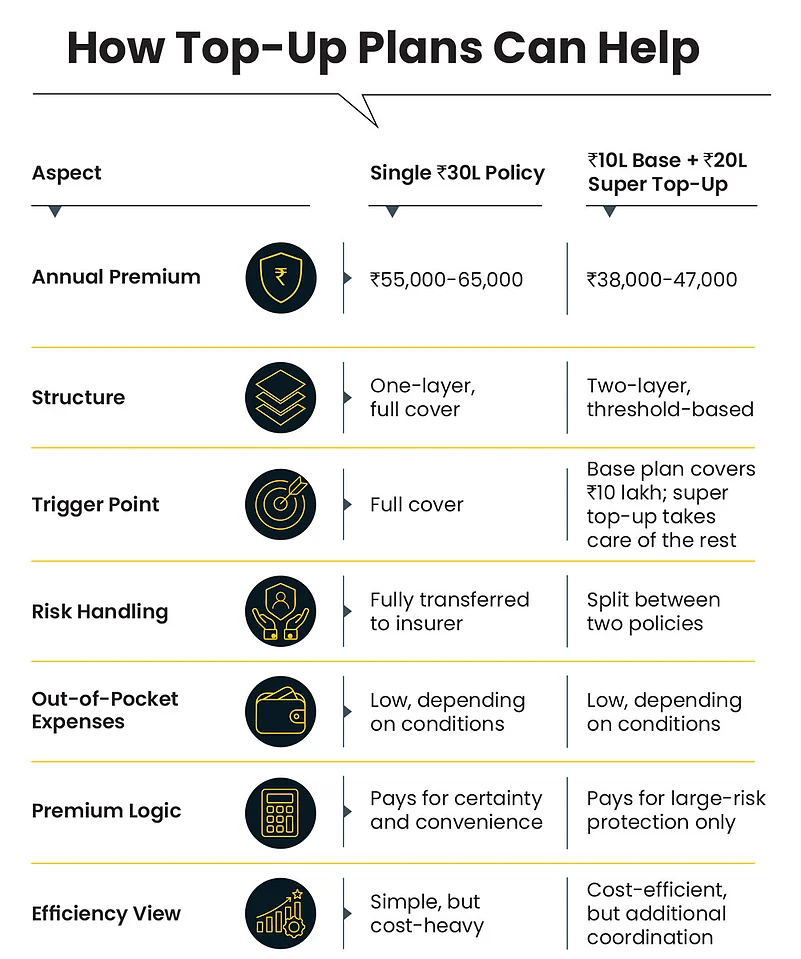
At present, a Rs 10 lakh base health plan for someone aged 60-70 typically costs around Rs 28,000-35,000 per year. If the same person were to buy a straight Rs 30 lakh cover, the premium could easily be Rs 55,000-65,000 annually, which is steep for most households.
An alternative is to combine a Rs 10 lakh base policy with a Rs 20 lakh super top-up carrying a Rs 5 lakh deductible. The super top-up may cost around Rs 10,000-12,000 annually, taking the total premium to approximately Rs 38,000-47,000. Based on these indicative figures, this structure may reduce the premium burden by around 25-30 per cent compared to buying a standalone policy of Rs 30 lakh. Since the deductible is Rs 5 lakh, the super top-up becomes available once aggregate admissible claims during the policy year cross this threshold, subject to the policy terms. Note that actual premiums will depend on the buyer’s age, location, medical history, insurer and policy features.
Top-up and super top-up plans are cheaper because the insurer covers claims above a certain threshold, lowering their risk exposure. For instance, if hospitalisation costs Rs 8 lakh, the base plan will pay for it completely, but if it is Rs 15 lakh, the top-up or super top-up plan will cover Rs 5 lakh that the Rs 10 lakh base policy won’t pay for.
Note the difference between top-up and super top-up plans and compare the prices. Top-up plans apply deductible for each claim in a year, whereas super top-up plans apply the deductible once a year for multiple claims.
Don’t Get Fixated On Low Premiums: Avoid making decisions solely on the basis of low premium. Says Prakash: “Choosing the lowest-cost product without understanding its suitability can sometimes lead to disappointment later. Health insurance should be selected based on healthcare needs, expected treatment preferences, and affordability.”
Also, make full disclosures of your medical history, lifestyle, and fill out other information required in the form, even if the seller discourages you, saying that certain disclosures like smoking and drinking might increase the premium. Full disclosure of medical history is critical, as non‑disclosure can lead to claim rejections.
A group insurance policy is another carrot that sellers dangle in the name of low premiums, but that’s usually a mistake. Pabitra Das, 77, a Kolkata-based policyholder, took a group health insurance policy through a bank because he found the premiums were more reasonable than that on a standalone policy. After a few years, the bank’s tie-up with the insurer that was providing the cover ended, and another insurer came into the picture. In the process, he lost the benefit of no-claim bonus that he had accumulated over the years. Also, when he tried porting the policy because the new arrangement didn’t provide the same level of benefits, he realised that was not allowed in group policies.
Be Clear About What’s Not Covered: Some policies may permanently exclude certain treatments or conditions, such as cosmetic procedures that are not medically necessary, infertility-related treatment, or treatment arising from substance abuse, depending on the policy wording. Others may impose disease-specific caps. Disease capping means the insurer fixes the maximum amount it will pay for a particular treatment, even if the policy’s overall sum insured is higher. For instance, a policy with a Rs 10 lakh sum insured may limit the payout for cataract surgery or joint replacement to a specified amount. Any expense above that limit must be paid by the policyholder. These caps vary across products and should be checked in the policy schedule.
Permanent exclusions should be thoroughly reviewed so that the insured is aware of conditions that will never be covered by their policy. Says Arun Ramamurthy, co-founder, Staywell.Health, a health insurance distributor and insurtech platform: “Instead of only focusing on the premium or the sum insured, one can consider looking at the overall scope of coverage and how much the insured may have to pay out-of-pocket. That way, one can decide better as to whether or not the policy will be appropriate for one’s insurance needs.”
Remember that waiting periods and exclusions may also apply to top-up and super top-up plans as they are separate policies. They may also have co-payments, room-rent restrictions or disease-specific limits, depending on the plan. Therefore, examine both policy documents to avoid gaps in coverage.

Evaluate Other Benefits: Don’t forget to evaluate the insurer and the services available under the policy. Check whether the insurer has a wide network of cashless hospitals in your city and whether the hospitals you are likely to use are included. The number of network hospitals alone may not help if none are conveniently located or equipped to provide the treatment you may need.
Emergency benefits should also be examined carefully. Ambulance cover may be included, but restricted to a fixed amount, or available only under specified conditions. Likewise, add-ons, such as reduced waiting periods, consumables cover, home healthcare, outpatient department (OPD) benefits or unlimited restoration should be considered only if they address a genuine need and justify the additional premium.
Also, assess the insurer’s credibility through its claim-settlement record, grievance experience and regulatory disclosures. However, do not choose an insurer solely because it reports a high claim-settlement ratio. Similarly, examine whether claims are settled promptly, the extent of deductions, and the quality of customer support. Irdai requires policy coverage, conditions and exclusions to be transparent, and its website provides lists of registered insurers, public disclosures and industry statistics that buyers can use for comparison.
Make Full Disclosures: Full disclosure of medical history is essential. After 60 continuous months of coverage, including credit received through migration or portability, an insurer generally cannot contest a policy or claim on grounds of non-disclosure or misrepresentation, except in cases of established fraud.
However, the five-year moratorium does not override exclusions, sub-limits or other policy conditions. If the sum insured is increased later, a separate 60-month moratorium applies to the enhanced portion. Therefore, read the policy schedule and exclusion clauses carefully before accepting an insurer’s offer or renewal.
Says Saxena: “Once this period is completed, no claim for a disclosed pre‑existing condition can be denied if it falls within the policy’s terms and conditions, except in cases of fraud. This provision ensures long‑term security and continuity of care.”
Evaluate Specialised Plans
You must look at specialised plans if you find your regular health policy excludes certain diseases or benefits you may want included. However, assess suitability and affordability carefully before doing so.
Senior Citizen Plans: Insurers offer a range of benefits for seniors, but there may be a catch.
Saxena lists some benefits. “Some products offer preventive and wellness benefits, such as teleconsultations, OPD coverage, lab tests, or annual check‑ups, depending on the plan chosen. Many also include domiciliary healthcare and physiotherapy services at home for added convenience.”
Some insurers offer value-added senior-focused services, such as concierge assistance, psychological counselling, ambulance services, or nursing care at home, subject to product design and optional features.
However, these benefits are typically structured as optional, paid riders that customers can attach to their base policy. Some insurance plans might also offer basic versions of these perks as free add-ons, but they come with severe restrictions. For instance, a complimentary gym benefit might only allow access three times a week and expire after just three months.
To get year-round utility, customers can opt for paid riders, which cost an extra Rs 500-2,000 on top of the regular premium. In comparison to free add-ons, these paid riders are more comprehensive, typically remain active for the full year and allow expanded access, such as gym visits 5-6 times a week.
Seniors should ideally maintain two separate medical funds—one for covering shortfall in claims, and another for caregiving expenses
Critical Illness Plans: A standard health insurance policy has one primary function: to pay the hospital bills. However, with major, life-altering medical events like cancer, heart attack, or a stroke, the hospital bill is often just the beginning of the financial strain. A severe illness triggers a wave of hidden costs, including forced time off work and lost income. For seniors, expensive long-term recovery care can be a drain on their pension income or those funding them. This is why a critical illness is seen as a partner to standard mediclaim.
Unlike regular health insurance, which reimburses specific hospital receipts, a critical illness plan pays out a guaranteed, tax-free lump sum of cash the moment you are diagnosed with a covered illness.
Disease-Specific Plans: Disease-specific health plans are designed to cover the treatment costs associated with a particular condition, such as cancer, diabetes, heart disease or kidney ailments. They may offer benefits tailored to the disease, including hospitalisation, specialised procedures, follow-up treatment or a lump sum payout on diagnosis.
However, the scope of protection is narrower than that available on a comprehensive health policy, and coverage may be subject to waiting periods, disease-stage requirements, age limits, and exclusions for existing complications. Senior citizens should, therefore, use a disease-specific plan only as a supplementary cover.

Make Your Own Pool
Buying health insurance is essential to protect against medical costs. However, given instances of claim rejection or cases of incomplete payment on claims, it is also important to build a medical fund of your own that is separate from your overall retirement corpus. It may work like a medical emergency fund for you. It can also come in handy in cases where you need to pay upfront due to a delay in claim processing or any other reason.
Abhishek Kumar, a Securities and Exchange Board of India-registered investment advisor (Sebi RIA) and founder and chief investment adviser of financial planning firm SahajMoney, recommends that senior citizens build a medical emergency fund through two separate pools.
He says: “The first pool should be used to meet any shortfall in health insurance claim settlement and may be kept in sweep-in fixed deposits (FDs). It can help cover consumables and other expenses deducted or not reimbursed by the insurer. The second pool should be created for long-term caregiving needs.”
Caregiving services can be expensive for patients of diseases, such as Alzheimer’s and Parkinson’s. Even a bad fall could make several seniors bed-ridden and in need of constant care. Health insurance may have only partial solutions. Nursing care at home may be covered under domiciliary treatment, home healthcare or post-hospitalisation benefits, but usually only for a specified period and may be subject to limits, such as on the number of days or visits, and daily or annual caps. They may also require the care to be medically necessary, prescribed by a doctor, and provided by a qualified nurse or authorised provider. Prior approval may also be needed. Routine attendant services, domestic help and long-term custodial care, such as continuous support for dementia patients, are often excluded, unless specifically covered.
But how much is enough? Says Kumar: “For a senior citizen couple residing in a metro city, we suggest that fund size should be at least Rs 10-18 lakh. A part of this—Rs 3-4 lakh—should be kept for funding the shortfall in claim processing by the insurer, and the balance Rs 7-14 lakh as long-term caregiving reserve. As a rule of thumb, we suggest that the caregiving reserve fund must cover at least 12-24 months of full-time caregiving costs.”
Kumar suggests investing the medical funds in instruments that provide a stable income at regular intervals, such as the Senior Citizens’ Savings Scheme (SCSS), or in liquid funds that can be quickly accessed during an emergency.
Preparing for medical expenses is a key part of retirement planning because they can become a drain on your corpus at a time when income is restricted. Several estimations say you are going to live longer. So, it's all the more important to ensure you live better by being able to avail of maximum care.
meghna@outlookindia.com