

Summary of this article
Verify official identity cards of enumerators to avoid impersonation.
Never share bank details or pay fees for census participation.
Use official government platforms for secure digital census self-enumeration.
As preparations are underway for Census 2027, government authorities have warned against possible scams targeting households through fake enumerators, phishing messages, and fake links to self-enumeration. To make the exercise successful, the Office of the Registrar General and Census Commissioner, India (ORGI) has recommended that the citizens should verify credentials and only use official communication channels during the exercise.
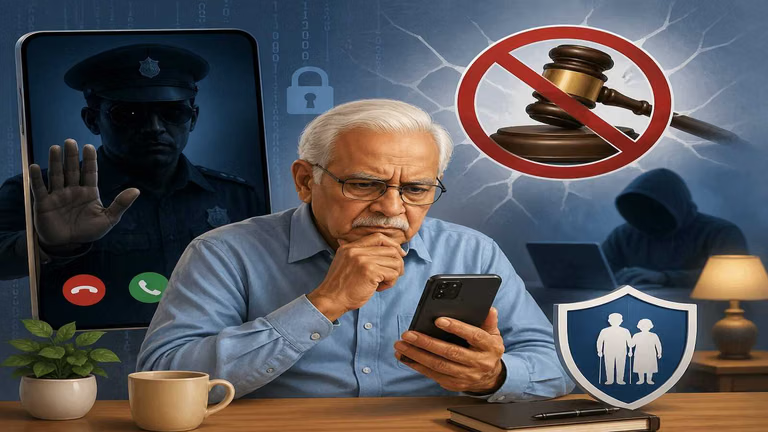
Survey procedure for the census usually include door-to-door data collection and online self-enumeration option. Although the process is intended to be secure, authorities indicate that vulnerabilities in awareness can expose people to fraudulent activities, particularly seniors and those with less digital exposure.
Typical Census-Related Frauds
One of the most commonly reported scams is impersonation. Scammers pose as census officers, and demand personal or financial data that is not part of the official questionnaire. In some cases, they might ask for important documents, OTPs, or even persuade you to make payment under false claims.
Phishing is another scam to be aware of. Phishing messages are usually constructed in such a way that they seem like they have been issued by government authorities; these messages may also contain links that request the user to complete a self-enumeration, or record update. These malicious links typically redirect to fraudulent sites, aimed at collecting sensitive information, such as Aadhaar numbers, bank details or even login credentials.
Government authorities have cautioned that census officials do not request bank account details, passwords, or payments. Any request that is of such nature should be labelled as suspicious.
How to Check an Enumerator?
According to the ORGI, all authorised census must carry their official identity cards issued by government officials. These cards usually contain the name, photo, and designation of the enumerator.
It is recommended that citizens confirm this identification prior to giving any information. In case of doubt, they can refer to local administrative offices, or the police, to verify the identity of the individual conducting the survey.
Enumerators are also guided by a structured questionnaire and do not digress into irrelevant personal or financial questions.
What is Self-Enumeration?
Self-enumeration is a process where households are able to enter their census data online instead of doing so during a door-to-door visit. Under this procedure, the resident fills in the census form on the official platform using household data, such as number of persons living in the household, age, education, occupation, and housing conditions.
Each household must present correct and updated information on behalf of all members of the household. Once submitted, the information is recorded in the official census documents. In other instances, an enumerator can come back to the house after digital self-enumeration to confirm or update the information given online.
How to Stay Safe During Census 2027?
Authorities suggest some simple measures. To begin with, do not provide sensitive personal or financial information to anyone claiming to be a census worker unless it is included in the official questionnaire.
Second, do not pay anything regarding census operations. Census is a government activity and does not require fees to participate.
Third, confirm all online communication. In case a message or a link seems suspicious, it is better to avoid it and go directly to the official platform through official sources.
Lastly, report any possible fraud to local law enforcement. Early reporting can help dodge bigger misuse and save others against such attempts.