




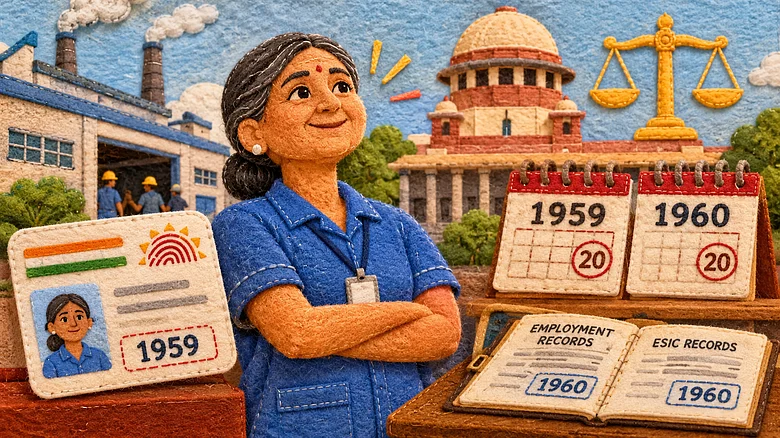


Summary of this article
Court rules Aadhaar alone cannot establish an employee's birth date.
Employer's ESIC records listed the worker's birth year as 1960.
Worker wins back wages plus six per cent annual interest.
A woman who had worked at an electronics factory for over 35 years lost her job just as she was demanding wages revised by the Delhi government. Her employer claimed she had reached the retirement age of 58, relying on her Aadhaar card to establish that she was born in 1959.
But the company's own records with the Employees’ State Insurance Corporation (ESIC) carried her birth year as 1960. The Delhi High Court has upheld the finding that her termination was illegal, ruling that Aadhaar alone cannot establish date of birth when other records contradict it.

Employer Relied On Aadhaar To Retire Worker Early
The woman joined the electronics firm on December 1, 1981, as a finishing worker and earned Rs 10,500 a month. In March 2017, the Delhi government revised minimum wages for skilled workers. She sought payment at the revised rates and also demanded her pending wages for April.
Her employment ended on May 20, 2017. The management claimed she had turned 58 that day, the retirement age followed at its factory. It relied on her Aadhaar card, which listed May 20, 1959, as her date of birth.
The company also argued that she had undergone cataract surgery in April 2017, expressed her inability to work and voluntarily resigned after receiving her dues. The woman disputed this account. The Labour Court has found her termination to be illegal and directed the company to pay back wages. The employer challenged the order before the High Court.
Official Records Contradicted Company's Claim
The company's ESIC records listed her date of birth as May 20, 1960. The entry was made when she was registered on June 26, 2010, using information provided by the management.
The High Court found that the company had no independent document to establish the 1959 birth date. It had also failed to question the ESIC official who confirmed the 1960 date or produce the records used during registration.
The court held that the employer could not rely on Aadhaar to justify an earlier retirement when its own official records carried a different date. It also referred to a Supreme Court ruling clarifying that Aadhaar can establish identity but is not conclusive proof of date of birth.
Company Liable For Back Wages And Interest
The year 1960 was accepted as the date of birth, and the woman was able to work until May 20, 2018. The employer failed to establish that the employee was a "retired" employee, and also that she had resigned voluntarily.
The High Court then confirmed the conclusion of the Labour Court that her dismissal was in breach of Section 25F of the Industrial Disputes Act.
The company was then directed to compensate the wages of Rs 14,698 per month from May 20, 2017, to May 20, 2018, and interest at 6 per cent per annum along with consequential benefits. The sum deposited with the Registrar General, together with the interest, will be paid to the woman. All other dues will be paid directly to the company within four weeks.





