

Summary of this article
India-EU FTA cuts tariffs, making premium cars and wine cheaper
Medical imports and tech components may see cost relief
Indian exports gain smoother access to wealthy EU markets
Trade deal signals outward growth push amid global protectionism
India has finally sealed a Free Trade Agreement (FTA) with the European Union, a deal that is expected to make a number of imported European products cheaper for Indian buyers, according to a recent report by NDTV, ending a negotiation marathon that stretched across nearly two decades and multiple administrations in New Delhi and Brussels.
The pact is broad and still needs to pass through procedural steps, but its commercial implications are unmistakable. For the average Indian consumer, the clearest takeaway is that certain high-value goods from Europe will no longer carry the kind of tariff burden that made them out-of-reach indulgences or hospital-sink expenses.
Premium Cars And European Wine In The Spotlight
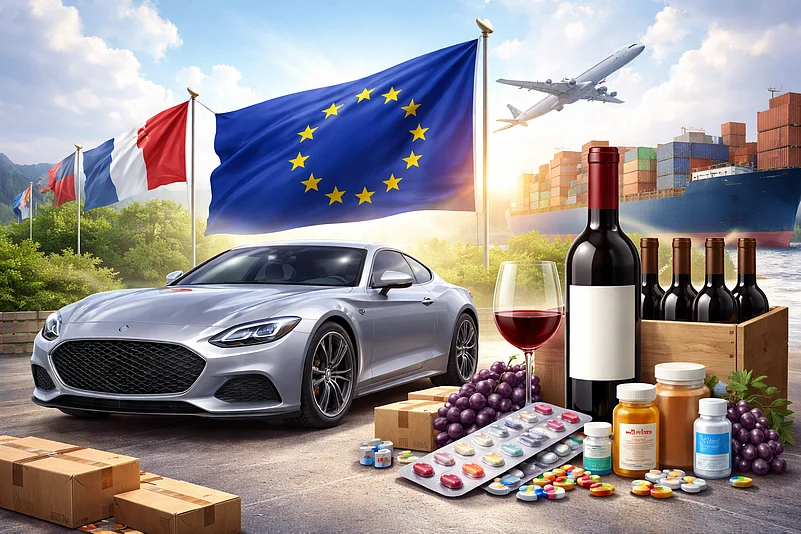
One sector that has drawn instant attention is the luxury automobile market. German and Italian marques, already symbols of aspiration in urban India, may undergo price recalibration once the tariff cuts begin to phase in. At present, import duties can push prices up by several lakhs, making even entry-level luxury sedans an expensive proposition. Under the new formula, the duty on vehicles priced above the EU’s benchmark will taper down and eventually settle at far more forgiving levels. The quota mechanism ensures that the tariff relief remains structured and does not swamp local manufacturers suddenly, but even a partial reduction could alter showroom dynamics.

3 September 2026
Get the latest issue of Outlook Money

Alcoholic beverages sit in a similar camp. India’s tariff regime on wine and premium liquor often doubled or tripled retail stickers, limiting consumption to affluent pockets in big cities. The new pact seeks to flatten that curve. Duties on wine are expected to come down sharply over a multi-year window, which could put French, Italian, and Spanish labels within easier reach. Retailers and importers believe this might broaden the market, not just deepen it.
Medical Imports And Tech Inputs May Get Cheaper Too
The agreement is not merely a lifestyle story. Certain medicines and medical equipment sourced from Europe, including specialised cancer drugs and diagnostic devices, are expected to get cheaper as duties fall. For families already stretched by long treatment cycles, even modest reductions in landed costs can make a difference.
Several industrial segments could see spillover benefits. Tariff easing on aircraft parts, electronics components, semiconductor inputs, and high-precision machinery should help bring down the cost of manufacturing in aviation, electronics, and allied sectors. If supply chains respond as intended, the consumer end could eventually notice it in product pricing.
Exports Eye A Bigger European Market
On the other side of the ledger, India gains improved access to the European market. Sectors such as textiles, leather, gems and jewellery, marine produce, and engineering goods are counted among the likely beneficiaries. For exporters, the allure is not just lower duties but a more predictable rules-based access to one of the world’s wealthiest consumer blocs. That could encourage investment and job creation at home, especially in small and mid-size manufacturing clusters.
Economists point out that the pact arrives at a moment when global trade is navigating a protectionist mood in several quarters. Against that backdrop, India’s move to deepen commercial ties with Europe signals a more outward-facing approach to growth and a bet that exports and trade diversification will matter in the next decade.
Industry reactions have so far leaned positive, though some domestic producers have asked for careful sequencing to prevent competitive shocks. Still, the broad business view is that the India-EU FTA marks an overdue reset in a relationship that had been stuck in diplomatic slow motion for years. For consumers, the more immediate reading is far simpler: items that once felt like rare treats, a German sedan, an Italian red wine, or a specialised imported medicine, may soon become less punishing on the wallet.