

Summary of this article
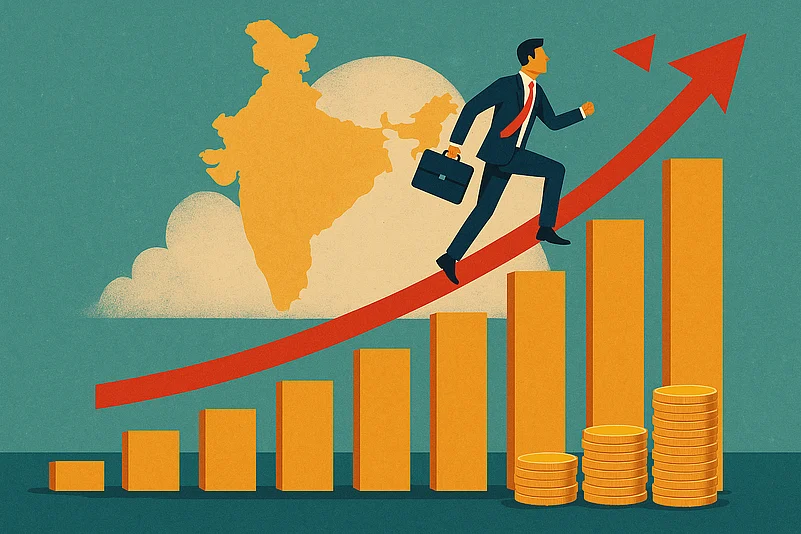
India’s top 100 firms created Rs 148 trillion wealth over five years.
Telecom, banks, and capital-market stocks led equity market wealth creation.
Airtel, ICICI Bank, and SBI emerged largest contributors to shareholder value.
Retail-investor participation and broad sector strength powered sustained market gains.
India’s equity markets have rarely seen a stretch as strong as the last five years. The country’s top 100 listed companies together added an unprecedented Rs 148 trillion in shareholder wealth between 2020 and 2025, as highlighted in a recent annual wealth creation study by Motilal Oswal. What began as a rebound from the pandemic shock has gradually turned into a broad-based expansion across several sectors, with domestic investors playing a far larger role than ever before.
The report makes it clear that the market’s centre of gravity has shifted. A deeper retail investor pool, improving corporate balance sheets, and steady earnings growth have combined to create a period unlike anything the study has recorded in nearly three decades.
Telecom, Financials, And Capital-Market Names Dominate The List
Among all listed companies, Bharti Airtel walked away with the top honour as the largest wealth creator of the period, adding close to Rs 8 trillion in market value. Banks followed closely, with ICICI Bank and State Bank of India taking the next two spots. Their strong credit growth, healthier loan books, and stable profitability kept them firmly ahead of most other sectors.

3 September 2026
Get the latest issue of Outlook Money

What stands out this year is the diversity in the top ranks. Bajaj Finance, Larsen & Toubro, HCL Technologies, ITC, Sun Pharma, Mahindra & Mahindra, and NTPC all featured within the top ten — a sign that the rally of the last five years was not confined to one narrow pocket of the market.
In terms of speed of wealth creation, BSE delivered the most astonishing showing of all, clocking a 124 per cent compound annual return over the period. Rail Vikas Nigam and Jindal Stainless also delivered exceptional gains, followed by a mix of engineering, power, and manufacturing companies that rode strong demand and, in many cases, structural shifts in their industries.
One company that drew particular attention was Hindustan Aeronautics. It not only outperformed the broader market every single year but also ranked as the best all-round performer across size, speed, and consistency. Few companies matched its combination of steady orders, cost discipline, and sector momentum.
A Rising Wealth Base Points To A Transforming Economy
The study also stresses that India’s expanding market capitalisation is not a temporary phenomenon. Over two decades, the country’s market value has grown fast enough to push India to fourth place globally. This swelling pool of financial wealth is beginning to influence consumption patterns, business investments, and household confidence — all elements of what economists typically call the “wealth effect.”
Looking ahead, the report lays out a long-term view: India’s economy could grow from its current size of about USD 4 trillion to nearly USD 16 trillion by 2042. If that trajectory holds, the next two decades may open up opportunities far larger than those seen so far, especially in financial services, consumer-facing businesses, and sectors tied to rising incomes.
For investors, the message is a familiar one but now backed by fresh data: companies that build scale, stay profitable through cycles, and consistently execute their strategy tend to dominate wealth creation over long stretches of time. The last five years have simply reinforced that pattern on a larger canvas.