

Summary of this article
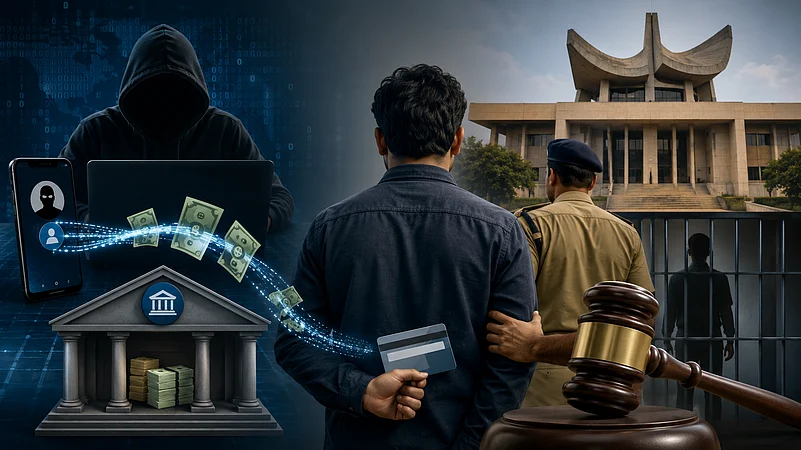
The Chandigarh district court denied regular bail to a man whose bank account was allegedly used as a mule account.
Police said the accused allegedly allowed the account to be opened in his name for money.
The court held that mule account holders can be held accountable for facilitating fraud proceeds and rejected his bail plea.
Digital financial crimes are rising through the misuse of mule accounts. In a recent ruling related to such accounts, the district court dismissed the regular bail plea of a man whose bank account was allegedly used as a mule account in multiple cyber fraud cases. Additional Sessions Judge Harinder Sidhu observed that the police investigation had found multiple fraudulent transactions in the said bank account. The transactions were allegedly part of a broader network of illegal activities, such as face investment schemes, part-time job scams, digital arrests, etc., where the money was extorted or deceptively received from unsuspecting victims.
According to the Hindustan Times report, the Chandigarh cyber crime police received inputs from the Indian Cyber Crime Coordination Centre (I4C), and during investigation, found numerous such complaints registered on the National Cyber Crime Reporting Portal (NCRP - 14C), where several bank accounts had been used as mule accounts. It identified these bank accounts, which were allegedly used to receive and withdraw the crime proceeds, and then initiated legal proceedings.


In this case, the police found that an account in IndusInd Bank account received money from three separate transfers of Rs 50,000, Rs 4.5 lakh, and Rs 1 lakh. This transaction was traced and found to be related to registered cyber fraud complaints. The account holder of this mule account worked as a peon in ICICI Bank, who, during interrogation, confirmed that one of his acquaintances (Salman Ansari) had opened this account in his name in exchange for money.
The police arrested Ansari and recovered the evidence, including a cheque book in the peon’s name, PAN card, and various company stamps, that allegedly have been used to open fraudulent current accounts.
During investigation, Ansari informed the police that he had handed over the bank account details to another individual (Dharambir Kalia), but his current whereabouts were unknown.

The police, under its Operation Mule Hunt—a specialised police drive to crack down on the misuse of personal bank accounts for digital financial frauds— took into custody both Ansari and the peon in whose name the account was opened because he permitted account opening in his name for money.
Reportedly, the peon sought bail, contending that he was not aware and was falsely implicated. He also contended for parity with Ansari, who had already been granted bail. However, the court held that his case was different. Judge Sidhu noted that Ansari was alleged to have facilitated the opening of the account, the peon was charged with specific allegations for involving his account to directly receive the fraud proceeds and, moreover withdrawal of these proceeds.
The court rejected his plea and emphasised that mule account holders can be held accountable for misusing their accounts, in the interest of all.

Rising Mule Accounts Activity In India
Cyber frauds are becoming more sophisticated with advancing technology. A recent report by BioCatch, a cybersecurity company, found that fraudsters prefer India-based mule accounts over overseas accounts for transacting and moving fraudulent funds, ANI reported. According to the report, earlier the mule accounts were located in other countries in South-East Asia. Still, due to enforcement action by the United Nations Office on Drugs and Crime (UNODC) in various centres in Myanmar, Cambodia, and Laos, these centres have been dismantled. Thus, the transactions are being routed through Indian’s mule accounts.
This judgment and the data highlight how crucial it is to be aware of transactions happening from one’s account, and to inform the bank, the police or the cyber cell in case of any unauthorised transactions in the account without delay.