





Summary of this article
CBDT releases 99-page FAQs for transition to Income Tax Act, 2025
Law simplified: sections cut from 819 to 536, forms from 399 to 190
Introduces single “Tax Year”, replaces old AY/PY system
Ensures continuity: PAN, TAN, filings, pending cases remain valid
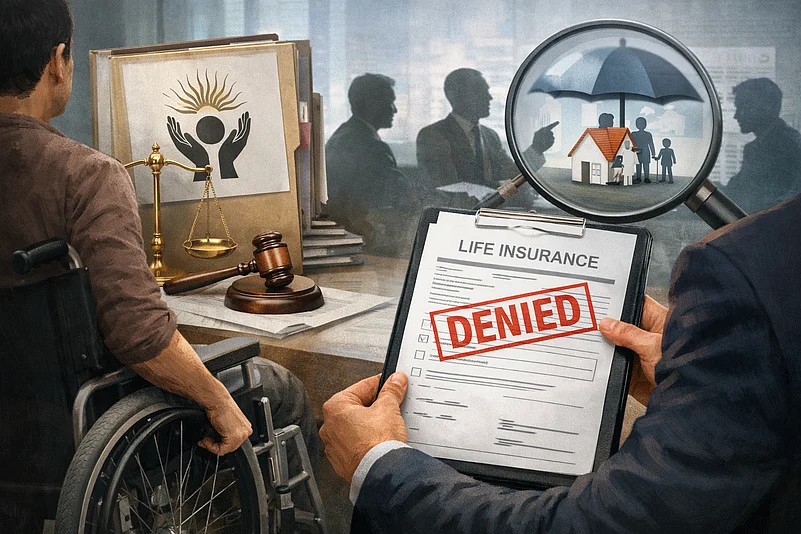
A regulatory question that has lingered in the background for years has now come into sharp focus. The National Human Rights Commission (NHRC) has asked the Insurance Regulatory and Development Authority of India (Irdai) to explain why persons with disabilities are reportedly being denied life insurance policies.
The trigger for the notice was a complaint claiming that people with hearing and speech impairments were turned away when they applied for life insurance. Taking note of this, the Commission has asked the regulator to explain its position within 15 days. It has also looped in the Finance Ministry, suggesting the concern may not be limited to one case but could point to a wider policy issue, according to a recent report by “The Hindu Business Line.”
At one level, this is a specific case. At another, it points to a deeper fault line, how India’s insurance industry deals with applicants who fall outside standard risk assumptions.

3 September 2026
Get the latest issue of Outlook Money

The Grey Zone Between Rules And Practice
The law, at least on paper, leaves little room for ambiguity. The Rights of Persons with Disabilities Act, 2016, bars discrimination in access to services, and insurance is no exception. Over the years, courts have also leaned in favour of inclusion, making it clear that disability alone cannot be a ground for exclusion.
But the way policies are issued tells a more uneven story.
Applicants with disabilities often face a different kind of screening. In some cases, proposals do not move beyond the initial stage. In others, the terms offered, higher premiums, exclusions, or limited cover, make the policy impractical. Much depends on the insurer, the underwriting team, and how risk is interpreted in that particular instance.
Insurers typically maintain that life insurance is built on actuarial judgment. If a condition is seen to affect longevity or health outcomes, it gets factored into pricing or eligibility. The problem, as flagged by rights groups, is that disability is frequently treated as a broad, undifferentiated category, rather than being assessed case by case.
That is where the friction lies: between a rights-based framework that calls for equal access and an industry that relies on risk classification.
More Than Just A Policy Decision
The denial of life insurance has implications that go well beyond the policy itself. For many households, life cover is a basic layer of financial security. It helps people plan ahead, offers a financial cushion to family members, and in many cases is linked to getting loans or other forms of credit.
For persons with disabilities, not having this kind of cover can make things even more restrictive. It may make it harder to get a loan, put money into assets, or set aside something for the family’s future. And when earnings are already unpredictable, the absence of insurance can leave them more exposed than others.
There’s a larger mismatch here. Financial inclusion has been pushed as a key policy goal in India, and access to banking and insurance has widened over the years. Yet, when a segment of the population continues to face barriers at the entry point itself, the idea of inclusion becomes incomplete.
What The NHRC Notice Could Trigger
The Commission’s intervention does not, by itself, change underwriting rules. But it does compel a response, both from the regulator and the industry.
For the Irdai, the immediate question is whether existing guidelines are sufficient and, if so, whether they are being followed in spirit. If the review shows that the rules aren’t being applied as they should be, the regulator may step in and spell things out more clearly so insurers handle these cases in a consistent way.
For insurers, this could be a moment to take a closer look at how things are being done internally. How applications are assessed, how decisions are recorded, and whether existing products actually account for different kinds of disabilities are all questions that could come under review.
The conversation is unlikely to end with one notice. But it does bring into the open a question that has often been handled quietly at the underwriting desk: who gets access to life insurance, and on what terms?
The answer will shape not just industry practice, but also how inclusive India’s financial system truly is.





