



Summary of this article
Student loan costs are spiralling towards Rs 30–40 lakh, while starting salaries have refused to budge – hovering around Rs 4-6 lakh per annum.
The degrees Indian families are sacrificing the most for - engineering, MBA, and professional qualifications - are barely delivering the promised returns.
Education costs keep rising at 10-12 per cent a year; salaries are not keeping up.
For years, professional degrees were considered a sure-shot way to climb up the ladder of success in India. That belief, however, is slowly beginning to crumble. Student loan costs are spiralling towards Rs 30–40 lakh, while starting salaries have refused to budge – hovering around Rs 4-6 lakh per annum. The return on investment just doesn’t seem worth it anymore. Pursuing these degrees – once thought to be the safe and secure long-term investment – is now being looked at as a risky, expensive proposition. Parents are beginning to ask themselves one question: Are these degrees worth it?
A recent research from the 1 Finance Global Economic Outlook 2026 has laid bare a troubling paradox at the heart of India's higher education system: the degrees families are sacrificing the most for - engineering, MBA, and professional qualifications - are barely delivering the promised returns. The research maps education costs against real salary outcomes across institutions and experience levels, finding that rising costs, oversupply of graduates, and a skills mismatch are quietly eroding the financial promise of a degree, even from the country's most prestigious institutes.


The Engineering Cost Trap
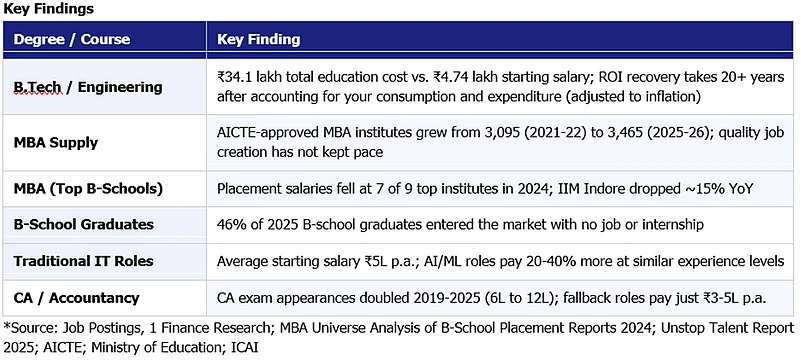
The ROI problem starts at the undergraduate level. A 4-year B.Tech degree from a mid-range private college in Mumbai costs approximately Rs 17.3 lakh in fees alone. Add schooling costs for the 13 years prior, and the total education investment to produce a software developer reaches Rs 34.1 lakh. Yet the same graduate entering the workforce faces an average starting salary of just Rs 4.74 lakh annually.
Even with 10 per cent annual increments, recovering the cost of education takes over two decades, even after adjusting for inflation and one’s expenditure, making traditional engineering degrees an increasingly poor investment for families that cannot absorb that risk.
The Skills Divide Within Tech: AI vs Traditional IT
The problem is not uniform across engineering disciplines. 1 Finance’s analysis of 950 job postings across Mumbai, Pune, Delhi NCR, Hyderabad, and Bangalore reveals a sharp divergence between AI-related and traditional IT roles:
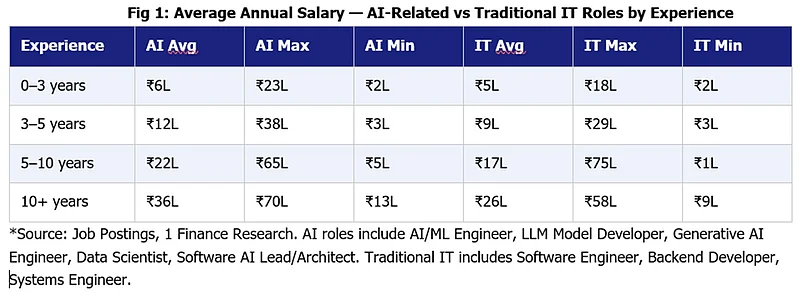
AI and data roles typically pay 20-40 per cent more than traditional IT roles at similar experience levels. Experienced AI professionals earn Rs 35-70 lakh annually, while many traditional IT professionals plateau between Rs 23 and Rs 58 lakh. The implication: the degree matters less than the specialisation it enables.
MBA: The Prestige Premium Is Shrinking
India now has over 5,000 institutions offering MBA or PGDM programmes, including 21 IIMs. The number of AICTE-approved MBA institutions increased from 3,095 in 2021–22 to 3,465 in 2025-26. MBA enrollments rose 25 per cent between 2017-18 and 2021-22. But supply has raced ahead of quality job creation. Placement data from India's top B-schools reveals the outcome of this demand-supply mismatch:
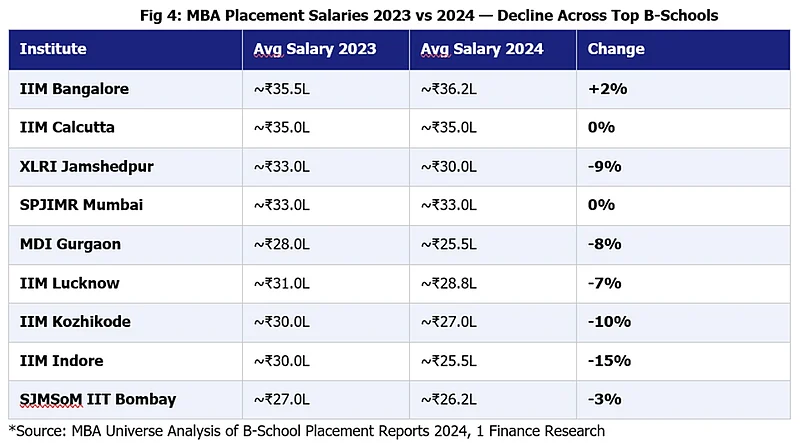
IIM Indore's average placement salary dropped nearly 15 per cent from 2023 to 2024, a dramatic decline for an institution that commands Rs 20-25 lakh in programme fees. Even IIM Bangalore and IIM Calcutta, which held steady, saw zero real wage growth after adjusting for inflation. The number of institutions is rising. Quality job creation is not.
46 Per Cent of 2025 Graduates Entered the Market Without a Job or Internship
The Unstop Talent Report 2025, which surveyed 30,120 respondents across engineering and management institutes in India, confirms the structural severity of the employment gap. Among 2025 B-school graduates, 46 per cent had no job or internship at graduation. In engineering schools, the figure was 83 per cent. Even within the Top 30 B-schools, one in four students remained unplaced. The research notes this is not a cyclical blip. It is the predictable consequence of an education system that has expanded enrolment without a commensurate expansion in industry-relevant curriculum or placement infrastructure.
Professional Courses: The CA Paradox
The same cost-outcome mismatch extends beyond degree programmes into professional qualifications. Total CA exam appearances jumped from 6 lakh in 2019 to 12 lakh in 2025, a doubling of supply in six years. Yet entry-level compensation has not kept pace. Fallback roles for semi-qualified CA candidates offer just Rs 3-5 lakh annually. Even within the profession, income is sharply bifurcated. While advisory and managerial roles like Tax Consultant, Audit Manager, and Finance Manager can yield Rs 15-26 lakh at senior levels, median salaries cross Rs 20 lakh only beyond a decade of experience. The high-pay ceiling exists, but it is accessible to very few.



Animesh Hardia, SVP, Quantitative Research, 1 Finance, says, "When a family invests Rs 30-40 lakh on education, that money is spent. The only return is the salary their child earns. And when that starting salary is Rs 4-6 lakh a year, the graduate is barely covering living expenses, let alone recovering what the family spent. Our research shows this gap is widening, placement salaries at several top B-schools dropped in 2024, 83 per cent of engineering graduates entered the market last year without a job or internship, and even in a high-demand field like chartered accountancy, the doubling of exam aspirants has pushed entry-level pay down to Rs 3-5 lakh.”
Education costs keep rising at 10-12 per cent a year; salaries are not keeping up. “As a financial advisor, I'd tell any family what I'd tell an investor: understand the downside before you commit the capital. The conversation needs to shift from 'which is the best college we can afford' to 'which skill is the market actually paying for, and what's the most efficient path to get there,” he adds.





