



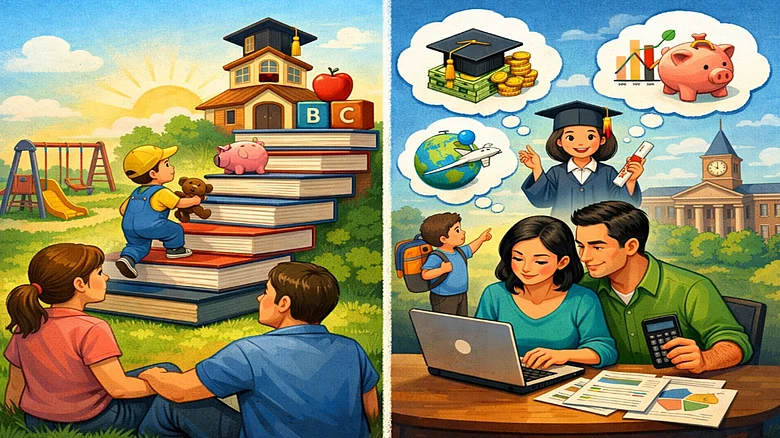


Summary of this article
A course that costs Rs 10 lakh today can easily cost Rs 40 lakh in 15 years. Starting early without adjusting for this reality creates dangerous overconfidence.
Smart planning means multiplying today’s fee estimates by 1.5 to 1.8 times to arrive at realistic totals.
The biggest mistake Indian parents make is sacrificing retirement to fund education.
Meera started planning for her daughter’s future the day she was born. She opted for a child plan, investing Rs 5,000 a month. Fifteen years later, when her daughter wanted to study medicine, the numbers didn’t add up. The expected cost was Rs 25 lakh. Her corpus stood at Rs 12 lakh. The gap came as a shock, not because Meera hadn’t saved, but because she had planned without realism.
Across town, Priya did nothing until her son reached Class 10. Panic set in when she calculated that an engineering degree would cost Rs 15 lakh in three years. She couldn’t save that much so quickly. But instead of freezing, she got strategic - equity SIPs she could afford, early education-loan planning, and a focused push toward government colleges where costs were a fraction. Three years later, she borrowed minimally and stayed financially intact.
Sanjiv Bajaj, Joint Chairman and MD at Bajaj Capital Ltd, says, “Financial planning isn’t about good intentions. It’s about realistic assumptions, disciplined execution, and preparing for multiple outcomes.”

The False Choice Between Early and Smart
The debate between starting early and starting smart is misleading. The best outcome is both, but if forced to choose, smart planning always beats early but uninformed saving. Education inflation runs far ahead of general inflation. While most households plan with 5–6 per cent, education costs rise at 8–10 per cent annually, and even faster for medicine, private colleges, and overseas education. A course that costs Rs 10 lakh today can easily cost Rs 40 lakh in 15 years. Starting early without adjusting for this reality creates dangerous overconfidence.
The First Rule: Plan For What Education Actually Costs
Parents underestimate education expenses because they look only at tuition fees. Real costs, however, include accommodation, food, books, devices, coaching, exams, travel, and emergencies. Tuition fees are often just 60 to 70 per cent of the bill.
Smart planning means multiplying today’s fee estimates by 1.5 to 1.8 times to arrive at realistic totals. It also means planning for multiple scenarios, like government college, private college, and aspirational options, rather than betting everything on one outcome.
“Hope is not a strategy,” Bajaj says. “Flexibility in planning is what protects families from financial stress when outcomes change.”
The Second Rule: Work Backwards From Reality
Smart education planning doesn’t begin with “how much can I save?” It begins with “how much will this realistically cost?” and works backwards. If your target corpus is Rs 40 lakh in 15 years, a disciplined equity SIP of roughly Rs 9,000–10,000 a month can get you there. If the same goal is eight years away, the number jumps dramatically. Time changes everything, but lack of time doesn’t mean failure. It means layering your strategy.
Smart planners don’t rely on one tool.
They combine:
• Equity SIPs for long-term growth
• Government-backed schemes like PPF or Sukanya for stability
• Education loans as strategic tools, not last-minute panic
• Serious exam preparation, because the difference between government and private colleges can be Rs 30–50 lakh
• Scholarships and aid, especially for overseas education
An education loan isn’t proof that you failed. For many families, saving 60-70 per cent and borrowing the rest is the most sustainable approach.
Age Matters, So Adjust Strategy
If your child is under 5, time is your biggest ally. So, lean into equity.
Between 6 and 10, balance growth with structure and start career conversations early.
Between 11 and 15, accept limits, pre-arrange loans, and focus on cost arbitrage through exam strategy.
After Class 11, planning becomes tactical - liquidity, approvals, and execution matter more than returns.
What matters is not perfection. It’s alignment with reality.
The One Line Parents Must Remember
The biggest mistake Indian parents make is sacrificing retirement to fund education. Your child can take a loan. You cannot take a retirement loan. Education planning should support your child’s future, not mortgage your own.
Bajaj notes, “Strong families are built when financial security flows across generations, not when one generation collapses to fund another. Starting early gives you time. Starting smart gives you control. The real question isn’t “Did I start early enough?” It’s “Given where I am today, what’s the smartest plan I can execute consistently?”





