





Summary of this article
A home loan may be the biggest liability, but it is often accompanied by a car loan, personal loan, credit card dues, consumer durable EMIs and a growing list of subscriptions and monthly commitments.
A medical bill, job transition, major home repair or even an annual insurance premium can force the family to dip into investments or reach for a credit card.
That is when a seemingly manageable financial situation can suddenly become uncomfortable.
For years, the common advice to middle-class households was simple: earn more, save regularly and avoid unnecessary debt. But the way families borrow has changed. A home loan may be the biggest liability, but it is often accompanied by a car loan, personal loan, credit card dues, consumer durable EMIs and a growing list of subscriptions and monthly commitments.
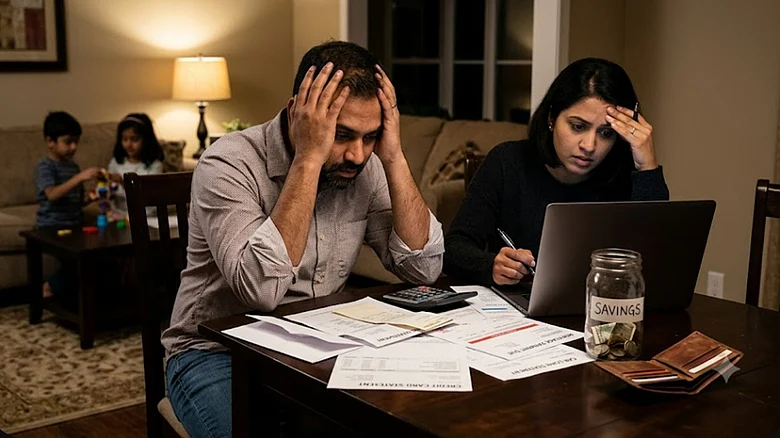
On paper, the family may be earning well. In reality, very little money is left at the end of the month.
This is creating a new personal finance problem: households that are not necessarily over-indebted, but are increasingly short of liquidity.
Consider a family with a combined monthly income of Rs 2 lakh. A home loan equated monthly instalment (EMI) of Rs 55,000, a car loan of Rs 20,000 and other EMIs of Rs 15,000 already take away Rs 90,000. Add rent or maintenance, school fees, groceries, insurance, utility bills and regular investments, and the disposable income can shrink surprisingly quickly.
The problem becomes visible when an unexpected expense arrives.
A medical bill, job transition, major home repair or even an annual insurance premium can force the family to dip into investments or reach for a credit card. That is when a seemingly manageable financial situation can suddenly become uncomfortable.

Income Is Not The Same As Financial Security
According to financial planners, people often focus on their income and net worth, but cash flow is equally important.
A household may own a valuable home and have a sizeable mutual fund portfolio, but if most of its monthly income is already committed, it may struggle to meet a sudden Rs 2 lakh expense.
This is particularly relevant for younger families that have taken on large home loans while also trying to maintain their lifestyle. The temptation to buy a bigger house, upgrade the car or purchase expensive consumer goods through EMIs can make monthly cash flow increasingly rigid.
The danger is not necessarily one large loan. It is the accumulation of several small commitments.
A Rs 5,000 EMI may appear harmless. So may another Rs 8,000. But when five or six such payments run simultaneously, they can quietly consume a significant portion of monthly income.
The Emergency Fund Gets Squeezed First
When household expenses rise, investments are often the first casualty.
A person may start a Rs 25,000 monthly SIP but stop it when school fees rise. Another may reduce retirement contributions to manage a car EMI. Someone else may use their emergency fund to finance a holiday, assuming the next salary will replenish it.
This is often where the original financial plan starts to get derailed.
Most experts suggest keeping enough money aside to manage essential expenses for a few months. But there is no one-size-fits-all figure. A family with two steady incomes may need a smaller cushion than a household that depends on a single salary or has an uncertain income.
A salaried couple with two stable incomes may need a different cushion from a single-income family or a self-employed person whose earnings fluctuate.
The important point is that an emergency fund should be calculated against essential monthly expenses and financial commitments, rather than simply being an arbitrary number.
The EMI Test That Borrowers Often Ignore
Before taking a new loan, borrowers usually ask one question: “Can I afford the EMI?”
A better question is: “What will my finances look like after paying this EMI every month?”
A household should add up all existing EMIs, insurance premiums, school fees, essential expenses and regular investments before committing to another loan.
It should also stress-test its finances.



What happens if one income stops for six months? What if the family faces a Rs 3 lakh emergency? Can the household continue paying the home loan without selling long-term investments?
If the answer is no, the problem may not be the new loan itself. The problem may be that the family's financial structure has become too dependent on uninterrupted monthly income.
The Slution Isn't Aways To Stop Borrowing
Taking a loan is not necessarily a bad financial decision. For many families, a home loan is the only practical way to buy a house, while an education or business loan can help create better earning opportunities in the years ahead.
The bigger issue is debt without adequate liquidity.
Before taking on another EMI, households should first build an emergency buffer, protect essential insurance cover and ensure that long-term investments continue even after the new loan begins.
It is also worth clearing high-cost credit card and personal loan debt before increasing discretionary spending.
The ultimate goal is not to have zero EMIs. It is to have enough financial breathing room that an unexpected expense does not turn into another loan.
For today's middle-class household, financial freedom may therefore mean something slightly different. It may not be about becoming debt-free overnight. It may simply mean reaching the end of the month with enough money left to handle whatever the next month brings.





