





Summary of this article
Medical technology has changed the way many procedures are performed. Robotic surgeries, laser-based procedures, stem-cell treatments and other sophisticated procedures are being offered at hospitals in India.
Health insurance policies have evolved alongside these developments, with many policies offering coverage for specified modern or advanced treatments, subject to policy conditions.
As medical technology expands, understanding how newer treatments are covered becomes just as important as knowing the headline sum insured.
When Neha was told she needed robotic-assisted surgery, her first reaction was relief. The treatment was available at her preferred hospital, the procedure was minimally invasive, and most importantly, she had health insurance. She assumed the policy would take care of the hospital bill.
The procedure cost Rs 4.5 lakh. Her claim settlement was lower than expected.
The reason was not that robotic surgery was excluded altogether. Her policy had cover for advanced treatment but the benefit was subject to a specified limit. The insurer evaluated the claim within the terms and sub-limits of her policy.
Advanced Treatment Does Not Always Mean Unlimited Cover
Medical technology has changed the way many procedures are performed. Robotic surgeries, laser-based procedures, stem-cell treatments and other sophisticated procedures are being offered at hospitals in India.
Health insurance policies have evolved alongside these developments, with many policies offering coverage for specified modern or advanced treatments, subject to policy conditions.
The important words are specified and subject to conditions. A policy may cover a particular advanced procedure but apply a sub-limit, percentage of the sum insured, fixed monetary ceiling or other condition. The remaining amount may then have to be paid by the policyholder.
“The availability of advanced medical technology is changing healthcare rapidly, but insurance coverage is ultimately determined by the terms of the policy. Customers should understand whether a treatment is covered, whether any sub-limit applies and what conditions need to be met before assuming that the entire hospital bill will be reimbursed,” says Sanjiv Bajaj, Joint Chairman and Managing Director, Bajaj Capital Ltd.

Why the Bill and the Settlement Can Look Different
Consider a policy with a Rs 10 lakh sum insured and an advanced-treatment limit of Rs 2 lakh. If an eligible procedure costs Rs 3.5 lakh, the fact that the policy has Rs 10 lakh of overall cover does not automatically mean that Rs 3.5 lakh will be payable for that treatment.
The applicable advanced-treatment limit could determine the amount considered under that benefit, subject to the policy wording and other applicable deductions. This is where policyholders can be caught by surprise.
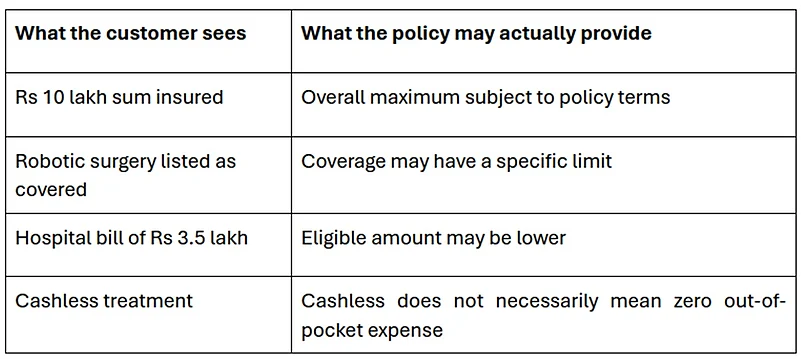

The table is illustrative. Actual coverage depends on the specific policy wording, treatment and claim assessment. The issue is therefore not necessarily whether an insurer is refusing to cover advanced treatment. It is whether the customer understood how that treatment was covered under the policy they purchased.
The Fine Print That Deserves Attention
Before opting for an advanced procedure, policyholders should check four things.
First, is the specific procedure covered? – Do not assume that every new technology or treatment automatically falls under the policy's advanced-treatment benefit.
Second, does the policy have a sub-limit? - Even when the treatment is covered, the insurer may not pay the entire cost. Thus, they may pay a fixed amount or a percentage of the sum insured.
Third, are there restrictions regarding medical necessity? – “The procedure may have to meet the definition of a covered or medically necessary procedure according to the policy,” informs Bajaj.
Fourth, what other deductions could apply? - Room-rent limits, deductibles, co-payments, exclusions and other policy conditions can affect the final payable amount.
“Technology in healthcare is moving faster than many customers realise. The right approach is not to avoid advanced treatments, but to understand the financial implications before treatment begins. At renewal, customers should review whether their policy continues to reflect the hospitals and treatment options they are likely to use,” says Bajaj.
Ask Before the Procedure, Not During the Claim
The easiest time to discover a sub-limit is before hospitalisation.
If a doctor recommends robotic surgery or another advanced procedure, the policyholder can ask the hospital's insurance desk for a pre-authorisation and check the insurer's applicable coverage.
A simple conversation can clarify: Is the procedure covered under my policy?
Does this treatment have a limit?
Does my sum insured extend fully or is there a separate sub-limit?
Are there any co-payments or deductibles?
Will room category affect the claim?
What amount could I potentially have to pay myself?
For planned procedures, these questions can be asked before admission rather than after the final bill arrives.
The Real Lesson About Advanced Treatment
Health insurance is designed to provide financial protection, but protection works within the contract purchased. As medical technology expands, understanding how newer treatments are covered becomes just as important as knowing the headline sum insured.
For customers, the most useful rule is simple: Don't ask only, “Is robotic surgery covered?” Ask, “How much of it is covered under my policy?”
That one question can make the difference between expecting a fully-covered hospital bill and being financially prepared for the amount that may remain payable.





