





Summary of this article
A new DBS Bank–Deloitte study finds Indian women rapidly adopting digital finance.
Over 50 per cent use UPI and credit cards, and most female entrepreneurs act as primary financial decision-makers.
It reveals that financial confidence rises with age and experience, yet digital safety remains a major concern.
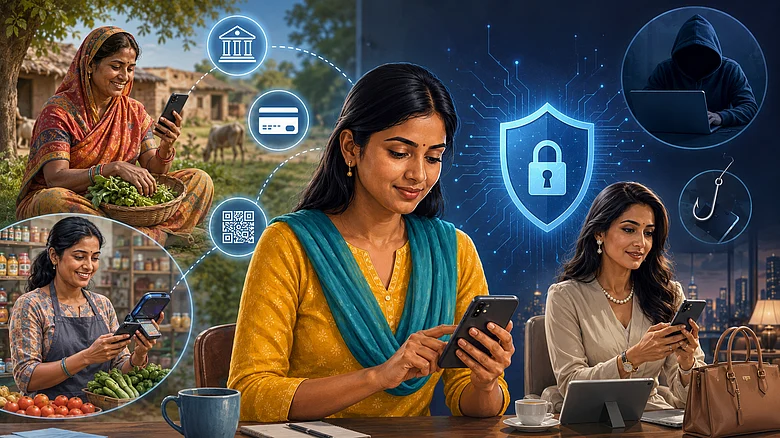
Ahead of the Digital India Day, which is observed on July 1 every year, the DBS Bank and Deloitte Touche Tohmatsu India LLP released a report titled, The Digital Opportunity: Access, Adoption and Trust, highlighting growing adoption of digital financial tools among women. According to the report, nearly 69 per cent of female entrepreneurs identify themselves as primary decision-makers for their finances, whereas only 60 per cent of the rural women earners and 58 per cent of the high-net-worth (HNW) women consider themselves so. The report, which is the second edition of its ‘Women and Finance’ report, shows the shift in how women are managing their wealth.
The survey was conducted in 2025 with a total sample size of a total of 1,342 women in three distinct demographic cohorts: 767 female entrepreneurs, 262 HNW) women, and 313 rural women earners, in the age group of 25 to 59 years. This study covered major states, including Tamil Nadu, Karnataka, Maharashtra, Delhi, and West Bengal, and rural districts like Jalgaon, Mehsana, Samastipur, and Devangare.
The report reveals increasing financial confidence with age and experience. For HNW women, independent decision-making rose from 45 per cent in their late 20s to 69 per cent by their 50s. For female entrepreneurs, financial confidence grew from 59 per cent to nearly 78 per cent as they gained business experience.




Digital Payment Platforms
The report highlights that 84 per cent of female entrepreneurs and 77 per cent of HNW women now use digital payment platforms. Unified Payment Interface (UPI) is used aggressively for financial transactions. According to the report, 77 per cent of HNW women, 72 per cent of female entrepreneurs, and 54 per cent of rural women earners use UPI as a primary tool for financial transactions.
However, the purpose of these transactions is different for them. Urban cohorts use digital tools for banking apps, premium credit card offerings, and brokerage platforms (29 per cent of female entrepreneurs and 28 per cent of HNW women), whereas rural women earners deal in cash but are gradually shifting to digital payments and app-based banking.
Spending Priorities
Spending priorities reflect that female entrepreneurs direct the largest share of their business spending towards staff salaries and contractor payments (65 per cent), followed by marketing and branding (53 per cent). For rural women earners, expenditure is focused on essential business inputs. Around 82 per cent of rural women earners spend money on raw material, 47 per cent reported spending on rent, and 35 per cent on market transportation. HNW women prioritise personal expenditures, such as groceries and daily essentials (50 per cent), utility bills (32 per cent), and healthcare (28 per cent). Around 27 per cent of HNW women reported spending on travel and vacations.

Credit Card Is Among The Top Choices For Payment
Credit cards are among the top three payment methods for urban women. Around 50 per cent of the female entrepreneurs frequently use their personal credit card, including 19 per cent who use their credit card daily and 31 per cent who use it a few times a week. Around 53 per cent of HNW women reported using a credit card for payments.
Travel-Related Rewards
Across both urban cohorts (entrepreneurs and HNW women), travel-related rewards are the most sought after, replied 65 per cent of respondents. This inclination is even higher among HNW women, with 70 per cent of them (25-30 age group) preferring travel-related rewards. Within the female entrepreneurs (26-35 years age group), around 68 per cent prefer this.
Digital Safety And Trust Remain A Challenge
However, the report also reveals that digital safety and trust remain a challenge. While 72 per cent of rural women earners reported high confidence in identifying digital fraud, only 27 per cent of female entrepreneurs and 22 per cent of HNW women felt highly confident in identifying digital fraud. Among female entrepreneurs, high confidence was common among those who regularly read blogs, newsletters, magazines, books, or accessed related websites. Among HNW women, high confidence was shown by those who consult financial advisors (59 per cent) or attend financial workshops (58 per cent).
The data shows that around 46 per cent of female entrepreneurs, 35 per cent of HNW women, and 13 per cent of rural women have actually experienced a fraud incident or a scam.

Divyesh Dalal, managing director and country head, Global Transaction Services, Corporate Banking, Financial Institutions and SMEs, says, “The findings of this report highlight an encouraging shift in the way women are engaging with their finances. Among female entrepreneurs, digital tools are becoming increasingly integral to business management, supporting everything from payments, credit, and payroll to customer acquisition and future planning. The study also underscores the importance of trust, convenience, and accessibility in driving digital adoption.”
Overall, the report suggests that while digital adoption is rising among women, they seek a more personalised, secure, and intuitive financial experience. As Kiran Mazumdar Shaw notes in the foreword of the report, true empowerment is achieved when every woman has the freedom and education to decide her own financial future.





