





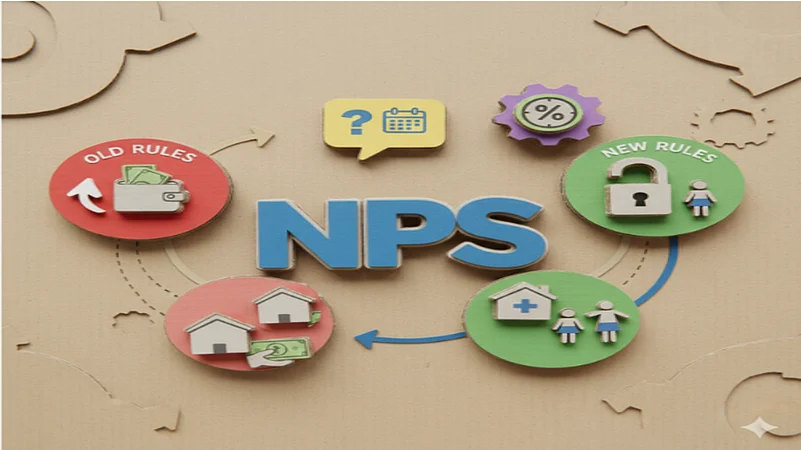


Summary of this article
PFRDA increases NPS partial withdrawals from 3 to 4 times with a 4-year intervals.
After age 60, subscribers can withdraw unlimited times with 3-year minimum interval.
One new purpose has been under which subscribers can withdraw funds to repay loans against lien on NPS account.
The Pension Fund Regulatory and Development Authority (PFRDA) has changed the withdrawal rules for the National Pension System (NPS). NPS, as a social security product, is for every Indian, whether a resident or non-resident, employed with the government or in the private sector, or even if self-employed. The change in partial withdrawal rules is aimed to provide subscribers more flexibility and make NPS a product not only for the post-retirement but also for certain purposes till the time one retires. The new rules will now be known as PFRDA (Exits and withdrawals under the NPS) (Amendment) Regulations, 2025.





How Much You Can Withdraw
There is no change in the limit of partial withdrawal in terms of the amount. Partial withdrawal is permitted after three years of subscription to the NPS. One can withdraw a maximum of 25 per cent of one's own contribution (excluding employer contribution).
Note that PFRDA allows partial withdrawal a couple of times until one exits the scheme. For every subsequent partial withdrawal, the permitted amount will be the incremental value of one's own contribution from the date of the previous withdrawal.
Partial Withdrawal Frequency
The change in partial withdrawal rules will apply to subscribers across all models, including the government, corporate, and all-citizen models.
Under the previous rules, the withdrawal was allowed only three times throughout the investment period, but now this limit is increased to four withdrawals. Under the new rules, there should be a minimum interval of four years between two partial withdrawals. Earlier, there was no such requirement.
As PFRDA has amended the withdrawal lump sum and annuity limits and exit age, too, in the amendments, NPS subscribers can remain invested in the scheme until the age of 85, which was previously 75. So, if a subscriber wants to remain invested in NPS beyond 60 years of age, will the same withdrawal rules apply?
According to the changed rules, the senior citizen subscribers are permitted to withdraw partially, without any restriction on the number of withdrawals. However, there should be a gap of three years between two withdrawals.

Purpose Of Partial Withdrawal
Earlier, partial withdrawal was permitted for higher education and marriage of children, purchase f construction of residential house of flat in own name or with spouse, medical expenses due to disability or incapacity of subscribers, treatment of specified illnesses, such as cancer, primary pulmonary arterial hypertension, kidney failure, coronary artery bypass graft, heart valve surgery, aorta graft surgery, stroke, major organ transplant, myocardial infarction, total blindness, paralysis, coma, and accidents of serious/life-threatening nature and Covid-19.
One could also withdraw money partially from the NPS corpus for re-skilling or self-development activities, or to start a venture.
However, now the withdrawal purposes are allowed for:
• Purchase or construction of a residential house if a subscriber does not own a house already. This is permitted only once.
• The new rules removed the list of specified list of treatment. One can now withdraw funds for medical treatment of illnesses without considering the specified list. This is permitted for the treatment of self, spouse, children, and parents.
• Withdrawal for skill development or self-development activities for subscribers and starting their own venture has been removed. Partial withdrawals for these purposes will not be allowed now.
• Besides this, a new purpose has been added. Subscribers can now withdraw funds to repay loans taken against their NPS account balance.





