





Summary of this article
Kerala HC clarifies banks are justified for not deducting TDS when Form 15H submitted.
Court says Section 197A(1C) protects senior citizens from TDS on interest income.
Judgment protects senior citizens' special tax treatment under income tax law.
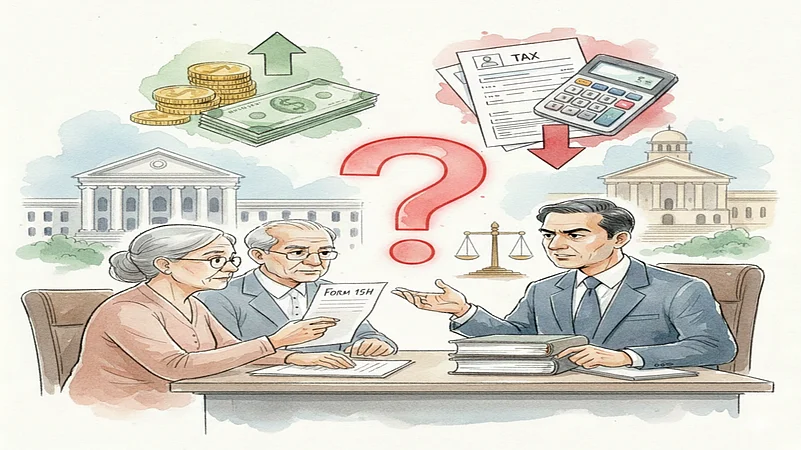
When a senior citizen submits Form 15H, it is an instruction to the bank not to deduct the TDS - tax deducted at source from the interest income of that senior citizen. But when the Income Tax Department treated this as a no deduction of TDS as a default on the part of the bank, the bank approached the court. The Kerala High Court, comprising Justice A. Muhamed Mustaque and Justice Harisankar V. Menon, noted the statutory duties of the bank regarding TDS when a senior citizen submits Form 15H.
The court checked whether the bank has to deduct the TDS if the interest income is more than the highest amount exempted from income tax, even if it has received a declaration through Form 15H. The court also clarified the limits of the rules and passed the verdict in favour of the bank.





Case Background
The case belonged to the South Indian Bank and the Income-tax department. The bank is required to deduct TDS from the interest income on FDs of senior citizens under Section 194A of the Income-tax Act, 1961.
However, Section 197A (1C) provides that no deduction of TDS in case a resident senior citizen’s income does not exceed the maximum amount that’s exempted from tax, and when the final tax liability for the year is Nil. Under this section, if a senior submits a declaration in writing, that is Form 15H, confirming that the tax on their estimated total income would be NIL, the bank does not deduct the TDS.
In this matter, the bank relied on the 15H declarations submitted by the depositor. It (bank) submitted those declarations along with TDS returns. However, the Income-tax (IT) Department initiated an enquiry and found the bank to be in default. It treated the bank as an “assessee in default” for not deducting TDS and demanded both tax and interest. The IT Department relied on Footnote No. 10 of the Form 15H.
Footnote no. 10 reads, “’The person responsible for paying the income referred to in column 15 of Part I shall not accept the declaration where the amount of income of the nature referred to in section 197A(1C) or the aggregate of the amounts of such income credited or paid or likely to be credited or paid during the previous year in which such income is included exceeds the maximum amount which is not chargeable to tax after allowing the deduction(s) under Chapter VI-A, if any, or set off of loss, if any, under the head “income from house property” for which the declarant is eligible. For deciding the eligibility, he is required to verify the income or the aggregate amount of incomes, as the case may be, reported by the declarant.”
In response to the IT department’s action, the Bank approached the Commissioner of Income Tax (Appeals) and the Income Tax Appellate Tribunal, Cochin Bench, but they rejected the Bank’s appeal. The Bank then approached the High Court.

Arguments
The respondent’s (IT Department) primary argument was that the bank should not have accepted Form 15H, since the interest income paid to the senior exceeded the basic exemption limit. In this case, when the interest income exceeds this maximum amount, the Footnote no. 10 mandates that the payer (bank) must not accept the declaration.
In response to this, the bank (appellant) argued that non-deduction of TDS was justified under Section 197A (1C).
Court Observation
The high court examined the provisions and noted that “it is to be specifically noticed that the exception carved out through sub-section (1B) is only as regards the non-deduction under sub-sections (1) and (1A) to Section 197A of the Act. It does not extend to the non-deduction under sub-section (1C) thereunder.”
The bench observed that Sub-section (1B) does not extend to the non-deduction provision under Sub-section (1C), which pertains to senior citizens.
It noted, “When the statute has been expressly amended through the insertion of sub-section (1B), it is a pointer to the effect that the liability on non-deduction and the requirement to check whether the payee is in receipt of interest in excess of the basic exemption limit should have to be prescribed through the statute itself. That being so, insofar as a similar exception has not been carved out with respect to the non-deduction under subsection (1C), we are of the opinion that the appellant was justified in not deducting tax at source in these cases.”
The bench also observed that the memorandum that explains the provisions of the Finance Act, 2003, introduced Section 197A(1C) as a welfare measure. As per the memorandum, “The prohibition contained in sub-section (1B) will not be applicable in the case of senior citizens.”
It also highlighted the impracticality of enforcing Foot Note No. 10, saying, “If Foot Note No.10 is made mandatory, the payer would have to insist on the payee providing his eligible claims under Chapter VIA/set off of loss, etc., so as to avail the benefit under Section 197A(1C) of the Act. Then the very purpose of providing a different/beneficial treatment for senior citizens would be defeated. This is all the more so when Form 15H does not show any columns requiring the payee to provide the deductions under Chapter VIA/set off, etc., eligible to him.”
Court Judgment
Based on the findings, the court held, “The legislature never intended to extend the prohibition under sub-section (1B) any further than what is prescribed.” It ruled in favour of the Bank, allowed the appeal, and held that the Bank was justified in not deducting TDS.





