








Summary of this article
New labour codes are likely to be implemented from April 1, 2026.
Wages must form at least 50 per cent of total pay.
The Labour Ministry says take-home pay would not fall if PF deduction is up to the wage ceiling or there is no change in contribution.
The new labour codes were notified on November 21, 2025. These are expected to become fully operational from April 1, 2026, after the central and state governments follow the process of pre-publishing draft rules, inviting public comments, and issuing the final notification. Among the many reform provisions, the ‘uniform definition of wages’ has generated the most confusion. Under the new codes, wages will now include basic pay, dearness allowance, and retaining allowance, and must be at least 50 per cent of the total remuneration. If allowances, other than those included in the definition of wage, exceed 50 per cent of the total remuneration, the excess amount will be added back to the wages. This would ensure consistency and improved benefits, such as higher gratuity and social security coverage.
However, would it also mean reduced in-hand or take-home payment? Experts say that if the remuneration remains the same, the take-home would reduce but only slightly. The change would not affect the take-home payment significantly if the contribution does not change.


EPF Deduction And Take-Home Pay
Ministry of Labour and Employment also issued clarification on social media platform X (formerly Twitter), posting, “The new Labour Codes do not reduce take-home pay if PF deduction is on the statutory wage ceiling. PF deductions remain based on the wage ceiling of Rs 15,000, and contributions beyond this limit are voluntary, not mandatory.”
So, if the EPF contribution is made only up to the wage ceiling, that is Rs 15,000, the new definition of wages and the consequent EPF contribution will not have much of an impact on take-home pay.
Here is the example shared by the Ministry to clarify this confusion.
It shows that if a person earns a Rs 60,000 monthly salary (Rs 20,000 as wages (basic + dearness allowance + retaining allowance, and Rs 40,000 as allowance), and contributes Rs 1,800 (12 per cent of Rs 15,000) towards the employees provident fund (EPF), the take-home will remain the same (Rs 56,400) under the new labour codes.
Is EPF Deduction Mandatory For Those Earning More Than Rs 15,000?
EPF deduction is mandatory if an employee’s salary (basic and dearness allowance) is up to Rs 15,000, but optional for a higher salary. According to the EPF FAQs, “The employees who are drawing the basic wages and dearness allowance up to Rs 15,000 are alone eligible to become a member. He will continue to be a member even when his pay exceeds Rs 15,000. However, his contribution to the Fund will be restricted to Rs 15,000.
Employees drawing more than Rs 15,000 can also become a member of EPF by giving an option under para 26(6) of the EPF Scheme. The option has to be submitted to the EPF office within 6 months of joining of such a member.”
Salary Structure Under The New Labour Codes
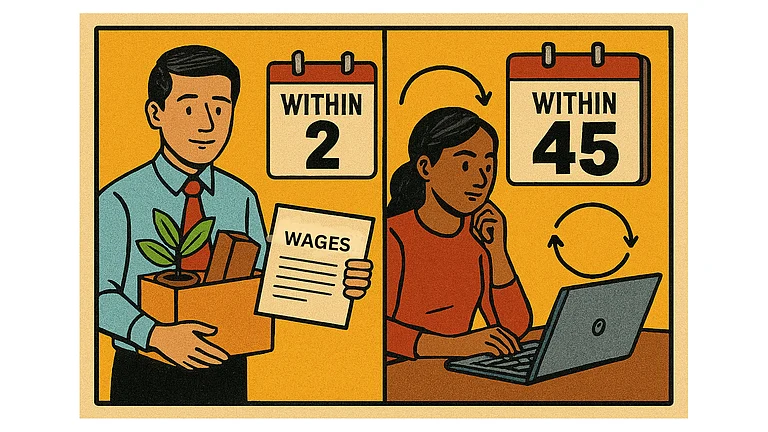
Under the new labour codes, the change will be in the salary structure and not necessarily in the take-home pay. As per the new codes:
Salary structure should be: 50 per cent wage + 50 per cent allowances
If total allowances exceed 50 per cent of the total remuneration (like in the example), the excess amount will be added to the wages. In the example, the wage would increase from Rs 20,000 to Rs 30,000.
Notably, EPF contribution up to the wage ceiling, if it was already being contributed, will not affect take-home payment, but other wage-based benefits, such as gratuity, etc., can affect it.
Divya Baweja, Partner, Deloitte India, says, “Given that the ‘wage’ base has increased, the gratuity cost may go up and the impact could be on ‘take home’ if gratuity is a part of CTC (cost to company).”

Alok Agrawal, Partner, Deloitte India, shares, “The new definition of wages is wider and only allows specific exclusions (which cannot exceed 50 per cent of total remuneration) and inclusion of benefits in kind (as per prescribed method). While, as per the definition, one-time payments/ performance pay are also covered while determining wages. In the event that the employer does not want the overall CTC to increase, any increase in contributions would be carved out of the existing CTC and lead to higher retirals for the employee in the future, but would reduce her monthly net take-home pay (where gratuity is part of CTC). On the other hand, if the employee’s current net pay is to be protected, the employer could have an additional cost to the extent of higher retiral contributions, etc.”
While the EPF-related changes are clarified, more clarity is needed about the allowances, one-time payments, and other retiral benefits and their impact on take-home payment under the new codes.





