




Summary of this article
Losing career identity and routine can feel like real grief after retirement.
Emotions shape how you withdraw or spend retirement funds.
Plan social life and purpose early to ease the transition.
By Bhuvanaa Shreeram
Why leaving a successful career can be harder than we imagine. Imagine spending 30 or 35 years building a successful career. You have worked hard, earned your promotions, built a team, enjoyed the recognition and, hopefully, made enough money to live comfortably after retirement.
Your last day at work is quite an occasion. There are speeches, photographs, farewell cake, and perhaps a few emotional moments as colleagues recount their experiences of working with you. You return home feeling rather pleased with yourself. You have earned this retirement, and you are looking forward to finally having time for all those things you have been postponing.


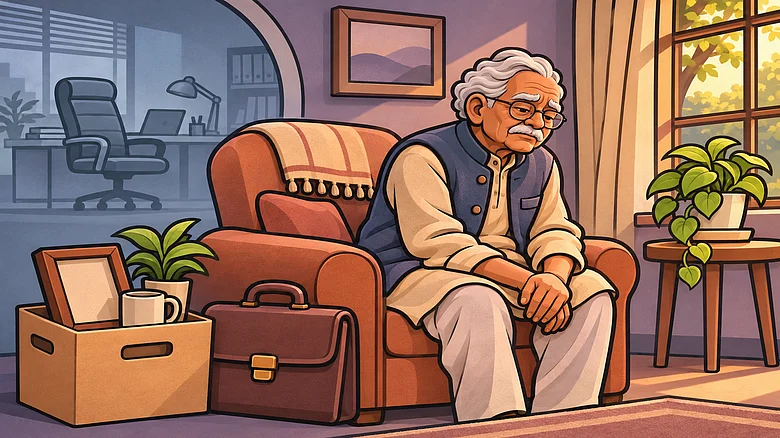
The first few weeks are wonderful. You wake up without an alarm, enjoy leisurely breakfasts, catch up with friends and perhaps take that long-awaited holiday. And then, one Monday morning, you wake up and realise that nobody is expecting you anywhere. There are no meetings to prepare for, no decisions waiting for your approval and no colleagues calling to discuss the latest crisis at work.
For some people, this is exactly the freedom they have been looking forward to. For others, it can feel surprisingly uncomfortable. After all, when you have spent a large part of your life being needed, getting used to a life where you are no longer needed in quite the same way can take some time.
What Do We Really Lose When We Retire?
When we prepare financially for retirement, we account for the loss of salary. We calculate how much income our investments must generate and how long our savings need to last.
But a career gives us many things beyond a salary. It gives us structure, relationships, challenges, recognition, and a sense of accomplishment. It often becomes an important part of how we see ourselves and how others see us.
Think about how we introduce ourselves at social gatherings. Very often, within the first few minutes of meeting someone, we ask, “What do you do?” And the answer tells us something about the person's identity.
Now imagine having answered that question in a particular way for 30 years and suddenly having to answer it differently. For someone whose professional life has been deeply fulfilling, this can be a significant adjustment.
Psychologists who study life transitions recognise that major changes often involve a sense of loss, even when the change itself is welcome. Retirement is particularly interesting because it is usually celebrated as an achievement, leaving little room to acknowledge that we may also miss parts of the life we have left behind.
The Emotions That Can Accompany Retirement
The five stages of grief, originally associated with Elisabeth Kübler-Ross, are often used to describe how people respond to significant losses.
Although retirement does not necessarily follow these stages, some of the emotions described in this framework can help us understand what people experience during the transition.
Denial
Have you met someone who retired several months ago but still talks as though they are temporarily between jobs? “I am taking a short break. Something will come up.”
There is nothing wrong with wanting to continue working. Many people build rewarding second careers after retirement. But sometimes, the expectation of another professional role becomes a way of postponing the uncomfortable task of imagining life without one.
Anger
Imagine having spent three decades in an organisation, only to discover that it has moved on rather efficiently without you! For some people, this can be difficult to accept. They may feel that their contribution is no longer valued or that their experience is being overlooked.
The frustration may occasionally spill over into family relationships, particularly when the people around them have already settled into routines of their own.
Bargaining
This is where people begin negotiating with themselves.
“Perhaps I should have worked another two years.”
“Maybe I should take up consulting.”
“If I remain busy enough, I will feel better.”
Some of these thoughts can lead to excellent decisions. Others may simply reflect discomfort with change. The challenge is to recognise whether we are genuinely excited about a new opportunity or trying to recreate a life that has already changed.
Sadness
For some retirees, the loss of routine, professional relationships and a familiar identity can lead to loneliness or prolonged sadness.
A person who once enjoyed a busy professional life may find it difficult to motivate themselves to pursue activities that previously seemed attractive. This deserves attention, particularly when sadness begins affecting sleep, relationships, everyday functioning, or interest in life. Persistent symptoms may require professional support.
Acceptance
Eventually, many people begin to settle into a different rhythm. They discover new interests, strengthen relationships, find meaningful ways to contribute, and become comfortable with the fact that their professional identity is only one part of who they are.
This process takes different amounts of time for different people. Some settle into retirement almost immediately, while others need considerably longer. And that is perfectly understandable.

What Does All This Have To Do With Financial Planning?
Quite a lot, actually! One of the most interesting things about financial planning is that money decisions are rarely made in isolation. They are influenced by our emotions, expectations, relationships, and sense of security.
Consider someone who has recently retired but is finding it difficult to accept that their earning years are over. They may have a perfectly adequate retirement corpus and a carefully designed withdrawal plan, yet feel deeply uncomfortable drawing money from their investments.
For 30 years, money flowed into their accounts every month. Now, they must get used to money flowing out. Even when the mathematics works, the emotional adjustment can be difficult.
Someone who is feeling frustrated or restless may suddenly become enthusiastic about starting a business or making a large investment. Another person may become excessively cautious, unwilling to spend even on experiences they can comfortably afford. Sometimes people repeatedly revisit their retirement calculations, looking for reassurance that they have enough money, when the underlying anxiety has more to do with the uncertainty of their new life.
This is why retirement planning needs to account for the person making the decisions, along with the numbers involved.
Preparing For The Emotional Transition
If you are approaching retirement, I would encourage you to spend some time thinking about what you enjoy most about your working life. Is it the intellectual challenge? The friendships? The opportunity to mentor younger colleagues? The recognition? The feeling of being useful? Once you understand what work gives you, you can begin exploring how some of those needs might be fulfilled after retirement.
You could also start building relationships and interests outside your professional circle while you are still working. It is much easier to develop a meaningful social life gradually than to suddenly create one after your last day at work.
If you are already retired and are finding the transition difficult, permit yourself to acknowledge it. You can be grateful for a successful career, pleased about your financial independence, and still miss the life you had before. These feelings can coexist, and that’s ok.
It also helps to have honest conversations with your spouse, friends, or someone you trust. Sometimes, simply recognising what you are experiencing makes it easier to decide what to do next.

Retirement Is A New Relationship With Yourself
One of the questions I find particularly useful in conversations about retirement is, “What are you looking forward to?” The answers usually begin with familiar things: travel, family, hobbies, relaxation.
But when we explore a little further, people often begin talking about things they have wanted to do for years, interests they abandoned along the way, or relationships they would like to spend more time nurturing. And sometimes, they discover that they have no clear answer yet.
That is worth exploring, preferably before retirement.
A successful career can be an enormously satisfying part of life. It is natural to miss the people, experiences, and sense of purpose that came with it. But if we have spent decades developing our professional capabilities, surely we can give ourselves some time to discover what else we are capable of enjoying and contributing. After all, retirement may give us something we have rarely had during our working years: the freedom to decide how we want to spend our time.
And learning to enjoy that freedom may be one of the most worthwhile transitions we ever make.
The author is a certified financial planner and certified financial transitionist and co-founder of House of Alpha Investment Advisors Private Limited.
This article is for informational purposes only and does not constitute investment advice. All figures used are illustrative. Tax laws are subject to change; please consult a qualified tax advisor for personalised guidance.
(Disclaimer: Views expressed are the author’s own, and Outlook Money does not necessarily subscribe to them. Outlook Money shall not be responsible for any damage caused to any person/organisation directly or indirectly.)