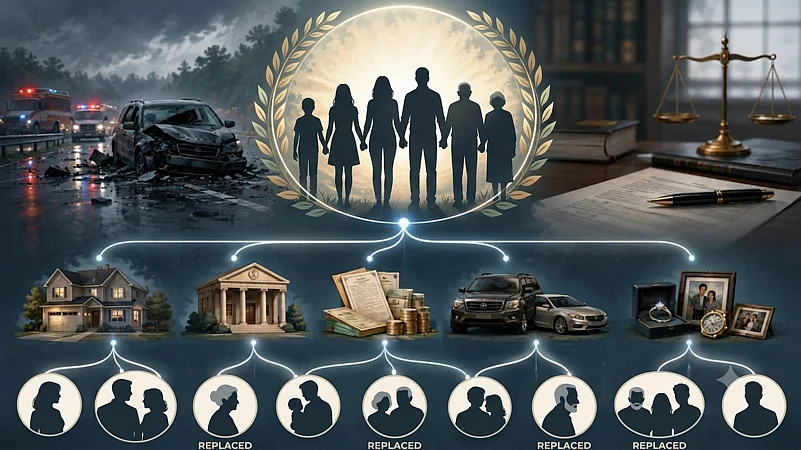


Summary of this article
What happens to a family’s assets when several or all members die in a single accident?
How is succession governed by personal laws?
How is the order of death presumed when property escheats to the government?
An accident and unexpected death can cause trauma to the surviving family members for the rest of their lives. Only the deceased's belongings remain to bring back memories of the member. However, when a full family is wiped out in an accident, the tragedy is inexplicable for the surviving near and dear ones. The recent tragic death of eight members of a family who stayed in a hotel in the Houz Rani area in Delhi to visit the eldest member of the family, an 80-year-old grandfather who was admitted to Max Hospital, Saket, is one such incident. All the family members, including the grandmother, son, daughter-in-law, their two daughters, maternal uncle, maternal aunt, and her husband, died in the inferno that engulfed a total of 21 people on June 3, 2026.
The ailing grandfather, who was admitted to the hospital on May 30 and was on ventilator support, is also no more. He passed away next week on June 9. An accident wiped out the entire family in one week, with the elderly patriarch’s passing away this Tuesday.
While the loss is catastrophic for the surviving relatives and friends of the family members, can they carry on the legacy of the deceased? In such heartbreaking tragedies, where the legal heirs also die in the same accident, how does succession take place?



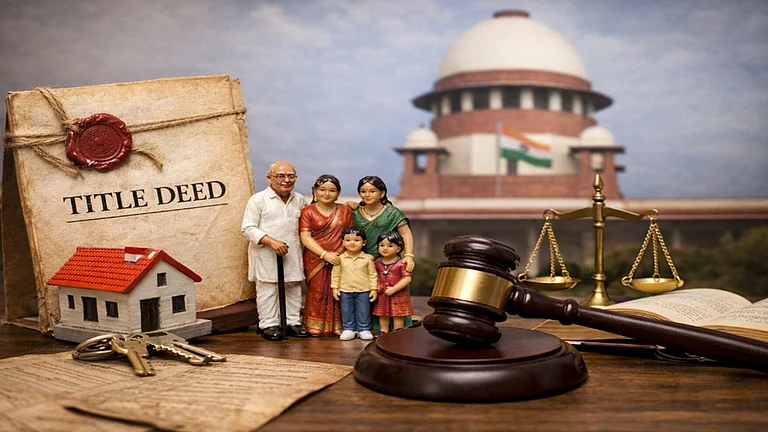

We asked experts about inheritance, insurance, and settlement of financial assets.
How Are A Family’s Assets Settled When Multiple Members Die In A Single Accident?
If there is a Will but no surviving legal heir, in such instances where there is no rightful owner, the property shall vest in the government.
Anjali Jhawar, Advocate, D.M. Harish & Co. LLP, says, “In the event multiple members die in a single accident or disaster where it is uncertain to determine the order of death, it is assumed, unless proven otherwise, that the younger survived the elder as per Section 21 of the Hindu Succession Act, 1956. In a case where there are no surviving legal heirs, the assets of the family would devolve on the government. It would mean that the government shall be entitled to the property subject to any obligations and liabilities, in accordance with Section 29 of the Hindu Succession Act (HSA), 1956.”
Devolution of assets becomes more nuanced if there is no surviving legal heir, both in the case of a will or intestate succession.
Varun Kalsi, Director – Private Client, Cyril Amarchand Mangaldas, says, “Succession in India is governed by personal laws: the Hindu Succession Act, 1956, applies to Hindus, Buddhists, Sikhs, and Jains; Muslims are governed by Sharia law; and other religions by the Indian Succession Act, 1925 (ISA).”
He adds, “Each deceased person's estate is treated individually. Under the HSA, intestate succession follows a hierarchy of heirs, with each class inheriting equally to the exclusion of lower classes. Under the ISA, property devolves first upon the surviving spouse, then upon kindred.”

What Happens When No Legal Heir Exists?
Kalsi says, “Where no heirs exist, the property escheats to the Government (under HSA) or devolves upon the nearest kindred (under ISA).”
Jhawar explains, “Escheat is a legal doctrine, which allows the state to take ownership of property in the absence of a rightful owner. The term ‘rightful owner’ refers to the last surviving legal heir of the deceased. Section 29 of the Hindu Succession Act specifically provides that if the intestate does not leave any heir qualified to succeed to his/her property, in such a case, the property shall devolve on the government.”
So, if the property belongs to a person covered under HSA who dies leaving no legal heir behind, the government becomes entitled to it, and if it belongs to someone under the ISA, it devolves upon the closest surviving family member.
Who Are The Legal Heirs?
Jhawar says, “The legal heirs and sequence of succession vary depending on the personal law applicable to the parties. For instance, for a male Hindu dying intestate, the legal heirs and the sequence of succession would be governed by Section 8, read with the Schedule provided in the Hindu Succession Act, 1956, where distant relatives are not covered as legal heirs. The Schedule covers relatives of the mother and father of a male Hindu; however, it does not cover the relatives of the grandfather or the grandmother.”
Typically, when three generations of a family die in the same incident, there remains no surviving legal heir. However, a surviving family member needs to check with an advocate the hierarchy of legal heirs under the law applicable to them.

When Some Or All Of The Deceased Had Life Insurance Policies, Who Can Claim The Proceeds?
Varun Agarwal, business head, term insurance, Policybazaar, explains, “The life insurance claims are generally payable even if multiple members of the same family die in a single accident, provided the policies were active, and all policy terms and disclosures were in order. The claim is usually payable to the legal heirs or legal representatives of the deceased policyholder, based on succession laws, wills, or court-issued documents such as a succession certificate or legal heir certificate.”
Legal Challenges For Surviving Relatives And What They Should Do
“The biggest legal challenge for any legal heir would be to understand and then prove their entitlement to the deceased's assets. Depending on whether there is a Will in play or not, one may need a probate or succession certificate to claim ownership of the deceased's assets,” says Kalsi.
Insurance and other financial assets, such as bank deposits, mutual funds, shares, etc., are easily transferred to the nominee, but when the nominee has also died, the surviving members must identify the rightful owner. And they should collect all the relevant documents to make the claim.
Kalsi suggests, “Firstly, they should work towards procuring the death certificate and any other documents such as a Will. If there is no Will, they should consult a legal professional for advice on applicable succession laws. Before doing so, they should try to take stock of all existing assets and liabilities of the deceased. Simultaneously, they should also reach out to their tax advisor for any tax compliance matters.”
Such tragedies are devastating when multiple members of a family die together or within a short span of time. While such unforeseen events are beyond anyone's control, prudent estate planning can ensure that assets, benefits, and personal wishes are passed on in a way that preserves the family’s legacy.