




India’s capital markets are older than most people assume. In 1875, decades before independence, a handful of Indian brokers put up their own capital to launch Asia’s first stock exchange in Bombay, ahead of Tokyo, Shanghai or Hong Kong, on a street that still carries an Indian name: Dalal Street. This paved the path for capital markets to become a part of India’s economic fabric over the last 150 odd years. Yet for most of that history, only a narrow section of the country participated in it, while household wealth sat in gold, land and deposits. What has changed over the last decade is that the investor awareness and access has increased, thereby opening up capital markets to everyone. Savers are gradually turning into owners of India’s growth.
As of 30-Jun-26, Mutual fund assets have grown six-fold in a decade to cross Rs 82 lakh crore. Folios have nearly tripled in five years to approach 28 crores, and the monthly SIP book has grown tenfold to cross Rs 30,000 crore, up from little more than Rs 3,000 crore a month a decade ago. A rising share of this comes from beyond India’s thirty largest cities, one in four investors is a woman, and twenty-somethings are among the most enthusiastic participants. Yet the runway ahead exceeds the road behind: around 6 crore Indians invest in mutual funds, in a country of 140 crore. India’s mutual fund AUM is close to a quarter of GDP, against the United States, where mutual fund assets alone exceed GDP.
Today’s investor is more inclined to let the instalment run and treat the fall as an opportunity. So, the money is invested regardless of the headline.
The more telling change is behavioral. In March 2026, the Sensex fell over 11 percent in a single month as global markets turned volatile; SIP contributions that same month touched a record Rs 32,087 crore. Equity schemes have now drawn net inflows for more than 60 months running, a stretch that has absorbed a pandemic, a war in Europe, tariff uncertainty and sustained foreign selling without a break. An earlier generation of investors bought into rallies and sold in panic; today’s investor is more inclined to let the instalment run and treat the fall as an opportunity. So the money is invested regardless of the headline.
This rests on four Ts: track record, transparency, technology and training, with trust as the outcome of all four. SEBI’s steady, investor-first reform agenda deserves real credit here, scheme categorisation has made products true to label, costs have turned globally competitive and disclosures now compare with the best anywhere
Financialisation has moved beyond mutual funds too. As of Mar’26, Alternative investment funds have gathered commitments of nearly Rs 17 lakh crore, up from Rs 8.3 lakh crore three years ago, REITs and InvITs have converted close to Rs 10 lakh crore (Jun’26) of roads, transmission lines and office parks into instruments an investor can own, and GIFT City now hosts over 350 fund schemes.
The shift carries weight beyond markets. As of March 2026, domestic institutions own about 20 percent of Indian listed equities against 16 percent held by foreign investors, the reverse of March 2016, when domestic institutions held near 12 percent and foreign investors over 21 percent. When global flows turned negative in recent years, Indian households kept investing and the market held its ground. That is what an Atmanirbhar capital market looks like in practice, with millions of households choosing, month after month, to become owners of India’s growth rather than merely being savers.
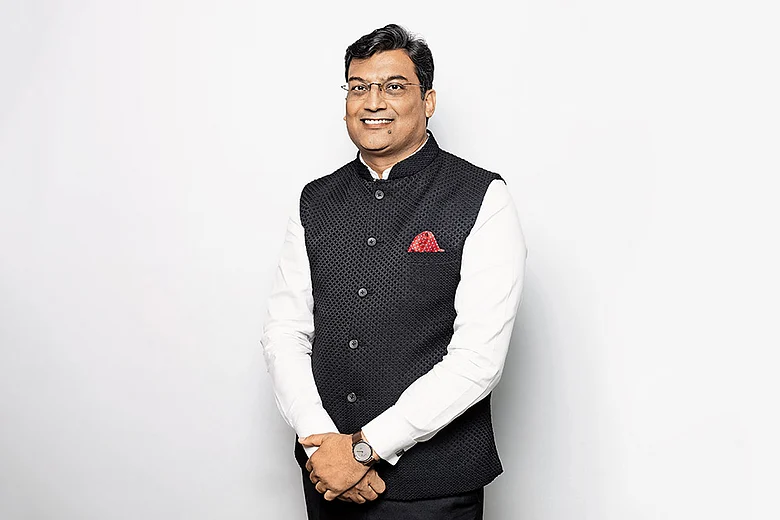
Disclaimer: The views expressed by Mr. Navneet Munot, MD and CEO of HDFC Asset Management Company Limited (HDFC AMC) are as of 20th August 2026. The views are based on internal data, publicly available information and other sources believed to be reliable.The statements contained herein are based on our current views and involve known and unknown risks and uncertainties that could cause actual results, performance or events to differ materially from those expressed or implied in such statements. Stocks/Sectors referred are illustrative and not recommended by HDFC Mutual Fund (“the Fund”)/ HDFC AMC. The Schemes of the Fund may or may not have any present or future positions in these sectors. It should not be construed as an investment advice or a research report or a recommendation by the Fund/HDFC AMC to buy or sell the stock or any other security covered under the respective sector/s. The Fund/ HDFCAMC is not guaranteeing any returns on investments made in the Scheme(s). Past performance may or may not be sustained in future and is not a guarantee of any future returns. HDFC Asset Management Company Limited (“HDFC AMC”) does not warrant the completeness or accuracy of the information herein. Neither HDFC AMC, nor any person connected with it, accepts any liability arising from the use of this material. The recipient(s) should before taking any decision, should make their own investigation and seek appropriate professional advice.
MUTUAL FUND INVESTMENTS ARE SUBJECT TO MARKET RISKS, READ ALL SCHEME RELATED DOCUMENTS CAREFULLY.
HDFC Mutual Fund: SEBI Registration Number: MF/044/00/6





