
Sponsored Content
Investment decisions are rarely straightforward, even under stable conditions. Complexity only increases when the environment turns uncertain. With trade tariffs, rising debt across developed and emerging economies, growth-inflation dynamics, supply chain disruptions, geopolitical tensions, wars and higher energy prices, a strategy that accounts for economic cycles becomes essential.
That’s where business cycle investing comes in. Its core idea rests on identifying the sectors best suited for the current macro environment and investing accordingly. A business cycle typically has four phases: growth, recession, slump, and recovery. In each phase, some sectors do well while others underperform.
How Cycles Shape Behaviour

1 August 2026
Get the latest issue of Outlook Money

Every phase of a business cycle shows distinct characteristics in corporate and consumer behaviour. In a growth phase, companies operate near full capacity, sometimes in three shifts. They plan capital expenditure and focus on expansion. Employees see multiple job offers. Consumers purchase discretionary goods such as white goods without hesitation. During a slump, businesses scale back expansion and reduce shifts to align with lower demand. Layoffs become common, and salaries are frozen or cut. Employees see few new job offers, and consumers hold back on purchases of cars, air conditioners, and similar durables.
Four Indian Market Episodes
How does this play out in practice? The Indian market over the past two decades offers useful illustrations. Here are four distinct episodes where the prevailing cycle phase, both domestic and global, directly shaped which sectors outperformed.
In 2008-2009, domestic growth was in strong recovery, even as global growth was weak. Pharma, technology and FMCG delivered well. During 2013-14, global growth was in a neutral zone, and domestic growth was recovering. Consequently, banks and auto stocks did well. From 2018 to 2020, the domestic economy was in recession, while global growth was strong. Technology, pharma, and FMCG outperformed. In 2021, global growth was strong while the Indian economy recovered, and banks, capital goods, and related sectors did well.
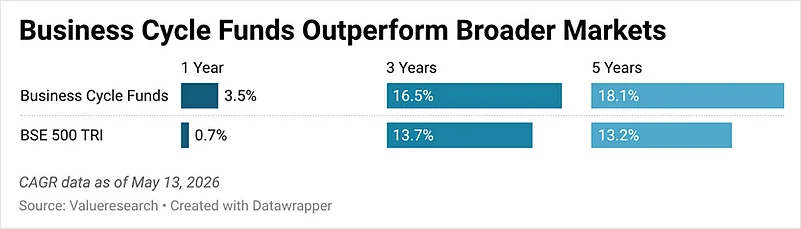

A Top-Down Framework
A well-defined process is essential, and a top-down approach is key. Domestic and global macro conditions must be tracked to identify the prevailing phase. Sectors aligned with that phase, and stocks within them, are then selected.
Several factors help identify the current phase. Macro parameters include fiscal deficit, current account deficit, industrial production growth, inflation, interest rates, credit growth, and capacity utilisation. Investment indicators include capital expenditure, new projects, and the government’s project pipeline.
Sentiment indicators include the purchasing managers’ index, business confidence index, and sales figures for discretionary goods such as cars, two-wheelers, air conditioners, etc. Global factors include developed economies’ growth and policy outlook, employment data, etc.
There should be no caps on market cap segments, themes, or sectors.
An Ideal Option For Retail Investors
For retail investors, business cycle funds offer a practical way to participate, as fund managers take macroeconomic and investment calls based on rigorous internal models and research. Instead of tracking multiple indicators themselves, they can delegate rotating sectors and market caps to professional managers as the cycle evolves. The downside is reliance on the manager’s ability to read the macro environment correctly.
Disclaimer: This article is written by Vijay Patel, Mutual Fund Distributor. The views expressed are his own. This is partner content and not an Outlook Money editorial feature. Outlook Money does not provide investment advice or endorse any products or services mentioned.
Mutual Fund investments are subject to market risks. Read all scheme-related documents carefully.
Disclaimer: The Views are Personal and not a part of the Outlook Money Editorial Feature