





Summary of this article
Gifts exchanged between a brother and sister are generally tax-free in the hands of the recipient.
Under the income-tax rules, a brother or sister qualifies as a “relative”. Therefore, the Rs 50,000 threshold that normally applies to gifts received from non-relatives does not apply when the gift comes from a sibling.
A bank transfer with a clear narration, a simple gift declaration and supporting purchase documents for gold or investments can help establish that the transaction was genuinely a gift and not a loan, repayment or undisclosed income.
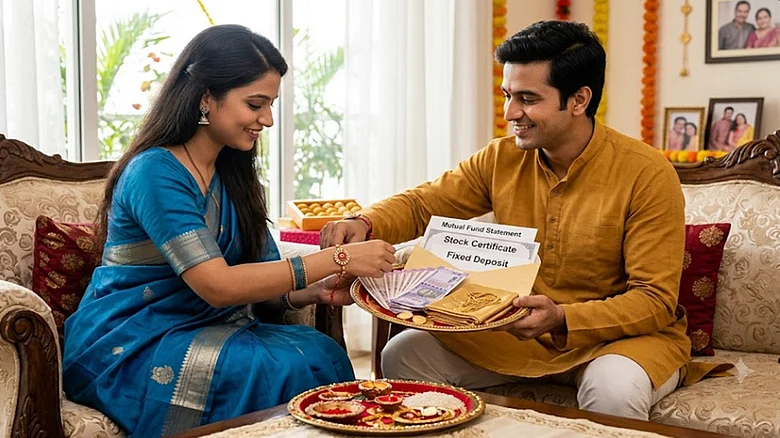
Raksha Bandhan is traditionally about a thread, a box of sweets and a promise to stand by your sibling. But increasingly, brothers and sisters are also exchanging gifts that can have a meaningful financial value - cash, gold, shares, mutual fund units or even investment accounts.
That raises a practical question: Will the gift attract income tax?
The good news is that gifts exchanged between a brother and sister are generally tax-free in the hands of the recipient. Under the income-tax rules, a brother or sister qualifies as a “relative”. Therefore, the Rs 50,000 threshold that normally applies to gifts received from non-relatives does not apply when the gift comes from a sibling.
Cash: No Tax, Even If It Is A Large Amount
Suppose a brother transfers Rs 1 lakh, Rs 5 lakh or even Rs 10 lakh to his sister as a Raksha Bandhan gift. There is no income tax in the sister’s hands merely because she received the money, provided it is genuinely a gift from her brother.
The Rs 50,000 rule often creates confusion. It applies to monetary gifts received from persons who are not covered by the definition of relative. If such non-relative gifts cross Rs 50,000 in aggregate during the year, the entire amount can become taxable - not merely the amount above Rs 50,000.
For sibling gifts, however, this threshold is irrelevant because brothers and sisters fall within the specified relative category.
Still, a large transfer should ideally move through banking channels rather than as unexplained cash. Keeping a simple gift deed, bank trail or written record can make the nature of the transaction easier to establish if questions arise later.

Gold: Tax-Free As A Gift, But Keep The Purchase Trail
Gold jewellery, coins or bullion gifted by a brother or sister are also generally outside the gift-tax provision because jewellery and bullion are among the specified movable properties covered by the rules, while gifts of such property from specified relatives are exempt.
So, if a brother buys a Rs 2 lakh gold chain for his sister, the sister does not have to pay income tax simply for receiving it.
But there is an important distinction: tax-free receipt does not mean tax-free forever. If the sister later sells the gifted gold, capital-gains tax can arise on the sale. The tax treatment will depend on the applicable rules and the holding period.
It is, therefore, sensible to retain the purchase invoice and some record of the gift. These documents can become useful when establishing the cost and ownership history at the time of a future sale.
Shares And Mutual Funds: No Tax On Receiving, Tax May Come Later
A sibling can also gift listed shares, mutual fund units or other eligible investments. The receipt itself is generally not taxable when the donor is a specified relative. Shares and securities are specifically covered as prescribed movable property under the gift provisions.
However, investors should not confuse gift tax exemption with exemption from capital gains.
If the recipient later sells the gifted shares or units, capital gains may be taxable. The recipient generally steps into the donor's shoes for determining the cost and holding period under the applicable capital-gains provisions. The Income Tax Department also treats shares and equity-oriented mutual fund units under specific holding-period rules for determining whether gains are short- or long-term.
For a sibling who is financially independent, therefore, gifting an investment can sometimes be more meaningful than handing over cash. You aren't creating a tax liability with the gift itself and the investment can continue to grow towards their future financial goals.
Says Harsh Rustagi, Consultant, Nangia & Co LLP: “Under the Income-tax Act, 2025, gifts received above Rs 50,000 in a tax year can be taxable as ‘Income from Other Sources’, subject to certain exemptions. The good news is that gifts received from specified relatives are fully exempt, with no limit on their value. Siblings are covered within the definition of specified relatives.”
“Gifts received on the occasion of one’s own marriage are also fully exempt, regardless of their value or who gives them. So, while a Raksha Bandhan gift may be valuable, it does not necessarily mean a tax bill. Keeping documents such as bank statements, gift deeds and purchase invoices can also help establish the source and nature of valuable gifts,” he adds.
The Bigger Point: Document The Gift
The tax rules are relatively friendly when gifts move between close relatives, but documentation still matters - particularly for high-value gifts.
A bank transfer with a clear narration, a simple gift declaration and supporting purchase documents for gold or investments can help establish that the transaction was genuinely a gift and not a loan, repayment or undisclosed income.
And remember, the exemption applies to the gift received. Any income generated from that asset - such as interest, dividends, or capital gains on a subsequent sale - can have its own tax implications.
So, this Raksha Bandhan, whether the gift is Rs 11,000 in cash, a gold bracelet or a portfolio of mutual fund units, the taxman is generally not the third sibling at the family celebration. A genuine gift between a brother and sister is tax-free at the time of receipt - but what happens to that gift afterwards can create a separate tax story.





