

Summary of this article
Income-Tax Department tracks only high-value transactions reported by banks, registrars.
No monitoring of emails, apps, social media, or routine digital spending.
Large cash deposits, property deals, investments trigger statutory reporting.
Matching AIS, Form 26AS with income declared reduces scrutiny risk
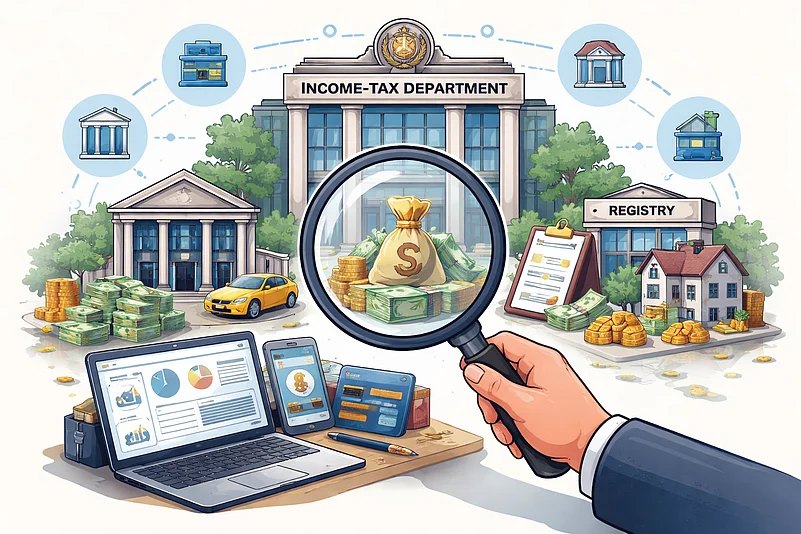
As taxpayers file their income-tax return (ITR), one question routinely troubles them: how much does the Income Tax Department actually know about their financial life? The answer is far narrower than the popular belief, with the department relying only on a defined list of high-value transactions reported through statutory channels.
The department scrutinises the financial data that is mandatorily shared by banks, financial institutions, registrars, and intermediaries when certain thresholds are crossed. These disclosures are embedded in law and are designed to flag potential mismatches between income declared and money spent or invested.
Transactions That Are Reported
Most reporting happens quietly in the background through third parties. Individuals are not required to separately inform the tax department when these transactions occur.
Banks report large cash deposits made during a financial year, whether in savings accounts or fixed deposits. Current accounts, which are mainly used for business transactions, are subject to higher reporting thresholds. Credit card companies also share information when spending crosses prescribed levels, especially where significant cash payments are involved, or total annual usage exceeds set limits.
The income tax department also monitors investment activity. Large transactions in market securities are reported through registrars and depositories. Property deals above the prescribed value are also reported by sub-registrars.
What Stays Outside The System
Despite persistent rumours, the tax department does not track routine digital behaviour. Every day, online purchases, small bank transfers, regular Unified Payments Interface (UPI) transactions, and normal credit card spending remain outside automatic reporting as long as they stay within defined limits.
There is also no monitoring of personal lifestyles. Social media activity, travel patterns, app usage, and communication platforms are not part of the tax department’s information pipeline. The system is transactional, not observational, according to a report by Moneycontrol.
This distinction matters, particularly for salaried individuals and retirees who often worry that ordinary spending could invite scrutiny. In most cases, it does not.

3 September 2026
Get the latest issue of Outlook Money

Why Taxpayers Should Still Be Careful
While the scope of tracking is limited, high-value transactions leave a permanent paper trail. These details are reflected in documents such as the Annual Information Statement (AIS) and Form 26AS, both of which taxpayers are expected to review before filing their returns.
Issues arise when significant investments or purchases are not supported by disclosed income. Even legitimate transactions can attract queries if the source of funds is unclear or missing from an ITR.
The solution is straightforward: accurate disclosure, proper reconciliation, and clear documentation. When income and reported transactions tell the same story, the chances of follow-up notices reduce sharply. The takeaway for taxpayers is simple. The Income-Tax Department does not watch how people live, but it does pay attention to large financial moves.
This distinction matters, particularly for salaried individuals and retirees who often worry that ordinary spending could invite scrutiny. In most cases, it does not.