






Summary of this article
RBI rounding rules do not automatically settle every credit card bill.
Late fees apply only after an account is past due.
Late charges should be calculated on the outstanding amount.
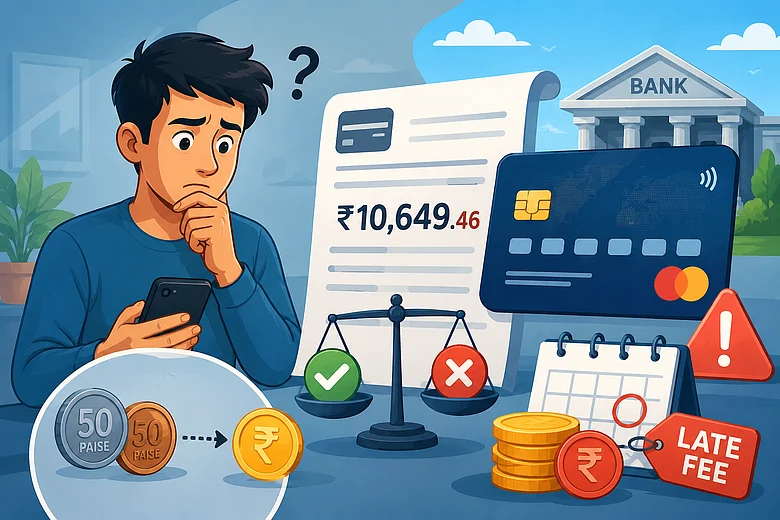
A difference of 46 paise would barely register in most everyday payments. But on a credit card bill, even such a small gap can raise questions about whether the bill has been fully paid and whether a late-payment charge can follow.
This came into focus after a credit card customer reported being charged more than Rs 1,200 after paying Rs 10,649 against a bill of Rs 10,649.46. The case has drawn attention to RBI's rules on rounding off banking transactions and its separate rules on credit card late-payment charges.
Does RBI Round Off The 46 Paise
The Reserve Bank of India (RBI) has a general provision for rounding off banking transactions to the nearest rupee. Under the rule, a fraction below 50 paise is ignored, while 50 paise or more is rounded up.
On that basis, Rs 10,649.46 would be rounded to Rs 10,649.
But there is a catch. A rounding rule does not necessarily mean a credit card customer can pay the rounded figure and assume the bill is fully settled. The amount due on the card statement and the manner in which the issuer records the payment are relevant.
That is why the distinction between a rounded transaction amount and the amount outstanding on a credit card account matters.
The Three-Day Rule For Late Fees
The three-day threshold is not a new 2026 rule. According to the RBI's Master Direction on Credit Card and Debit Card, issued in 2022, an account has to stay 'past due' for more than three days before any late-payment charges and other related penalties can be levied.
The same framework also requires late-payment charges and penalties to be calculated on the outstanding amount after the due date, rather than the total amount billed.
If a Rs 25,000 credit card bill is partly paid, and Rs 3,500 is unpaid after the due date, any late-payment charge should be calculated on the outstanding amount (Rs 3,500), not the original bill (Rs 25,000).
What If A Few Paise Is Unpaid
Take a bill of Rs 18,500.35. If the cardholder pays Rs 18,500, the difference is only 35 paise.
If the card issuer records that 35 paise as an outstanding amount, the payment may not match the exact amount shown as due. The customer should therefore check the statement and payment record rather than assume that the difference has been automatically adjusted.
The size of the shortfall, however, is not the only factor in determining whether a late fee can be charged.
Takeaway For Cardholders
The provision for rounding off and the late-payment provisions address different parts of the payment process. Rounding determines how certain banking amounts are expressed, while the credit card rules determine when an overdue account can attract late-payment charges and how those charges are calculated.
For cardholders, the safest approach is to check the exact amount payable on the statement, particularly where the bill contains paise. If a charge is imposed after a small shortfall, the customer can check the payment date, amount paid, amount outstanding and the calculation used by the issuer.





