Summary of this article
India raised petrol and diesel prices four times recently.
Falling global crude oil fails to lower domestic pump rates.
Oil marketing companies face losses, triggering further price hikes.
India awoke to the news of the fourth hike in petrol and diesel rates in less than 11 days on May 25. Notably, petrol prices were hiked by Rs 2.61 per litre and diesel prices were increased by Rs 2.71 per litre. Since the first fuel hike announced on May 1, fuel prices have increased by nearly Rs 7.50 per litre in less than two weeks.
Why Are Prices Rising Despite A Dip In Crude Oil Prices?
Even as crude oil prices dipped, fuel prices rose in India. And it is unlikely that the current fuel hike will be the last one. While the global crude oil benchmark dipped below the $100 per barrel mark the structural risks in the energy market supply chain are still present.




Following the price hike, Union Finance Minister Nirmala Sitharaman also spoke about the current trend of rising fuel prices and how it is impacting both the government and citizens. In her address at the foundation day of SIDBI, Sitharaman said that the government has been absorbing a significant part of the global energy price hike to protect citizens from the full brunt of the volatility in global energy markets. Sitharaman said that currently the government has sacrificed Rs 1 lakh crore of revenue by reducing the excise duty on diesel and petrol to manage the supply crunch.
In her address the Finance Minister highlighted that the ongoing crisis in West Asia, is far more than a diplomatic issue. Due to India’s heavy dependence on crude imports, tensions in the region directly translate into higher shipping costs as the Strait of Hormuz remains disrupted. The downward movement in spot crude prices fails to lead to immediate reductions in pump prices as the overhead costs of moving oil continue to act as a headwind.
The pressure is further compounded by the financial strain on state-run Oil Marketing Companies (OMCs) such as Indian Oil Corporation, Bharat Petroleum, and Hindustan Petroleum. While stocks of the companies rallied today amid the rise in pump prices and dip in crude oil prices, the pressure on their business still looms large.
According to a statement by Sujata Sharma, Joint Secretary in the Ministry of Petroleum and Natural Gas given on May 18, despite the first two retail fuel price hikes, the industry was still absorbing losses to the tune of nearly Rs 750 crore per day across auto fuels and domestic LPG.
According to a report by credit rating agency, ICRA before the recent streak of price corrections began, OMCs were losing an estimated Rs 14.00 per litre on petrol and Rs 18.00 per litre on diesel due to surging international crude prices.
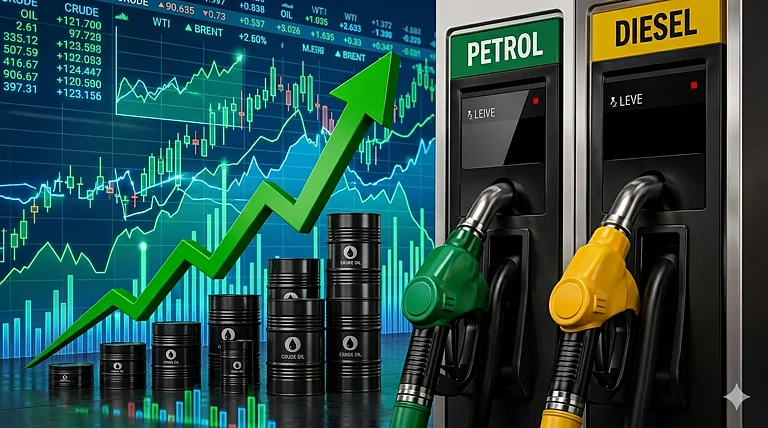
Post the government tax cut and the fuel price hike the loss is expected to be lower. On the tax front, the government's excise duty cuts provided relief of Rs 5.00 per litre for petrol and Rs 6.00 per litre for diesel. Additionally, the recent retail fuel price hikes passed an additional Rs 5.80 per litre for petrol and Rs 4.50 per litre for diesel onto consumers.
Upon adding these, the total cost recovery stands out to be Rs 10.80 per litre for petrol and Rs 10.50 per litre for diesel. When compared to the initial deficit mentioned in the ICRA report, it is estimated that OMCs are still losing nearly Rs 3.20 per litre on petrol and Rs 7.50 per litre on diesel based on long-term average product spreads. Thus until retail prices catch up sufficiently, further pump price revisions remain highly likely.
Why Higher Fuel Rates Are Cause of Worry
The rise in petrol and diesel rates creates a cascading effect throughout the economy, heavily impacting both businesses and ordinary citizens. For businesses higher diesel rates increase their raw input costs and shrink their working capital which in turn can impact their future profitability. On the other hand, for the common person the impact is visible in the form of a bigger monthly fuel bill, squeezing household budgets. On the other hand, the impact on businesses is also passed on to the consumers as higher fuel costs increase the transport costs for food, daily essentials, and consumer goods.