





Summary of this article
Indian US ETFs show massive, artificial price distortions recently.
RBI investment caps halted new ETF unit creation completely.
Always verify the real-time iNAV before buying international ETFs.
With the recent rally in global markets, domestic investors across portfolio sizes are now looking for opportunities to diversify their portfolios by investing in exchange-traded funds (ETFs) that track foreign markets.
A key driving factor behind this trend is the investment opportunity provided by ETFs tracking foreign indices, such as the Nasdaq 100 or the S&P 500, which offer investors exposure to global tech giants and other stocks listed on the Wall Street.
The Gravity Defying Returns of US Tracking ETFs
Amid this investor interest, the performance of several US ETFs listed in India, such as Motilal Oswal Nasdaq 100 ETF or Mirae Asset NYSE FANG+ ETF have seen a sharp surge in price. Between September 3 and September 9, 2026, the traded prices for several prominent US tracking ETFs saw big and seemingly inexplicable jumps in market price in five trading sessions.




The data below highlights these short-term price surges seen in ETFs, such as the Motilal Oswal Nasdaq Q 50, Mirae Asset S&P 500 Top 50, Mirae Asset NYSE FANG+, and Motilal Oswal NASDAQ 100.
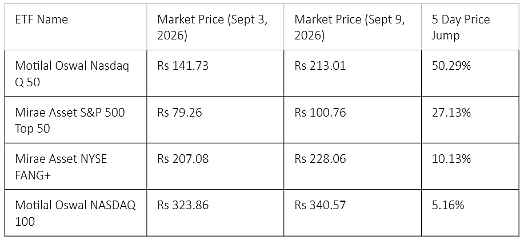

In the past five sessions, these ETFs have seen gains between 5 per cent and 50 per cent. Notably, such double digit gains are surprising for ETFs in such a short span of time. However, most of these gains came on September 7, when the US stock markets were closed for the Labor Day public holiday. Thus, the actual underlying US tech stocks held by these funds did not even trade, meaning their true net asset value (NAV) remained entirely static.
At the same time, in India, the traded market price of Motilal Oswal Nasdaq Q 50 ETF surged from Rs 141.93 to Rs 164.09, while the Mirae Asset S&P 500 Top 50 ETF jumped from Rs 79.86 to Rs 85.90, even as the US market remained closed.
In ETFs, the absolute NAV is simply the per unit worth of the underlying assets. A fund with an NAV of Rs 150 is not necessarily performing better than one with an NAV of Rs 15, because the actual returns are measured by percentage growth of the underlying assets.
When an investor sees a 50 per cent jump on their brokerage app while the actual underlying market is barely moving or entirely closed, they are not seeing superior fund performance, but instead a market distortion.
Manasvi Garg, CFA and Founder and CEO of Moneyvesta Wealth Management, a Sebi Registered Investment Advisory (RIA) highlighted the structural differences across global exchanges.
"The time-zone difference is another important factor. Indian markets can remain open when US markets are closed, meaning the US securities used in calculating the indicative value may still reflect the previous US closing prices. As a result, the ETF can trade in India based on new information, currency movements and domestic demand even though the underlying US securities are not currently trading," Garg said.
What Is Driving ETF Prices Higher?
One of the key reasons behind the price distortion seen in ETFs is a regulatory supply freeze. The Reserve Bank of India (RBI) has capped the total overseas mutual fund investments at $7 billion, alongside a $1 billion sub-limit for ETFs. In early 2022, the domestic mutual fund industry exhausted these limits.
"The $7 billion industry-wide limit was effectively exhausted in 2022, and the $1 billion ETF-specific sub-limit was separately exhausted later, following which several international schemes restricted or stopped fresh investments," Garg said
Thus, fund houses cannot remit additional capital abroad to buy underlying US equities. This, in turn, forces them to stop creating fresh ETF units. Without authorised participants being able to create new units to arbitrage price discrepancies, the supply of these ETFs on the exchange remains locked. However, the sustained retail demand for exposure in US stocks bids up the finite pool of existing units. This buying side pressure drives traded prices to artificial premiums over the actual underlying value of the ETF’s units.
This lock on the creation of new units directly translates to an imbalance on the exchange.
"When fresh units cannot be created easily but demand for existing units remains strong, investors have to buy units from other investors on the exchange. This can create a scarcity premium, pushing the exchange-traded price above the underlying value," Garg said.
The Perils of Investing in India-Listed US ETFs
Buying ETFs when they are experiencing such price distortions can potentially expose investors to several risks. Notably, these are not just limited to ETFs which track equities listed on foreign indices, but also gold ETFs and silver ETFs which see similar demand-supply related issues.

The NAV Mismatch
Consider this, if you buy the Motilal Oswal Nasdaq Q 50 ETF at a premium over its intrinsic value, the underlying US index must rise by that exact premium percentage just for you to break even on real value. However, even if it does rise, you are paying for tomorrow’s anticipated gains today.
It is crucial for market participants to comprehend the difference between a fund's intrinsic worth and its trading price to avoid misjudging their investments.
"The most important distinction for investors is between NAV, iNAV and the exchange-traded price. For example, if the iNAV is ₹100 but the ETF is trading at Rs 120, an investor is effectively paying a 20 per cent premium to the estimated underlying value. If that premium subsequently disappears, the investor can suffer a significant loss even if the underlying US index itself has risen," Garg said.
The Policy Change Risk
As there is a supply crunch of ETF units due to the RBI’s cap, hypothetically, if the central bank and the Securities and Exchange Board of India (Sebi) decide to raise the overseas investment caps, mutual funds will resume creating new units. The sudden influx of fresh supply can potentially cause the market price premium to collapse toward the real NAV, thereby instantly erasing investor capital even if the US market stays perfectly flat.
Currency and Time Zone Fluctuations
Since such ETFs trade in rupees while holding dollar assets, an investor’s holding carries ongoing exchange rate volatility alongside the pricing lag between Indian and US market operating hours.
Why Checking iNAV Is Important
Investing in ETFs which track foreign markets is a sound strategy to diversify your portfolio and increase your exposure to markets which may have stocks from industries which might not be there in the domestic market, such as artificial intelligence (AI) stocks or shares of chipmakers. However, before placing a buy order for an international ETF, investors should verify the indicative NAV (iNAV). The standard NAV is published once at the end of the day, while the iNAV provides a real time estimate of the ETF’s per unit value throughout its trading hours.

To check the iNAV, you can either look directly in your trading app by searching for the ticker with an iNAV suffix, or visit the official website of the asset management company (AMC).
Fund houses update the live iNAV on their specific ETF pages frequently during market hours. If the traded market price you see on your app is significantly higher than the live iNAV on the AMC website, you could be paying a higher premium for your investment than its actual price.
"Checking iNAV before investing therefore provides an important price-discipline mechanism. It allows an investor to assess whether the exchange price is broadly in line with the underlying value or whether they are paying an unusually high premium because of scarcity or strong domestic demand," Garg said.
Investors can also consider exploring other regulated avenues for international exposure.
"With the development of GIFT City/IFSC, investors have an additional route to access international investments through products offered from the IFSC. This can provide an alternative when an India-listed overseas ETF is trading at an unusually high premium," Garg said.





