






Summary of this article
Bond yields have risen despite RBI's rate cuts
Experts see yields hardening as rate cut cycle is seen near its end
Here are what could lead to movement in bond yields in 2026
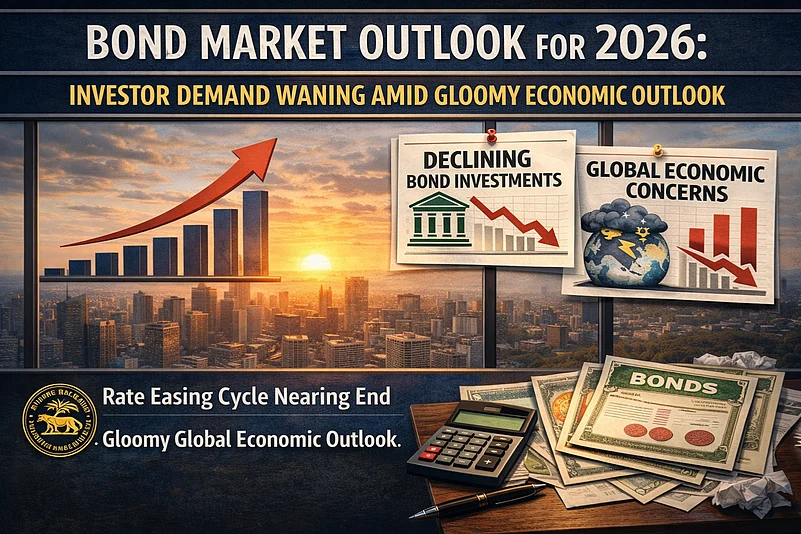
Indian bond yields have risen in December despite the Reserve Bank of India easing the key policy rate. The benchmark 10-year government bond yield is hovering around 6.67 per cent, with over 1.4 per cent interest rate differential with the benchmark repo rate of the country, which was lowered this month to 5.25 per cent. Institutional investor demand has waned as they see the rate easing cycle of the RBI to be mostly done, and a gloomy global economic outlook also drags investments into the bond market.
Market experts are of the view that bond yields will hover around similar levels in 2026 and have limited scope for a fall, with some expecting yields of the 10-year benchmark bond to gradually inch towards 7 per cent by the end of December. While global pressures are expected to limit inflows into the debt market, investors are also concerned that the gross borrowing of the government will increase in the upcoming financial year due to higher redemption pressures.
“Next year (FY27), the issue becomes the fact that the overall gross supply will be high because redemption is also high...around Rs. 10 lakh crores, centre plus state,” said Gaura Sengupta, chief economist at IDFC First Bank. “I would say it's the only thing that can change market sentiment, which would be that if we get some positive news, and usually it is, I think in around January when they'll give some positive indication about possible inclusion of India into the Bloomberg Bond Index.”
Experts agreed that a very limited downward bias on bond yields remains, and possible inclusion of Indian bonds into global bond indices and RBI’s support in the market through bond purchases could be the only two cues which could drive down yields.
Due to continued intervention of the RBI in the foreign exchange market to arrest the fall of the rupee, the RBI is expected to continue buying bonds and undertake other measures to counter the liquidity outflow in the banking system caused by the RBI’s dollar sales. RBI’s bond buys through open market operations are expected to continue, with market participants hoping for another Rs. 1-2 lakh crore of liquidity to be infused in the final quarter of the current financial year.
However, the fall in yields due to the RBI’s bond buys alone could be muted. The RBI, along with reducing the key policy rate in December, also infused Rs. 1 lakh crore of liquidity through OMO auctions, and conducted a $5 billion dollar-rupee buy-sell swap. But these actions did little to trigger any softness in bond yields.
“Liquidity conditions will remain slightly on the tighter side, and RBI had to continue on their current stance on liquidity when they want, I mean, for a longer period of time. So let's say at least through H1 they do want to maintain liquidity comfortable, and if risk sentiments don't remain comfortable or favourable, then balance payment may not remain favourable,” Upasana Bharadwaj, chief economist at Kotak Mahindra Bank, said.

Experts said that a fall in bond yields could come if, in addition to the RBI’s bond buys, Indian bonds are included in the Bloomberg Global Market Index, a decision of which could be announced in January. If Indian bonds are added to the index, foreign inflows to the tune of $25-30 billion are expected to come. As the best-case scenario, experts agree that the 10-year bond yield could drop as low as 6 per cent if the volatility in the rupee reduces and a trade deal with the US is reached.
A minority part of the market also expects a slight fall in bond yields if there is another rate cut of 25 basis points by the RBI’s Monetary Policy Committee sometime in February or April, on expectations that inflation print could remain benign.
“We expect bond yields to fall from current levels due to benign inflation trends and continued infusion of liquidity by RBI through OMOs and a 25 basis repo rate cut,” Abhishek Kumar, a Securities and Exchange Board of India (Sebi)-registered investment advisor (RIA), said.
Market participants and experts said that foreign capital inflows into the debt segment could see an uptick in the upcoming year, due to the possible index inclusion and if there is clarity on the trade deal with the US.
“Foreign flows in debt could remain modest but gradually improve through 2026. The recent outflows reflect the year-end portfolio rebalancing and yen carry trade unwinding and are not due to structural weakness,” Kumar said.

However, most experts were of the opinion that a pickup in inflows in the equity segment due to repositioning of portfolios could be more than that in the debt segment, especially until global economic uncertainty persists. This was also followed by the monetary policy tightening in Japan’s interest rates, which triggered a reversal of yen-carry trades.





