





Summary of this article
RBI rate easing cycle is seen nearing end
Bond market traders shift to other cues such as US India trade, tariff news
The Reserve Bank of India (RBI) has slashed the benchmark repo rate by 125 basis points (bps) this year. On the other hand, the US Federal Reserve has lowered its benchmark rate by 25 bps in December, and projected a higher bar for future rate cuts. Now, bond market traders are looking for other cues to drive down yields, though most expect India’s bond yields to remain range-bound due to uncertainty on the global macroeconomic front.
What are Bond Traders Eyeing
India's 10-year benchmark bond is currently giving a yield of 6.59 per cent. A fall in yields leads to rise in bond prices, and vice-versa. Here’s what market participants are looking at which could further drive bond yields.
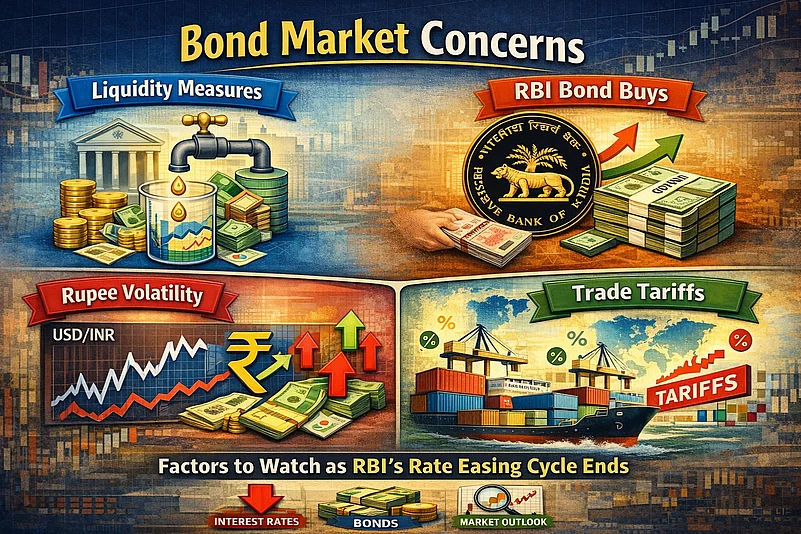
Liquidity Measures: The RBI has announced a slew of liquidity infusing measures. It has bought Rs. 50,000 crore of government bonds, and conducted a second tranche of infusion through another open market operation (OMO) auction of the same amount, due on December 18. Today, the RBI is conducting a $5 billion dollar-rupee buy-sell swap to infuse rupee liquidity in the market. While the rupee is hovering around record lows, bond market traders will look at measures taken by the RBI to offset the outflow.
Along with this, OMO auctions are also expected to limit rise in bond yields in the secondary market with the RBI spreading its bond buys across different maturities. Along with that, movement of overnight rates depending on available liquidity in the banking system will be something market participants will look at.

“Liquidity is going to remain a critical driver of bond yields, particularly at the short to medium end of the curve. If surplus liquidity is made available either due to RBI operations or due to capital inflows, it could compress money market and shorter tenure yields, whereas tight liquidity or bigger government borrowing would steepen the curve and increase volatility in bond prices,” said Abhishek Kumar, a Securities and Exchange Board of India -registered investment advisor (Sebi RIA).
Trade Restrictions Or Tariffs Easing: Investors are waiting for the India-US trade negotiations to reach an outcome. Most market participants are expecting the 50 per cent tariff imposition on Indian goods to be brought down. A trade deal or any development on trade and tariff negotiations could determine the RBI monetary policy committee’s (MPC’s) policy stance. Market participants see gross domestic product (GDP) growth to be under pressure in the second half of the current financial year due to higher tariffs on India and many other Asian peers. However, with the trade deficit expected to widen due to the tariffs, the government may opt to fund some of the deficit by increasing bond borrowings, which could lead bond yields to rise, they said.
Volatility In Rupee: As long as a trade deal between the US and India is not attained, the rupee is expected to keep falling. Most bond traders remain in a risk-off sentiment due to the falling rupee as foreign portfolio investors (FPIs) sell Indian bonds due to the depreciating rupee.
“Rupee is in a falling bias and though it could be a good entry point for foreign investors, the sales are more because there is still no certainty how much more depreciation in rupee is left,” a bond dealer at a private sector bank who wished to remain unnamed, said.

Index Inclusion: Some market participants expect foreign inflows to pick up if Indian bonds are included in another global bond index. Bloomberg is expected to announce whether it is going to include Indian bonds in its Global Aggregate Index in January.
“If that happens then it could trigger steady foreign inflows over multiple years. While the headline numbers can be large, the effective impact will depend on how quickly global funds adjust their allocations, the liquidity of eligible securities, and how domestic macro and currency conditions evolve during the inclusion window,” Kumar added.





