





Summary of this article
Infrastructure development has consistently gone in parallel with Gurugram’s real estate evolution. Whenever a new road or expressway is built or an aspect of connectivity is upgraded in the city, it unlocks a new phase of growth, investment, and demand.
Residents and commuters are already benefiting from shorter travel times, easily accessible airport facilities and reduced commute stress while traveling between Delhi and Gurugram.
As these corridors continue to evolve, Gurugram remains one of India’s strongest examples of how infrastructure-led development can sustain real estate momentum over the long term.
Gurugram’s real estate growth has long been characterised by the presence of robust infrastructure. The connectivity facilitated by infrastructure developments has aided the city’s geographical and economic expansion, in addition to enhancing the investment appeal. Several corridors along the region have matured and emerged as key catalysts in shaping market sentiment and long-term value creation.
Infrastructure development has consistently gone in parallel with Gurugram’s real estate evolution. Whenever a new road or expressway is built or an aspect of connectivity is upgraded in the city, it unlocks a new phase of growth, investment, and demand. While improved infrastructure has allowed residents to commute conveniently, it has also unlocked new areas for real estate development in the city over the years.
One of the biggest examples of this shift is the Dwarka Expressway. For the last few years, the expressway has remained at the centre of Gurugram’s real estate conversations. 2023-2024 was a record period for anticipation from developers, buyers and investors alike for the stretch, especially during its launch phase. And now that the Delhi stretch has been fully operational since 2025, it has truly become one of North India’s most prominent connectivity corridors, linking Delhi, IGI Airport and Gurugram’s key business districts together.
Residents and commuters are already benefiting from shorter travel times, easily accessible airport facilities and reduced commute stress while traveling between Delhi and Gurugram. It was only natural for real estate demand to heat up around the corridor too. Buyers who had purchased properties along the corridor hoping to gain from long-term price appreciation are now experiencing the benefits. Along the Dwarka Expressway, real estate prices have reportedly gone up by up to 58 per cent in a year. Additionally, average NCR residential prices reached a new high of Rs 8,570 per sq ft in 2024.
Today, the story of the Dwarka Expressway doesn’t just revolve around long-term potential. We are already witnessing the development coming to life. New housing societies are being occupied, commercial activity is increasing and top developers are launching large-scale luxury and world-class township projects with contemporary amenities. The corridor is attracting city slickers, high net worth individuals and NRIs who value connectivity along with a high-quality lifestyle and promising appreciation potential.
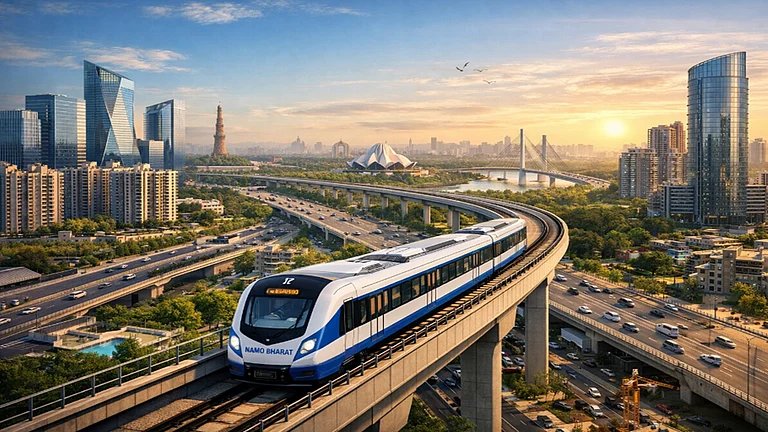
The Southern Peripheral Road (SPR) corridor is another major growth driver that continues to witness increasing interest with ongoing development of elevated road infrastructure and improvement in connectivity. Though it was announced earlier and is not new in itself, regular construction milestones have kept the corridor in focus. SPR has emerged as a strategic link connecting Golf Course Extension Road, Sohna Road, NH-48, and Dwarka Expressway, making it one of Gurugram’s most important mobility spines. The corridor has also emerged as one of NCR’s most active luxury housing belts.
According to JLL, SPR accounted for nearly 39 per cent of Gurugram’s ultra-luxury housing sales in H1 2025, with Gurugram itself contributing 91 per cent of all luxury home sales in Delhi-NCR during the period. Prices for residential properties along SPR have witnessed a significant uptick from approximately Rs 7,690 per sq. ft. in 2020 to around Rs 17,300 per sq. ft. in mid-2024, driven by strong end-user demand, enhanced connectivity, and consistent availability of premium housing options. The recent resolution of land acquisition hurdles across key missing stretches between Sectors 62–65 and 71–73 is further expected to strengthen the corridor’s long-term growth momentum.
Robin Mangla, President, M3M India, says, “Gurugram’s growth corridors are playing a defining role in the city’s real estate evolution, with connectivity emerging as the biggest growth catalyst. Key infrastructure projects such as Dwarka Expressway, Southern Peripheral Road, Golf Course Extension Road, and metro expansion have significantly enhanced accessibility and opened new investment and habitat hotspots. Improved connectivity reduces travel time and also increases the livability and long-term value creation at these locations. For developers, these corridors present immense opportunities to create future-ready communities that blend convenience with modern lifestyles. As Gurugram continues to expand, well-connected micro-markets will remain the cornerstone of sustained real estate growth and appreciation.”
Aman Sharma, Managing Director & Founder, Aarize Group, echoes similar views: “The strong market momentum and improved connectivity have made Gurugram’s key growth corridors steadily transform from infrastructure-led prospects into well-developed real estate destinations. Especially, Dwarka Expressway has enhanced the overall ecosystem for residential, commercial, and retail development by strengthening connectivity between Delhi, Gurugram and the airport region. With these corridors witnessing continuous urban expansion, the demand for organized retail and integrated lifestyle spaces is also rising consistently. Retail developments today are becoming an essential part of modern urban communities, offering convenience, accessibility, and social engagement within rapidly developing and well-connected neighbourhoods.”
This connectivity has encouraged a wave of premium residential launches, mixed-use developments, and commercial interest. As road networks improve further, the corridor is expected to strengthen its position as a preferred destination for both end-users and investors.
Deepak Sangwan, Chairman, Origen Realty, says, “Gurugram’s real estate growth continues to be strongly driven by connectivity-led development. Corridors such as Dwarka Expressway, SPR, metro expansion routes, and emerging districts like Global City have created a robust foundation for long-term appreciation and demand. While these projects are new announcements, their steady execution and visible progress are what truly matter to the market today. Homebuyers and investors are increasingly placing trust in locations where infrastructure is taking shape on ground. For developers, this creates opportunities to build future-ready communities in well-connected micro-markets that offer convenience, accessibility, and sustained value creation over time.”
The metro expansion plans for Gurugram, led by local development authorities, also continue to feature in discussions around future urban growth.
Once implemented, they will ameliorate public transport accessibility, reduce congestion and integrate residential locations with commercial and employment hubs.
As professionals seek convenience and reduced commute times to workplaces, metro connectivity of the region becomes a decisive factor for driving sustained demand of real estate.
Similarly, Global City, Haryana’s flagship mixed-use mega development, has long been projected as a transformative urban project for Gurugram. Announced some time ago, the project is still in various stages of development and planning. Though often repositioned as future potential, Global City’s scale and ambition continue to make it relevant. Envisioned as an integrated district with offices, retail, hospitality, and residential spaces, it has the potential to redefine the city’s urban landscape once operational.

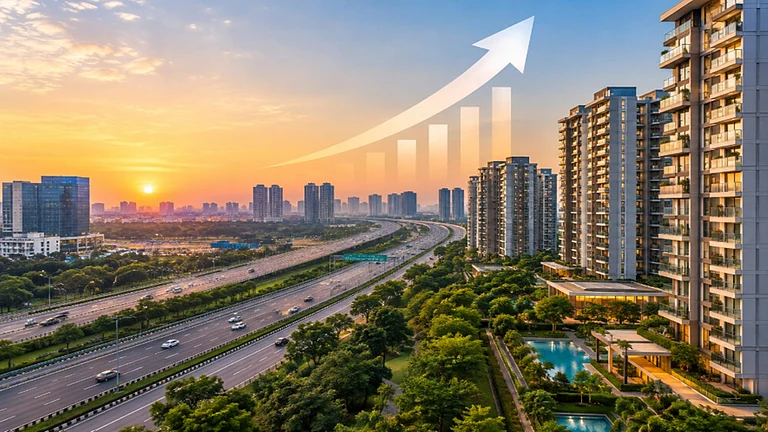


These examples serve as testament to the growth of the city which has been facilitated by the steady execution of previously envisioned infrastructure. The market today is responding to factors such as enhanced connectivity, utility driven infrastructure and has transitioned to maturity. Value creation is getting increasingly linked to delivery and functionality rather than mere future promises.
As these corridors continue to evolve, Gurugram remains one of India’s strongest examples of how infrastructure-led development can sustain real estate momentum over the long term.
FAQs:
1. How will Dwarka Expressway impact Gurugram real estate?
Dwarka Expressway has enhanced connectivity between Delhi, IGI Airport and Gurugram, and is witnessing increasing demand for property. With shortest travel time connectivity between key locations in Gurugram and NCR, Dwarka Expressway has turned out to be a promising avenue for buying with notable appreciation along the corridor.
2. SPR is shaping up to be another prominent growth corridor in Gurugram. What gives?
SPR or Southern Peripheral Road provides connectivity to major roads like Golf Course Extension Road, Sohna Road, NH-48 and Dwarka Expressway. Owing to SPR’s connect to major nodes, several luxury residential projects and high-end mixed-use projects are being launched in this part of Gurugram.
3. How are infrastructure developments affecting real estate demand in Gurugram?
With robust infrastructure and developing metro network, Gurugram is fast emerging as one of the most lucrative places to buy property in India. Developments of multi-cuisine restaurants, entertainment zones and high-end residential projects is increasing day by day. Large-scale infrastructure projects such as Global City further promises to improve real estate demand by providing better connectivity.





