





Summary of this article
According to Anarock Research & Advisory’s September 2026 report, residential prices along Dwarka Expressway have risen 135 per cent since 2021, from around Rs 6,032 per sq ft to Rs 14,180 per sq ft in H1 2026.
The appreciation is among the strongest recorded by any residential corridor in India. Prices are also now higher than Gurugram’s average of Rs 13,350 per sq ft in H1 2026.
Infrastructure could provide the next leg of growth. The proposed Gurugram Metro extension towards Dwarka Expressway, completion of UER-II and the development of the 1,000-acre Global City Gurugram are expected to improve connectivity and create additional employment-led housing demand.
Dwarka Expressway has moved beyond being an infrastructure promise to becoming one of Gurugram’s most closely watched residential corridors, with strong price appreciation, premium housing demand and a growing ecosystem of connectivity and social infrastructure reshaping the micro-market.
According to Anarock Research & Advisory’s September 2026 report, residential prices along Dwarka Expressway have risen 135 per cent since 2021, from around Rs 6,032 per sq ft to Rs 14,180 per sq ft in H1 2026. The appreciation is among the strongest recorded by any residential corridor in India. Prices are also now higher than Gurugram’s average of Rs 13,350 per sq ft in H1 2026.
The 29-km, signal-free corridor connecting Mahipalpur in Delhi with Kherki Daula in Gurugram has been a key driver of this transformation. Its links with UER-II, NH-48 and the Delhi-Mumbai Expressway, along with proximity to IGI Airport, Cyber City and Udyog Vihar, have strengthened its appeal among homebuyers seeking better connectivity without compromising on premium housing.

Says Robin Mangla, president, M3M India: “Dwarka Expressway has firmly established itself as one of Gurugram’s key residential growth corridors, with prices appreciating 135 per cent over the past five years. The launch of nearly 14,000 units in 2025 underlines the strong confidence in the market. The corridor’s ability to support large, well-planned communities is also helping developers offer more spacious homes and premium amenities. With infrastructure and social infrastructure improving, Dwarka Expressway is steadily strengthening its position as a luxury residential destination.”
Deepak Sangwan, chairman, Origen Realty, adds, “The region is playing a major role in Gurugram’s luxury housing transformation. The price appreciation over five years shows how buyer perception has changed - from a future-growth location to a credible premium residential destination. With nearly 115 active projects and around 14,000 new units launched in 2025, the market is gaining depth. New projects will further strengthen its connectivity and long-term growth potential.”
The report estimates total residential supply of about 38,680 units in the micro-market between 2021 and H1 2026. In H1 2026, available inventory was approximately 10,770 units, with inventory overhang of nearly 18 months at the current sales rate. This translates into a fairly balanced market.
The corridor continued to witness skew towards bigger homes. Three bedrooms comprised 39 per cent of total supply, while supply of 4 BHK+ homes accounted for another 28 per cent. Two bedrooms homes made up for remaining 27 per cent. Upscale end-users, particularly HNIs and NRIs are driving demand for spacious and amenity-rich homes.
According to Anarock Research, the premiumisation of the corridor is also visible in its pricing. A large share of new supply falls in the above Rs 2.5 crore segment. At the same time, average monthly rents for a 2-BHK of around 1,000 sq ft are estimated at Rs 25,000–31,250. Rents have risen 87 per cent since 2021, indicating that the rental market is beginning to benefit from the corridor’s improving connectivity and employment linkages.
Large developers, including DLF, Godrej, Sobha, M3M, Signature Global and Elan, have established a significant presence in the area. Their continued investment is helping raise construction and design standards while reinforcing the corridor’s premium positioning.
As per the report, infrastructure could provide the next leg of growth. The proposed Gurugram Metro extension towards Dwarka Expressway, completion of UER-II and the development of the 1,000-acre Global City Gurugram are expected to improve connectivity and create additional employment-led housing demand.
Says Navdeep Sardana, founder, Whiteland Corporation: “Dwarka Expressway is fast moving from an emerging corridor to one of NCR’s most compelling luxury residential destinations. The 135 per cent appreciation in residential values over the past five years reflects rising buyer confidence, better connectivity and a stronger lifestyle ecosystem. The growing demand for larger, premium homes also shows how buyer aspirations are changing. As infrastructure continues to improve and connectivity strengthens, Dwarka Expressway is well positioned to emerge as a leading luxury housing hub, offering both enhanced lifestyle value and sustained investment potential.”


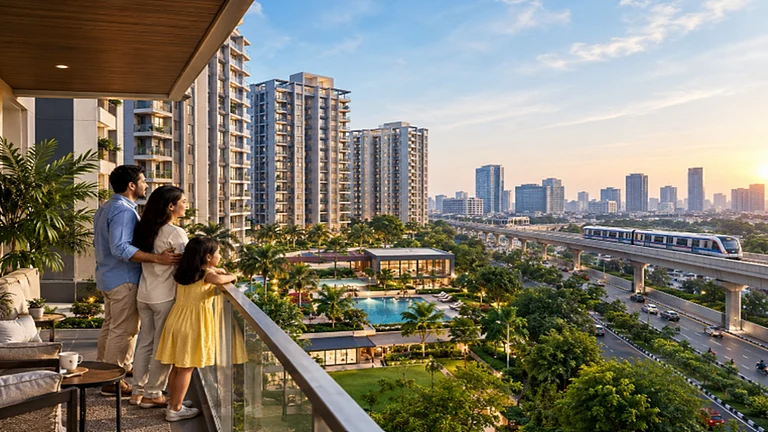

According to Manik Malik, CEO and president, BPTP, Dwarka Expressway has emerged as one of Gurugram’s most promising luxury residential corridors, driven by better connectivity, infrastructure and improving social amenities. He says: “Easy access to Delhi, IGI Airport and major employment hubs is attracting homebuyers who increasingly value convenience and quality of life. As the corridor matures, we expect demand to remain healthy, supported by improving liveability, robust infrastructure, and the continued development of the surrounding ecosystem.”
However, the market is not without challenges. High entry prices could limit affordability, while oversupply risks remain in the Rs 1.5–3 crore segment. Internal sector roads and social infrastructure in some pockets also need to keep pace with rapid development.
Even so, with infrastructure, premium housing and employment growth converging, Dwarka Expressway appears well placed to remain one of NCR’s key residential growth markets over the next few years.





