




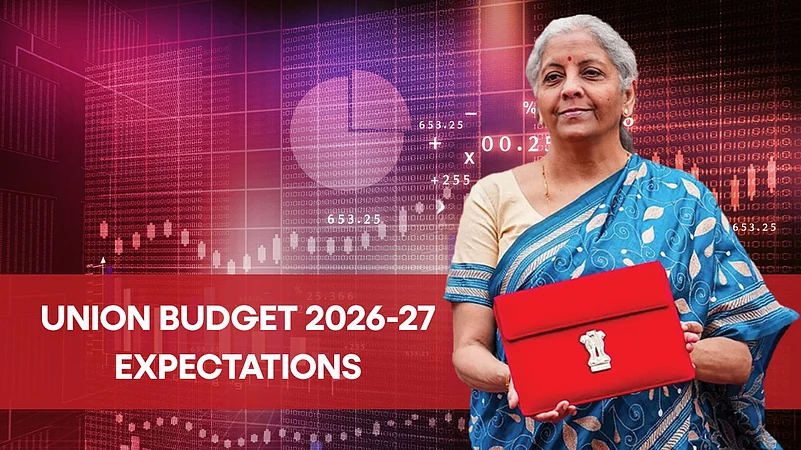

Union Budget 2026-27 Expectations: As the Union Budget for 2026–27 draws closer, equity markets are already busy pricing in expectations. Even before the finance minister rises to speak, markets start reacting to expectations. How investor position their portfolios and rotate funds across sectors is driven more by what the Budget might say rather than what it eventually delivers.
The year 2025 was a mixed year for equity investors as it saw heightened global trade tensions, persistent foreign fund outflows, muted corporate earnings, aggressive rate cuts by the Reserve Bank of India (RBI), a depreciating rupee and a strong rally in safe-haven assets like gold and silver. Yet, despite all this noise, the Sensex and Nifty 50 ended the year close to record highs.
Amid this environment, equity investors are not expecting big-bang announcements from Union Budget 2026–27, but are instead looking for clarity, stability and continuity. Market experts say expectations are mainly centred on taxation, trading costs and the long-term policy direction.
Stability in Equity Taxation
One of the biggest asks from equity investors is a stable and predictable tax regime. According to Anil Rego, founder and fund manager at Right Horizons PMS, investors are not looking for surprises.
“Equity investors will primarily be looking for stability and simplicity in the tax regime rather than surprise moves,” Rego says. He adds that a clear, time-consistent framework for capital gains taxation is high on the agenda, ideally with fewer holding-period slabs and no retrospective changes.
Any relief on long-term capital gains tax or restoration of indexation benefits for longer holding periods would be seen as supportive for long-term investing. Rego says that such steps would strengthen India’s equity culture by rewarding patient capital rather than short-term speculation.
Capital Gains, Dividends and Indexation in Focus
Taxation of dividends is another area where investors are hoping for some relief. Rego points out that a “more benign treatment of dividends, such as lower marginal incidence or a threshold exemption for small investors,” would help address concerns around double taxation.
Vinayak Magotra, product head and founding team member at Centricity WealthTech, echoes similar views. Markets are watching closely to see if the Budget addresses key capital market issues such as dividend tax parity and clarity on capital gains.
Magotra also flags interest in whether the government revisits the removal of indexation benefits for debt mutual funds. Restoring inflation adjustment, he says, could improve real post-tax returns for investors, especially in a high-inflation environment.
Rationalisation of STT and Trading Costs
High transaction costs are also a long-standing concern among stock market investors, especially as derivatives trading volumes continue to dominate cash markets. Two years back, while presenting the Union Budget 2024-25, Finance Minister Nirmala Sitharaman announced an increase in the Securities Transaction Tax (STT) on Futures and Options (F&O) sales. The revised taxes came into effect from October 1, 2024.
As a result, STT on sales of futures increased from 0.0125 per cent to 0.02 per cent, while STT on sales of an option rose from 0.0625 per cent to 0.10 per cent.
Rego says, “Rationalisation of STT, especially on delivery trades and options turnover, would be an important ask, as it directly affects trading costs and market liquidity.”
What Would Boost Retail Investors' Confidence
For domestic retail investors, the biggest sentiment booster may not be a tax cut, but reassurance. “The single biggest confidence enhancer would likely be an explicit assurance that there will be no sudden, adverse changes to capital gains or equity taxation for a multi-year period,” Rego says, adding that such clarity would give investors the “comfort to continue with their systematic investment plans (SIPs) and long-term allocations without policy anxiety.”
Rego also suggests that a refreshed, tax-efficient equity savings product with reasonable lock-ins could nudge first-time and small investors towards disciplined investing.
“Measures that lower friction for retail participation, such as simplified KYC, rationalised STT on delivery trades, and clearer, uniform rules across platforms, would also improve sentiment. Finally, strong signalling on investor protection in small and medium enterprises (SME) and small-cap segments, with better disclosures and surveillance, would reassure households that policy is on their side,” adds Rego.
According to Magotra, the biggest sentiment boost would simply be confidence that the rules of the game won’t keep changing, especially when it comes to equity taxation, along with a clearer push to reward long-term investment.
“Over the past year, many retail investors have dealt with sharp swings in mid- and small-cap stocks and a slowdown in earnings momentum, while at the same time constantly hearing speculation about possible changes in capital gains taxes. That mix has naturally made people cautious. A budget that clearly signals stability in capital market taxes and strengthens incentives for long-term products would help restore trust,” says Magotra.
What Would Genuinely Reassure Markets
Both experts stress the importance of fiscal discipline and execution.
Rego believes investors would draw comfort from a realistic fiscal consolidation path that protects public capital expenditure while gradually reducing deficits and debt ratios. Stable and non-disruptive tax policies across capital gains, customs and goods and services tax (GST) matter more than one-off concessions, he says, as they reduce policy risk premiums in valuations.
“Markets would also watch for progress on long-term growth enablers: reforms that ease doing business, deepen financial markets, support manufacturing and exports, and accelerate energy transition without destabilising finances. Transparent roadmaps on asset monetisation, disinvestment and strategic sectoral policies add further credibility,” Rego adds.
Magotra highlights the importance of continued public capex to support sectors like infrastructure, cement, capital goods and logistics, while also crowding in private investment without pushing borrowing costs higher.



“At a sector level, the expectation is that the budget shifts focus from launching new schemes to making existing policies work better. In manufacturing and export-linked sectors, investors are probably watching closely for evidence that initiatives such as production-linked incentive (PLI) schemes are translating into scale, cost competitiveness and greater supply-chain independence, especially after a year of global volatility. The recent disruptions have reinforced the need for India to reduce import dependence in critical areas and deepen domestic value chains, alongside a sustained push toward green energy and clean manufacturing,” Magotra says.
“For banks and non-banking finance companies (NBFCs), predictability in regulation is critical, particularly after a year in which CASA ratios have come under pressure and net interest margins have started to shrink for large banks due to higher deposit costs. Measures that support stable deposit mobilisation, ease funding stress for NBFCs, and ensure smooth credit transmission would be far more valuable than short-term stimulus,” he adds.
Overall, a Budget that signals policy continuity, focuses on execution, and supports long-term competitiveness, rather than chasing short-term optics, would meaningfully strengthen confidence across sectors, Magotra concludes.





