




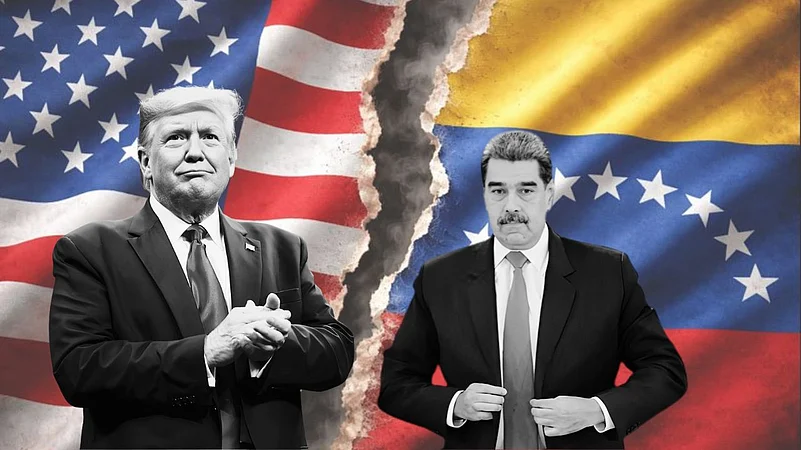

Markets turned cautious after geopolitical tensions escalated sharply in Latin America, following US military strikes on Venezuela’s capital, Caracas, on January 3. The strikes triggered multiple explosions across the city and reportedly killed at least 40 people, including civilians and military personnel, according to a New York Times report. Venezuelan President Nicolás Maduro declared a state of emergency, calling it an “extremely serious military aggression” by the US.
Later the same day, US President Donald Trump announced that Maduro had been captured in what he described as a large-scale military operation. The developments come after months of heightened US action against Venezuela, including strikes on alleged drug-smuggling vessels, seizure of oil tankers, and an increased US military presence off the Venezuelan coast.
At the close of trading hours on January 5, domestic equity benchmark indices settled lower, suggesting a cautious tone among market participants. Sensex fell 322.39 points, or 0.38 per cent, to end at 85,439.62. Similarly, Nifty 50 slipped 78.25 points, or 0.30 per cent, to end at 26,250.30.
Broader markets, however, remained resilient, with the Nifty Smallcap 100 rising 0.53 per cent, bucking the overall risk-off sentiment. On the other hand, Nifty Midcap 100 closed 0.16 per cent, reflecting the cautious mood.
Among the worst-impacted sectoral indices today were the Nifty Oil & Gas index, weighed down by a decline in oil marketing companies (OMCs) such as Indian Oil Company, Bharat Petroleum, Hindustan Petroleum, and index heavyweight Reliance Industries.
How Serious Is the US-Venezuela Conflict For Indian Equity Markets
While the escalation has added to global uncertainty, market experts believe the direct impact on Indian equity markets is limited, at least for now.
According to Ross Maxwell, global strategy operations lead at VT Markets, the Venezuela situation is not a systemic threat to Indian equities but could act as a macro headwind through crude oil prices.
"India is a large net oil importer, so any sustained geopolitical premium in crude prices feeds into higher import costs, inflationary pressure, and potential constraints on monetary policy. In the near term, this increases market volatility rather than triggering a structural derating of Indian equities. The risk becomes more serious if oil price spikes are persistent rather than episodic," Maxwell told Outlook Money.
Sachin Jasuja, head of equities and founding partner at Centricity WealthTech, echoed the view that the Venezuela crisis is currently more of a headline risk than a fundamental threat to Indian markets.
"At this stage, the Venezuela turmoil is more of a geopolitical headline risk than a material economic threat for Indian equity markets. While Venezuela holds the world’s largest proven oil reserves, its actual contribution to global crude supply is barely around 1 per cent, constrained by long-standing sanctions, infrastructure decay, and logistical bottlenecks. As a result, markets are pricing in operational and political uncertainty rather than an immediate supply shock," Jasuja told Outlook Money.
Sectors Likely To Be Impacted On Further Escalation
Sectorally, experts say companies with high energy dependence could face pressure if the crisis escalates further.
"Sectors with high energy sensitivity are most exposed. Oil marketing companies face margin pressure if crude rises faster than retail fuel price adjustments. Airlines, logistics, chemicals, paints, cement, and fertilisers are vulnerable due to higher input and transportation costs. Consumer-facing sectors such as FMCG may also see margin compression if cost inflation cannot be fully passed on. Conversely, upstream energy producers may see relative support in a higher crude environment," Maxwell added.
According to Jasuja, even if tensions escalate, sectoral stress is likely to remain contained for now.
"If the crisis were to escalate, the most sensitive pockets of the Indian market would be sectors exposed to energy prices, currency movements, and shifts in global risk appetite. Oil marketing companies, aviation, logistics, and paint manufacturers typically come under pressure when crude prices rise sharply. However, given the current global supply cushion, stress across these sectors appears limited for now," he said.
US-Venezuela Tensions Impact On Global Oil Supply
Venezuela holds the world’s largest proven oil reserves, estimated at 303.8 billion barrels as of 2020, narrowly ahead of Saudi Arabia’s 297.5 billion barrels, according to data from PL Capital. Following the two, Canada, Iran, and Iraq have reserves of 168.1 billion barrels, 157.8 billion barrels, and 145 billion barrels, respectively.
However, over a decade of sanctions, weak investment, and deteriorating infrastructure have left Venezuelan oil output at just around 1 per cent of global production, keeping it out of the top 20 oil-producing nations.
Crude oil prices remained volatile in trade on January 5, as Brent crude and West Texas Intermediate (WTI) crude, the two benchmark crude oil futures contracts, swung from highs to lows.
As of the time of writing, the Brent crude oil futures were up by 0.53 per cent at $61.07 per barrel, and the WTI crude oil futures traded higher by 0.70 per cent at $57.72 per barrel.
According to Jasuja, global crude supply conditions are in a comfortable situation.
"OPEC, in its latest communications, has reiterated its commitment to maintaining adequate supply, and the International Energy Agency expects global oil markets to potentially move into surplus by 2026, driven by strong production from OPEC+, the US, and other non-OPEC producers," Jasuja said.
For India specifically, the direct oil supply impact is muted, he said, as crude imports from Venezuela have already declined sharply due to sanctions. “Any spillover effect is therefore more likely to be indirect, transmitted through global risk sentiment rather than through physical supply disruption," he added.
Will the US-Venezuela Conflict Spook FPIs
Amid an ongoing sell-off in Indian equities by foreign portfolio investors (FPIs), there are also concerns that rising geopolitical uncertainty could make emerging market-focussed funds more cautious on India. However, experts say India is relatively well placed to withstand such global shocks, supported by stable macro fundamentals, steady domestic growth, and limited direct exposure to developments in Venezuela.
"A sharp rise in geopolitical uncertainty typically leads to risk-off positioning across emerging markets, but India is unlikely to see disproportionate outflows purely due to Venezuela-related tensions. India’s relative macro stability, domestic growth visibility, and reform momentum act as buffers. However, sustained high oil prices could narrow this advantage, making India less attractive on a relative basis compared to energy-exporting emerging markets," Maxwell said.
Jasuja said, "There is currently no evidence of Venezuela-specific risk driving incremental foreign fund outflows. Any near-term rebalancing by emerging market funds is more likely to be influenced by broader factors such as US interest rate expectations, dollar strength, and trade policy clarity rather than developments in Latin America.”
US-Venezuela Conflict: How Will The Political Turmoil Impact Rupee
During periods of geopolitical uncertainty, the rupee usually comes under mild pressure as investors gravitate towards safe-haven assets, lending strength to the US dollar. The impact, however, tends to remain contained unless tensions trigger sustained FPI outflows or lead to a prolonged rise in crude oil prices.
As of the time of writing, the dollar/rupee pair was trading 0.26 per cent higher at 90.23, indicating that the rupee had weakened by around 23 paise against the US dollar.
Anindya Banerjee, head of currency and commodity research at Kotak Securities, said the impact on the Indian rupee is expected to be minimal.
"The Indian rupee faces negligible pressure from Venezuela's recent geopolitical tensions, given its less than 1 per cent share of global oil production, OPEC+ output stability, and no energy infrastructure damage from the US operation.”
What Investors Should Do
Experts advise investors to avoid knee-jerk reactions to geopolitical headlines.
Maxwell said, “Retail investors should avoid reactive positioning based on headlines. The current environment argues for staying invested but rebalancing selectively, rather than broad risk reduction. Portfolios should tilt toward companies with strong pricing power and lower energy dependence, while maintaining exposure to defensives. Periods of oil-driven volatility may also create tactical opportunities in quality stocks that correct due to macro fears rather than fundamentals. Gold and silver can act as short-term hedges, but the equity strategy should remain long-term focused.
Jasuja also believes that the situation does not call for a reactive response, especially from retail investors.
Banerjee noted that Trump’s subsequent threats to resource-rich nations like Greenland, Cuba, and Mexico highlight an intensifying competition for critical resources and could push major players like China, India, and other BRICS nations to ramp up industrial development and secure key raw materials. In this environment, he recommends investors to “take measured positions in gold and other hard assets, as de-dollarisation gains momentum and growing self-reliant manufacturing drives long-term demand."





